

The Sivasagar Flood: What I learn so far
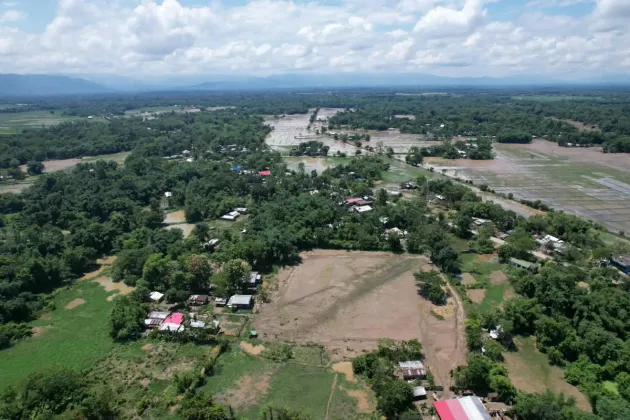

There are many lessons for us to learn from the Sivasagar disaster. Among them, I have highlighted a few that I consider important, based on the information available to me up to 10 August 2026, my observations from the affected area, and my previous experience with rivers, water and floods.
1) Floods will return—this is sure. The severity of a disaster depends, on how many years have passed, before floods return to an area. The Sivasagar flood has shown us that the longer the interval, the greater the devastation can be. During a long flood-free period, people forget the memory of floods, administrative preparedness becomes negligent, riverbanks are encroached upon, and settlements expand into the natural pathways of water. Seen in this light, many other parts of Assam—supposedly protected from flooding by poorly planned embankments—may face a Sivasagar-like disaster in the future. It is now only a question of when. An embankment can hold back rising water only for a while; it cannot erase a river’s memory of its course.
2) Failure of the administrative system. During the Sivasagar flood, the government machinery failed completely in early warning, immediate rescue operations and rehabilitation. Even after nearly 22 days, its inability to present a clear public account of the disaster’s actual impact has exposed the hollowness of our system. How many people died? How many are missing? How many houses were completely destroyed? How many families lost their livelihoods? Who received how much assistance? Even now, these details are not clearly available in one place. The absence of information—or inability to provide necessary information at the necessary time—is itself a disaster. Having the information but failing to make it public is an even greater failure.
3) We have become disconnected from biodiversity and geographical knowledge. Most people do not have a clear understanding of which river affected whom, where and how during the Sivasagar flood. People outside the region certainly do not, but even many of those affected lack this essential knowledge, apart from communities living directly beside the rivers and a handful of informed individuals. We do not know the source of the river flowing past our village, its tributaries, or the direction in which its waters move. Knowing only a river’s name does not mean knowing the river. We must also understand its source, course, floodplains, wetlands and relationship with human life.
4) We must move from immediate service to long-term thinking. Through this flood, the people of Assam displayed extraordinary compassion and service during a disaster. They stood beside those in distress with food, clothing, medicines and drinking water. Many young women and men risked their own lives in rescue and relief work. Yet, in many cases, people seem to have found momentary satisfaction in these acts alone. We cannot assume that our responsibility ends after distributing a relief packet, taking a photograph and posting it on social media. This has almost become an Assamese trait: responding emotionally during a disaster and forgetting everything a few days later. The flood has also given us an opportunity to change this tendency and begin thinking for the long term.
5) A new responsibility for social media and Gen Z. This flood also revealed the courage, energy and leadership of social-media users and Gen Z. In many places, they reached people before the government machinery did. They collected information, rescued people, organised relief and carried the story of the disaster beyond Assam. A major opportunity now lies before them: to plan properly, continue standing beside people after the disaster, and resist forces that are misleading, aggressive or opportunistic. This strength will acquire its true value only if immediate courage is transformed into long-term social responsibility.
6) Negligence in planning and implementation. The flood exposed the poverty of thought and planning among the elected representatives of the affected constituencies, the principal representatives of the government system, and various institutions and organisations. Once human-made factors have intensified a disaster in an area, simply displaying sympathy or bluster achieves nothing. What did they do before the disaster? Why did the early warning not reach the last person? Where was the rescue plan? Why were interventions in rivers and natural drainage channels not prevented? This flood has demonstrated how narrowly confined the thinking of our system and elected representatives has become.
7) We must read history anew. Instead of glorifying history solely through the achievements of kings and a religious lens, this flood offers us an opportunity to examine every lesson relating to biodiversity, rivers, water and people’s struggle for survival. Who the king was and which temple was built during whose reign are parts of history. But history also includes where rivers flowed at the time, how people coexisted with floods, how they built their homes, how they preserved food, and how communities rebuilt after a disaster. Recovering this history and taking it to the new generation is now an extremely important task.
8) We must preserve the memory of floods. Flood memory is vital in a water-centred, riverine state such as Assam. We must search through every page of history, how our ancestors coexisted with floods. People in earlier times did not regard rivers as enemies. They understood the energy of a river and the language of flowing water. We must once again recognise that there is no alternative to working with rivers and water. Our greatest mistake is to imagine that we can control rivers forever by confining them between embankments, excavating their beds and blocking their courses.
9) Educational institutions must teach about rivers, water, disasters and coexistence. Every college and university in Assam should introduce a compulsory course on these subjects without delay. Such a course must not remain confined to classrooms and examinations. Students should study the rivers, water bodies, wetlands, embankments and drainage routes in their own regions. They should collect local people’s memories of floods. They must learn in practice what to do during a disaster, how to understand early warnings, and how to participate in rescue and rehabilitation work.
10) Danger will not come only during the monsoon. The Sivasagar flood was a monsoon flood. In the coming years, danger may arise not only during the monsoon but also in the dry season. Many artificial reservoirs have already been constructed upstream of Assam. Even during the dry season, these could trigger sudden disasters in different parts of Assam, similar to the one in Sivasagar. If water is suddenly released from a dam or an accident occurs at an artificial reservoir, how much time will downstream communities have to prepare? The relevant departments should inform the public. At the same time, governments in upstream and downstream states must begin discussions, people on both sides must communicate directly about the possibility of future disasters. Rivers do not recognise state boundaries; therefore, our discussions, information and preparedness cannot remain confined within those boundaries either.
If these ten lessons remain confined once again to papers, meetings and social-media discussions, then during the next flood we will ask the same questions, repeat the same mistakes, and lose people and biodiversity in the same way. The Sivasagar deluge must not remain merely a memory of disaster; it must be transformed into a lesson capable of changing the future.
Comments (0)
No comments yet. Be the first to share your thoughts.
Leave a Comment