

Ranganadi–Panyor Flash Flood: Not a Dam Release, Yet a Warning for Every Downstream Community
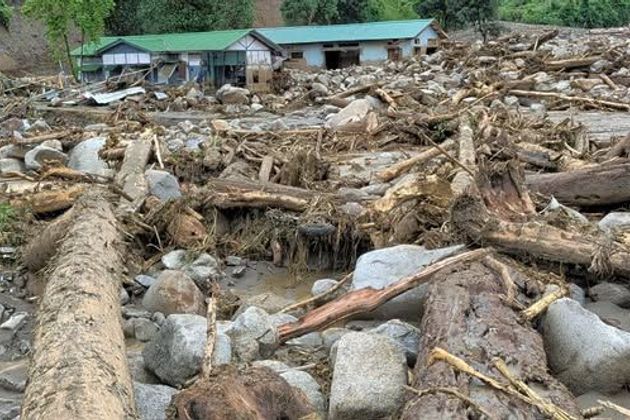

As the information available so far suggests, this appears to be a cloudburst or an intense localized rainfall event somewhere in the upstream catchment. The flooding itself seems to have originated in a different channel before eventually entering the main river system. Because of this, the impact may not be reflected significantly in the far downstream reaches. However, the floodwater will inevitably find its way into the Ranganadi–Panyor system, and people downstream may witness a sudden rise in water levels.
What is becoming increasingly clear is that the affected area lies above the dam elevation. Therefore, the incident cannot be directly attributed to water released from the reservoir. Likewise, it is difficult to conclude that the devastation was caused by gate operations at the dam. Information available at present suggests that only one gate was opened and approximately 1.5 metres of gate opening was maintained to allow water to flow downstream. Such a release, by itself, is unlikely to create havoc across the downstream areas of Lakhimpur.
Yet flash floods do not always follow conventional assumptions. When a large volume of water suddenly becomes channelized into a river system, the consequences can be severe. Unlike planned reservoir releases, these events often come without warning. The existing DDMA early-warning mechanisms are largely dependent on information regarding gate operations and water releases from dam authorities. In a situation where the flood originates from an upstream cloudburst or sudden catchment failure, those warning systems may not be sufficient.
Fortunately, the incident reportedly occurred around 6 AM. It is now nearly 7 PM. Given the travel time of the flood wave and the available information, there appears to be little possibility of a major downstream disaster at this stage. Nevertheless, this incident should be treated as a lesson and perhaps a new learning opportunity for Disaster Management Authorities, especially in districts located immediately downstream of existing and upcoming dam projects.
The dependence of early-warning systems solely on project authorities needs serious reconsideration. A robust warning mechanism should also incorporate upstream meteorological monitoring, catchment-based rainfall observations, real-time hydrological information, and independent forecasting systems.
Another important question remains unanswered: how much rainfall actually occurred in the upstream area during the night?
The IMD datasets presently visible do not clearly represent the specific location where the incident occurred. However, rainfall data available for the Lower Subansiri region indicates around 26.6 mm of rainfall against a normal rainfall of about 6.4 mm. While this is considerably higher than normal, it does not, by itself, conclusively establish the occurrence of a cloudburst.
And that is where the questions begin.
In a fragile Himalayan ecosystem, should we limit ourselves to the cloudburst explanation alone? Could reservoir backwater accumulation have played any role? Could there be reservoir-induced impacts on local aquifers? Was there any form of slope saturation, seepage concentration, or aquifer outburst? These may or may not be connected to the incident, but they certainly deserve further scientific investigation.
On the other hand, if we are saying that the devastation—which, according to reports circulating on social media, has left several people missing—has no connection whatsoever with the reservoir, then another question naturally arises: how did such a massive volume of debris, logs, and floating materials suddenly enter the water with such force and turbulence?
We all witnessed images of huge logs moving through the reservoir waters. Fortunately, both the dog and a boy , who were trapped amidst those floating logs, could be rescued. But how did they survive atop such a dangerous mass of debris? What exactly were the hydraulic conditions inside the reservoir at that moment? These are not merely emotional questions; they are technical questions requiring scientific answers.
I am reminded of discussions held nearly a decade ago. During meetings in the Assam Secretariat around 2017, following recommendations and advisory inputs associated with IIT Guwahati studies, there were strong demands—including protests by AJYCP—for the establishment of automatic upstream meteorological stations and real-time monitoring systems. The objective was simple: to understand microclimatic conditions in the catchment and improve downstream forecasting capabilities.
As someone involved in those discussions, I clearly remember repeated recommendations emphasizing the need for upstream automatic weather stations and real-time hydrological monitoring. Whether those systems were eventually installed and are functioning effectively today, I do not know.
Ironically, after today's incident, I tried to access the discharge data on the NEEPCO project website. Earlier, such information used to be available publicly. Today, I found it inaccessible or unavailable. If a project equipped with advanced scientific instruments, monitoring systems, and technical expertise is unable to protect its own colony from such an event, then an uncomfortable question emerges: how will downstream communities continue to place complete faith in the data, predictions, and assurances provided by the same system?
This incident leaves us with many questions and very few answers.
What exactly happened in the catchment?
Was it purely a cloudburst?
Was there any role of local geological or hydrological conditions?
How effective are our present early-warning systems for non-dam-induced flash floods?
Are monitoring systems in place and functioning as intended?
And perhaps most importantly, are we learning quickly enough from each disaster before the next one arrives?
For now, this tragedy should not become a debate about blame. It should become an opportunity to ask better questions, improve transparency, strengthen scientific monitoring, and build a more resilient warning system for both upstream and downstream communities.
Because the river will always test our assumptions. The real question is whether we are prepared to learn from it.
Comments (0)
No comments yet. Be the first to share your thoughts.
Leave a Comment