

Filmmaker Dr. Shankar Borua talks about his new film BLUE OCEAN
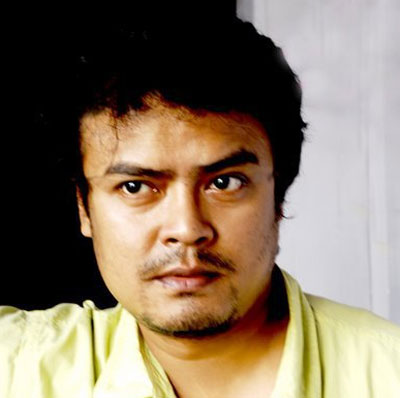
Dr. Shankar Borua is a distinguished scholar-practitioner, filmmaker, entrepreneur, and startup mentor with over two decades of multifaceted experience across academia, creative industries, and entrepreneurial ecosystems in both North America and South Asia. Born and raised in Assam, Dr. Borua holds a Ph.D. in Mass Communications from Texas Tech University, USA. His doctoral research, titled “American Political Documentaries: Structure, Agency, and Communication of Meaning”, reflects his deep academic engagement with media, culture, and storytelling.
Dr. Borua’s career seamlessly blends rigorous academic scholarship with hands-on industry practice. In a well-regarded body of work that defies easy categorization and has consistently wowed audiences everywhere, he has written, directed, produced, and starred in a number of independent films as a filmmaker. His filmography includes critically recognized titles such as Angst at Large, If God Be With Us, All Those Longings, Center Mass, Hope is a Good Thing, Beleaguered, Grief on a Sunday Morning, The Curiosity Shop, and Colorful.
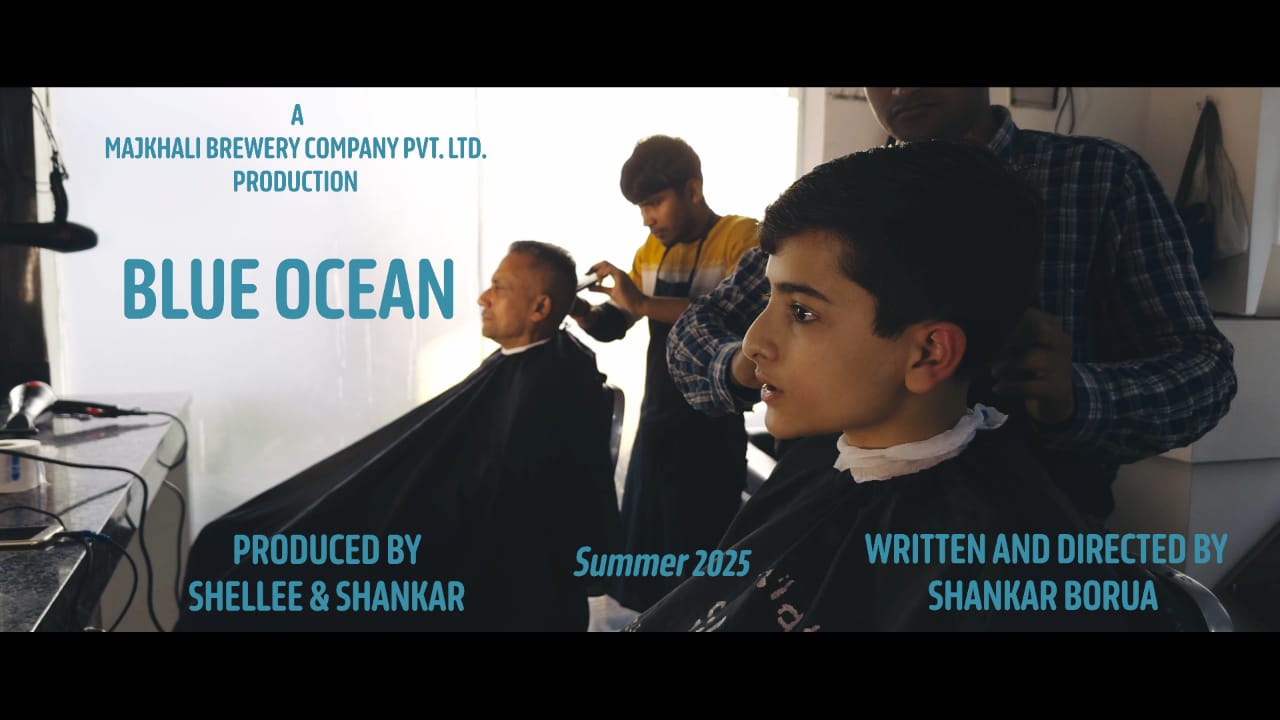
Shankar Borua’s newest film BLUE OCEAN, produced in Hindi, English, and Punjabi, is an intriguing blend of thriller, drama, and philosophy that guides viewers on a journey where the distinctions between truth and deception become indistinct. The upcoming film is poised to captivate audiences with its blend of mystery and psychological intrigue. In this exclusive interview, Dr Borua talks about BLUE OCEAN, a gripping Himalayan narrative woven with themes of crime, greed, deceit, and betrayal, all enmeshed and intertwined in Dehradun, India, nestled at the foothills of the majestic Himalayas.
Q&A:
Prantik Deka: In the past, you have made films that delve into powerful social narratives, addressing various issues faced by communities in Assam and the Northeast region, frequently shedding light on injustice, inequality, or the need for social transformation.
What was the driving force behind the inception of this new project ‘Blue Ocean’? I believe this is your maiden venture into the world of Hindi cinema.
Shankar Borua: The mountains have always beckoned me and embraced me and they never let me down. I first thought of BLUE OCEAN a couple of months after my arrival in Dehradun in the Spring of 2024 after a rather uneasy and unhappy couple of years leading up to my Daddy’s passing in January 2024. ‘Blue Ocean’, the gym in Dehradun, where I signed up to spend about an hour each morning working out, is where a rather expansive narrative in my head first triggered. I mentioned the idea to a friend who is a Professor at a University here in Dehradun, she liked it and I felt encouraged to explore more! I conceived BLUE OCEAN as a fictitious yet realistic tale incorporating the gym at the center of the narrative and allowed elements and characters to float around it yet gravitate towards it.
It was a challenge to shoot a movie without a bound script, the first time ever for me! Yet, it truly was liberating and quite exhilarating to indulge in this free-form storytelling, and to literally encourage the talent to go with the flow much to the surprise of our actors and also the crew! We shot the entire film over nine days in my neighborhood of Rajender Nagar in Dehradun; for a day we shot in Chandigarh and also at Paonta Sahib Gurudwara in Himachal Pradesh where Guru Gobind Singh, the 10th Guru of the Sikhs wrote the 10th Chapter of the Holy Book, the Guru Granth Sahib, on the banks of the river Yamuna.
Yes, this is my maiden venture into the world of Hindi cinema traditionally dominated of course by the star system and formulaic films. Having said that, it is pertinent to point out that there are all kinds of Hindi cinema today, like in the past as well, and it is imprudent to put a wide range of content into neat boxes of genres, that will definitely not be wise! BLUE OCEAN, I believe, touches upon many thematic considerations and so you just cannot put this little movie from the mountains into a little box on a shelf somewhere, no way!
<img alt="" data-cke-saved-src="/sites/default/files/sb.png" src="/sites/default/files/sb.png" auto"="" width="100% height=" hspace="20" border="2">
PD: The Himalayas function as a significant and influential element in shaping the narrative of ‘Blue Ocean’. To what extent does the presence of the Himalayas impact the conceptualization of the story?
SB: BLUE OCEAN is a Himalayan narrative set at the foothills of the hoary Himalayas in Dehradun, India where I have been living for a little over a year now. The movie is deeply embedded with the twin subtexts of the Himalayan identity on the one hand and the Himalayan crisis on the other. As we all know, this is one of the most ecologically sensitive mountain regions in the world under constant pressure for decades now from catastrophic human intervention in the name of tourism and development activities accompanied of course by the disastrous effects of climate change. Of course, my own journey as a wilderness enthusiast finds its way into the narrative. I am taking this opportunity to mention that a section of the proceeds that we generate by streaming BLUE OCEAN will go towards the conservation of the beautiful elusive Alpine Musk Deer, an endangered species in the Himalayan ecosystem. We will also donate a portion of the proceeds towards the protection of our marine ecosystems in our wondrous oceans; they take care of close to a third of the carbon dioxide that is generated by us on this planet, this beautiful ‘pale blue dot’ of ours is our only home! So, yes, the mighty Himalayas are an integral part of the film and its presence across the narrative is palpable. Folks, however, will not see a snowclad Nanda Devi or Trishul in BLUE OCEAN, beautiful Himalayan peaks that, I am sure, have inspired mountaineers, photographers and filmmakers across generations. What they will clearly sense though is the deep crisis in the Himalayan region and folks waking up to it albeit a little too late. May I mention that the Himalayas extend all the way from Pir Panjal (also known as the Lesser Himalayas) to Northeast India and Upper Burma, these magnanimous mountains have given birth to rivers and civilizations while nurturing communities and cultures for thousands of years. So, you can well imagine how ‘significant and influential’, to use your phrase, the Himalayas are to me personally as the filmmaker weaving BLUE OCEAN and hence, of course, to the narrative as well. A brilliant yet achingly beautiful and poignant song written for the movie by acclaimed Bollywood lyricist-composer Shellee, a buddy of mine from back in the day, highlights the tragedy of the Himalayas - “Ek Chiraiyya Purvai Se Nir Pata Hai Puche” - A bird asks the easterly winds about its nest that it can’t find – Little does it know that the tree holding its nest has been decapitated by humans! Such is the tragedy of the Himalayas!
PD: What specific elements did you consider when transitioning from gritty realism to the captivating genre of thriller in your storytelling? How did you navigate through this creative process?
SB: BLUE OCEAN is unlike any of my other films in terms of its treatment, that is true. It is fairly realistic (of course not the ‘gritty realism’ though in the tradition of the 1950s British classic Night and the City), yet always kind of operates in this twilight zone between fantasy and reality, between truth and falsehood. Interestingly, the audience knows who’s who and what’s going on while the characters don’t! I tried this treatment as a whodunit in reverse; we don’t know if it’s going to stick or not but we tried throwing something out there to see if it does.
The gym itself with all the mirrors, as a ‘space’ and as the ‘proscenium theatre’ where the drama and subterfuge unfolds in BLUE OCEAN, can be quite phantasmagoric. Here the ‘gaze’ is not at the ‘other’. The ‘gaze’ is on one’s own self in the mirror, quite an exercise in narcissism in this digital age of Selfies and Reels! Once you step out of the gym into the real world and no longer stare at yourself on your phone, you come back to ‘gritty realism’.
To answer your question though, you got to navigate creatively each film and story on its own terms, you got to meet the story somewhere in the middle. If you try to come on too hard, there is a distinct possibility that the story is going to fly off the handle, of course at the peril of losing your audience half way through! It's tricky territory but isn’t that what you are supposed to be navigating as the director! I really like your use of the word ‘navigate’ – it is all about navigating at the end of the day, just like life!
PD: What type of research and design efforts were involved in ‘Blue Ocean’, a Himalayan tale set in Dehradun? Could you provide details about the artistes and technicians involved in the project?
SB: The research and design for BLUE OCEAN had to ensure that we stick to everything the way it is - no alterations, no additions, no embellishments, no messing around with real locations where the entire film was shot in December 2024. What we portray on screen is exactly what you will see walking around my neighborhood of Rajender Nagar in Dehradun today.
We shot through the night with our actors at ‘Blue Ocean’, the gym, to make sure we do not disrupt their business during the day. Outside of that, I cannot even begin to tell you about the cooperation and warmth that the crew of BLUE OCEAN received from the businesses and stores where we shot extensively – New Kamal Dairy, MBA Chaiwala, Costa Coffee, Sheesha Lounge & Restaurant, Horilal Vegetable & Fruit Juice Corner, Bollywood Bar & Lounge, Heaven’s Rooftop & Skylounge, Banjara, Mind & Body, and many more. I remain forever grateful to all these folks for making BLUE OCEAN possible with their generosity and kindness.
As for the crew, it was a sheer miracle to have my talented MBA students as the two Executive Producers and the two Directors of Photography on BLUE OCCEAN. They were interning on a feature-length movie for the first time and it is one internship they are all going to remember, I am sure, for a long time! The entire movie was shot on two Apple 15 Pro Phones loaded with Filmic Pro. The location sound mix was done by a professional sound crew from Bombay as everything was shot sync sound with ‘real people’ if I can call them that, just no way we were going to head to the studios for dubbing! That’s pretty much what one can do on a no-budget scenario.
Most of the ‘actors’ in the sequences at the gym are folks who are the regulars at ‘Blue Ocean’. In particular, may I mention Kajal Thapa, Mohin Khan, and Gulfam Khan for their brilliant performance and cooperation all throughout up until now! Four professional actors from Chandigarh joined us in Dehradun and it was a blessing to have all of them on board our little bitty film BLUE OCEAN, my heartfelt gratitude to all of them – Abhitej Singh, Suraksha Gaire, Shelly Taneja, and Tajinder Kaur. In addition to all my friends and colleagues who stepped in to perform as actors to whom I am forever grateful, a special word of gratitude to our specially abled actor Ambica Chatamba and our child actor Gaurang Chauhan for generously giving us their time and shooting till the wee hours!
Film Editor Jiten Borah returned to collaborate on BLUE OCEAN after a gap of almost 6 years. I just felt good and safe with him around, this year marks our 10th year of collaboration and I am proud of our long-standing creative engagement and association.
PD: Could you provide some insights regarding your collaboration with Shellee, a prominent lyricist known for his work on critically acclaimed films such as ‘Dev D’ and ‘Udta Punjab’, in the production of the movie?
SB: I have known Shellee for more than two decades now, back from the time when we were ‘strugglers’, like they say in Bombay! It has been a remarkable one-of-a-kind special friendship that has only now come to fruition on the professional front. We are just plain buddies, but don’t get me wrong, we could not be more dissimilar in our temperament and dispensation! I have been a maverick all my life and my journey so far is littered with colossal failures, but once in a lifetime, you run into somebody like Shellee, a deeply empathetic poet who truly understands the human condition and so do you as well!
So, for Shellee to collaborate with me, as I imagine, or vice versa, wasn’t some special preparation or setting an agenda with a professional collaborator, we are buddies first, you can’t take that reality away and put that in a box – he is a very good listener but knows very well when to ask me to shut up. I am loquacious to no end which can cut both ways actually. As a film director, your first asset is clarity of thought and expression; your job is to get the best out of your crew. If they are not clear about your larger vision and the big picture, it can land the film in trouble.
May I mention that I am not the brooding artist; I am first and foremost a craftsman and Shellee knows that all too well. So, he is quite critical of my craft at times which is a real blessing for me. Usually, people close to you shun from telling you that! When he is listening or taking notes about how I want the songs done in terms of content (as in BLUE OCEAN), Shellee, as the lyricist, first makes me listen to his initial writings although I am not always patient, I must say that! Thereafter, once a rough draft is ready, I listen to bits and pieces until the time its all put together.
Actually, it was a great pleasure and a learning experience collaborating with Shellee on BLUE OCEAN. The fertile exchange of ideas culminated in the Punjabi song ‘Kih Dassan Main Kaun Hai Thagda’ (Is the World Playing games with me, Or am I the one Playing Games with this World?), ‘Sach hai Chupp Tey Jhuth Peya Nachda’ (Look around, the Truth is Agonizing in Silence While the Lie Dances in Ecstasy ). It was soulfully rendered by Mir Basu Barkat Khan from Pugal, Bikaner. I told Shellee that I need a song for BLUE OCEAN that reflects this reality – The biggest con job is what we do to ourselves! The song is just so deep, powerful and mind blowing that when I heard it first, I pretty much went into a trance! It truly encapsulates the psychological condition of Prakash Negi, the undercover cop entrusted with a job to nab a con artist at the foothills of the Himalayas.
PD: Will the upcoming movie be a groundbreaking addition to the world of Hindi cinema, challenging the usual norms and going beyond the conventional boundaries?
SB: I believe over a period of time, one develops a distinct signature and a clear point of view – camera movements, choice of locations and lenses, choice of actors and non-actors, choice of stories to tell at a particular point in time - all of this reflects that and plays critically into the final product. I cannot make any tall claims about BLUE OCEAN breaking new ground or like you mentioned ‘going beyond the conventional boundaries’. Each time I make a film, at a fundamental level, I interact with the ‘structure’ of film, with the twin coordinates of time and space, and organize my resources of sound and picture to tell a hopefully compelling story, linear or non-linear. My peculiar interaction with the ‘structure’ and the agency it provides me to wrestle with the medium of film while being cognizant of the limitations of the medium is what defines my work as a filmmaker and storyteller.
As for the world of Hindi cinema, it’s a world unto itself and I am not privy to it, not all pretty though as I understand. For me as a film entrepreneur though, putting men, women, and material together is what matters most to me. I ain’t waiting for someone like Irrfan to walk into my film to be a part of my storytelling, I got to get the job done, I got to get my story out there, star or no star, I couldn’t care less. Period. I have no illusions of making something earth-shattering that will alter the course of history, I am just a mere moviemaker at the end of the day. I am glad I don’t suffer from megalomania!
Comments (0)
No comments yet. Be the first to share your thoughts.
Leave a Comment