Skip to content Skip to navigation

Remembering Panditji

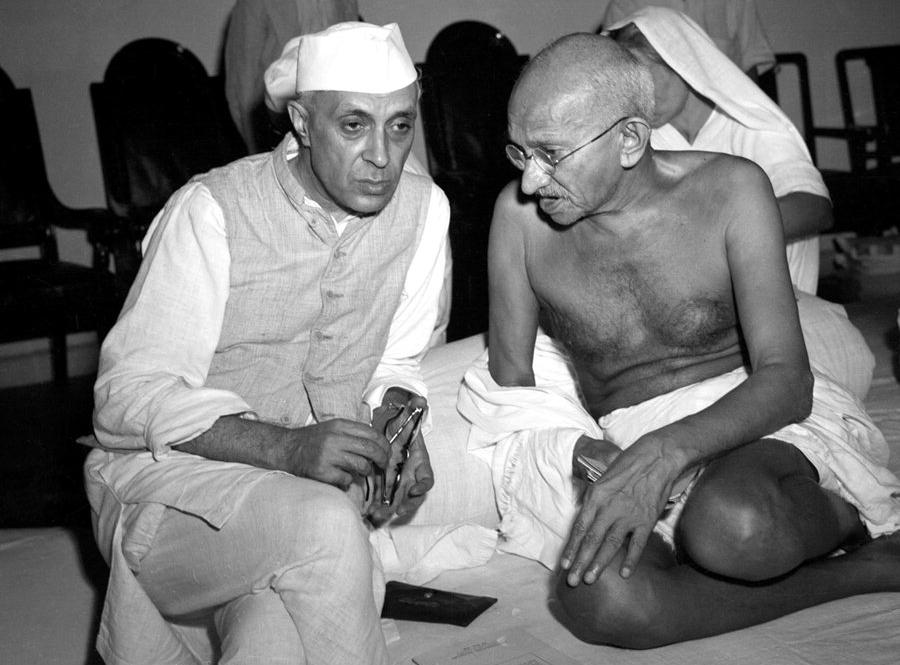
Forty-four years ago on May 27 the first Prime Minister of India died in harness. About Pandit Jawaharlal Nehru, Maulana Abul Kalam Azad wrote in his autobiography: ‘Jawaharlal asked me in despair, what other alternative there was to accepting partition?……..I told Jawaharlal that I could not accept his views.’ Azad added: ‘The Muslim League had accepted the Cabinet Mission Plan, and a satisfactory solution of the Indian problems seemed in sight. Unfortunately the position changed and Mr. Jinnah got a chance of withdrawing from the League’s earlier acceptance of the Plan…… I warned Jawaharlal that history would not forgive us if we agreed to partition. The verdict would then be that India was divided as much by the Muslim League as by the Congress.’ Partition was then inevitable.

In the 1946 July election of Congress President, Maulana Azad would not accept the high office. He desired unanimous election. The contest meant fighting over the opposite issues: Cabinet Mission Plan or Mountbatten Plan? As Vallabhbhai was adamant and would not withdraw, Azad withdrew himself. In my view Azad should not have withdrawn. In the contest he was sure to be re-elected. His was an error of judgment, nay his life’s blunder. The course of history would have been otherwise. There would have been no partition.

The majority in Congress was for the Poona Formula and Meerut Congress resolution of November 1946 – the ‘Congress Formula’ vis-a-vis Cabinet Mission Plan, and strongly against partition. Azad’s Working Committee would have given an altogether different course to the events. Maulana later confessed his error. India as a whole was in no mood to accept partition. So Vallabhbhai found slender support in the Congress. There was confusion – a deadlock. The Congress was caught on the horns of dilemma. Patel had no chance. At the end Jawaharlal was found to be the missing link. He was unanimously elected July 22, 1946. This weak link soon broke down.

I am tempted to ask, why Jawaharlal, who always soared high and who was a staunch, uncompromising opponent of partition of India up to the last, at last succumbed to Mountbatten? Thou too, Brutus!……Nehru did not hold Patel’s view; on the contrary, he was radically opposed to it. In fact, Nehru admitted that ‘Partition was wrong’, but he felt that it was ‘inevitable’, and that ‘it would be wisdom not to oppose what was bound to happen’, and that ‘it would not be wisdom to oppose Lord Mountbatten on this issue’! Jawaharlal accepted defeat, surrendered totally. He ‘believed’ that his friends, the Mountbattens ‘acted in India’s interests as zealously as any India could have done’, so wrote Allen Andrews under the caption, ‘The Fantastic Mountbattens’.

My own reading is: Jawaharlal Nehru might have pleaded that, in the then compelling circumstances ‘individuals did not count’; no ‘static’ thinking would do; ‘force of rapid events’ were compelling; the Congress must take ‘dynamic decision’ in the exigency of the situation that developed; etc. That was all playing to the gallery. But the fact remains that he completely succumbed to the overtures of Mountbatten. And, as a very shrewd politician that he was, he foresaw that it was ‘wisdom’ not to range himself against Patel, the coming hero of partition and therefore to be the sole leader of Congress as soon as partition became a fait accompli: A battle for leadership! In power politics ‘wisdom’ is dictated by majority of votes. Jawaharlal Nehru was after all a ‘democratic leader’! It is an open secret that this battle of leadership and wits between Nehru and Patel continued ad nauseam until the latter made his journey to the ‘bourne from which no traveller ever returns’. Behold, the partition resolution of June 14, 1947, was passed in the A.I.C.C. – the last resolution in pre-independence Congress, by 29 votes for Patel-cum-Nehru and 15 against! (My father, Maulana M. Tayyebulla, Assam Congress President voted ‘against’.) Too many abstentions and absentees….

With all the weaknesses that every political leader has, Panditji remains the most respected, loved, adored and remembered Prime Minister.

Comments

nayan's picture

Nehru was responsible for partition of India. He was selfish and power hungry.

Pages

Add new comment

Other Contents by Author

Guwahati : There was another high profile kidnapping in Assam. Cement Corporation of India (CCI) official Kailash Nath Jha and his security officer, Madan Kumar Bora were abducted at gun point by suspected militants at a place which falls under Bilai outpost of Bokajan Police Station, about 300 kilometres from Guwahati on Sunday. Police Officials suspect the Karbi Longri National Liberation Front (KLNLF) to be involved in the kidnapping. The KLNLF has very close links to the ULFA as well and hence officials have not ruled out the hand of ULFA in the kidnapping as well. CCI has a cement plant at Bokajan. CCI officials were not available for comments. This high profile kidnapping comes at a...
Way back in the late 1960s, there were two individuals in the then sleepy town of Jorhat who were making and dreaming music in the confines of their homes. The young boys used to go to the local music school, perform in programmes in Assam and create music with rich melodies. Gradually they started capturing the heart and soul of Assam and came to be known as Jitu-Tapan. It so happened that one day the great Mohammad Rafi visited Jorhat in Assam for a show and on the same show there was an orchestra that was presented by the young duo of Assam. Rafi was more than impressed. He called both of them the next day and requested them to teach and compose Assamese songs for him. And “...
Arunachal Pradesh is one of the naturally beautiful states of India situated in the foothills of the Himalayas and there we have the Pakke Wild life sanctuary which is fast developing as a hot spot for Tourists. The River Bhareli (known as Kameng in Arunachal Pradesh) is on the northern and western sides of the sanctuary, to the east is the Pakke River and to the south lies the Nameri National Park of Assam. In this sanctuary the endangered Black Panther species is available. The Wild Life Institute of India (W.I.I.), Dehradun and the forest department of Arunachal Pradesh detected the presence of the Black Panther through camera trapping. This collaborative programme that works for tiger...
Nameri National Park: Aranyak is a biodiversity conservation society of North-East India. It organized a workshop on Eco-Camp of Nameri National Park (a tourist resort) on tiger conservation and its problem in NNP. The Brahamaputra valley in Assam is an important stronghold of the Royal Bengal Tiger (Panthera Tigris) in India and facing serious anthropogenic threats that may lead to extinction in future. The Nameri National Park is one of the designated tiger reserves in Assam. As per the latest tiger census carried out by Forest Department, approximately 37 tigers were found in the park. This accounts for 10.6% of the total tiger population of Assam. The organizer invited a variety of...
Guwahati: Noted tea industrialist Hemendra Prasad Barooah has revealed in a new book about being traced by the ULFA to Philadelphia, about his English acquaintance involved in the Great Train Robbery in the UK, and about the search for Dr Bhupen Hazarika's lost Rolex watch one dark night on a street near Sivasagar. The planter, a multifarious personality, who has remained away from media glare, shares many intimate details of his life with eminent journalist Wasbir Hussain in 'Life and Times: Story of an Assamese Tea Baron', an authorized biography. The book, published by Spectrum Publications, Guwahati/New Delhi, was released by chief minister Tarun Gogoi at a function in a...
Talap : Reports have come in that there was an exchange of fire between ULFA and SULFA in Talap on Thursday . The Sulfa member, Sriman Chetri managed to escape unhurt. This may be precedence for many such instances in the future.
Guwahati : AJYCP, Gorkha Association , have withdrawn the economic blockade that had been in force against Nagaland from last Friday. Post discussions with the Government authorities, the Organsiations have withdrawn the economic blockade.Notably, post the Naga aggression on Assamese villages which had left 3 people dead, the AJYCP, Gorkha Association alongwith the AASU and some other groups had come together to enforce a economic blockade on the roads leading to Nagaland. AASU had earlier withdrawn from the economic blockade on humanitarian grounds on 11thof July 07.
Sibasagar: There was a false alarm at Sibasagar when police received a call informing them that one Mr Dilip Chetri a ULFA member was on his way to the Indian Bank to deposit a large sum of money there. Police and Army personnel descended on the Bank and waited for almost three hours but no one turned up. Investigations are on.
Dhemaji: Floods are in full flow in Dhemaji. Almost 40,000 people have been displaced after a breach in the embankment of the Jiadhol river. 25 villages are reported to be under water and the people have been stranded at various places. People have taken refugee in schools and colleges. Military helicopters are also dropping food and other essentials, officials said on Friday. A government spokesman said that nearly 120 villages in all in Dhemaji are affected since Thursday. This is the second spate of floods to hit Assam this year after the lull in floods last year
Nasscoms had launched the Assessment and Certification Programme (NAC) for the BPO sector which is a great success. Nasscom is now in the process of launching a similar testing and accreditation offer, NAC Tech, for the IT services, according to Mr Kiran Karnik, Chairman of Nasscom. The NAC was launched as a pilot last year for the BPO sector to ensure transformation of a “trainable” workforce into an “employable” workforce. The pilot was first rolled out in Rajasthan where 2,500 people took the NAC test. By the year-end, NAC for BPO will be rolled out in various States, including Tamil Nadu, Gujarat, Chandigarh, Andhra Pradesh, West Bengal and the North eastern...