
Assamese Documentary on Tokari Geet Wins National Jury Honours

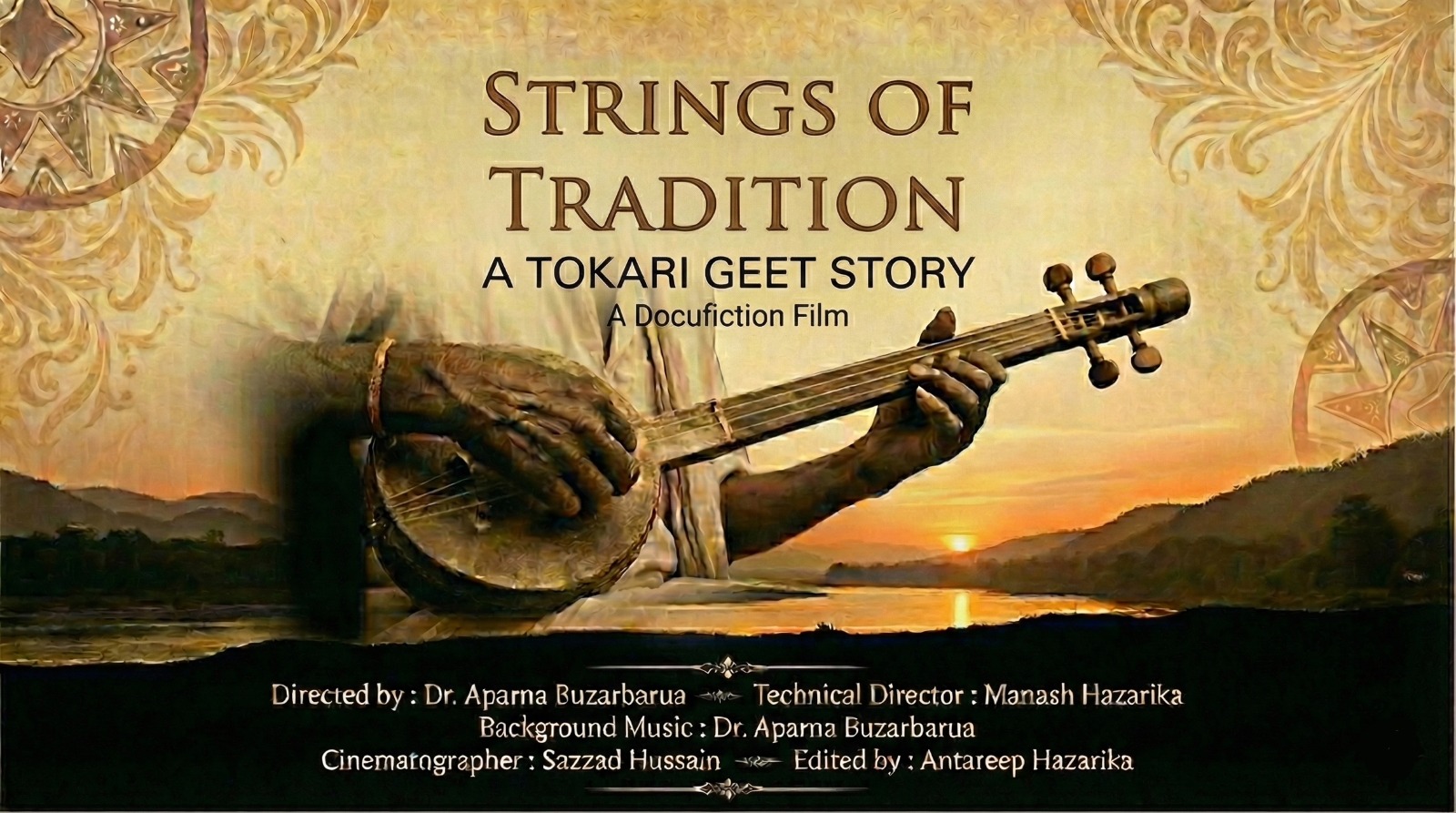
A documentary spotlighting Assam’s traditional Tokari Geet has earned national recognition at two prominent film festivals, underlining renewed efforts to preserve an oral folk heritage.
Strings of Tradition: A Tokari Geet Story, a 28-minute feature, received an Honorable Jury Mention at the 16th Dada Saheb Phalke Film Festival 2026 held in New Delhi on April 30. The film also secured a Special Jury Mention at the Indian World Film Festival in Hyderabad.
Directed and produced by Dr. Aparna Buzarbaruah—an author, musician, and botanist—the documentary follows a scholar’s journey to explore the philosophical and cultural depth of Tokari Geet, a devotional folk tradition rooted in Assam. Blending fiction with documentary storytelling, the film presents both historical context and contemporary relevance.
Tokari Geet, performed using the tokari—a traditional string instrument—remains deeply embedded in Assam’s spiritual and cultural practices. The film highlights the urgency of preserving this art form, which continues to rely largely on oral transmission.

To reconstruct its history, the documentary draws on insights from noted practitioners and researchers including Gautam Sharma, Khagen Gogoi, Hirak Jyoti Sharma, Dr. Jadab Baishya, and Nayan Jyoti Saikia. Their contributions trace the tradition’s pre-Sankari origins and its continuity in present-day Assam.
The film also examines the legacy of Umakanta Bairagi, a Sangeet Natak Akademi awardee, recognised for his work in preserving Tokari and Dehabichar Geet traditions. Through archival references and narrative reconstruction, his contributions are placed within a broader cultural framework.
Beyond music, the documentary captures the craftsmanship behind the making of the tokari instrument, including the use of traditional materials like Chatiyana wood, reflecting the close link between artistry, spirituality, and indigenous knowledge systems.
Produced under the banner of Rohini Production, the film represents a collaborative effort combining artistic vision and technical expertise. The makers aim to expand its reach through digital platforms and festival circuits, particularly among younger audiences.
The film’s recognition signals a growing national interest in regional cultural narratives while raising concerns about the sustainability of oral traditions in an increasingly digital age.