
Skip to content Skip to navigation

Remembering Panditji

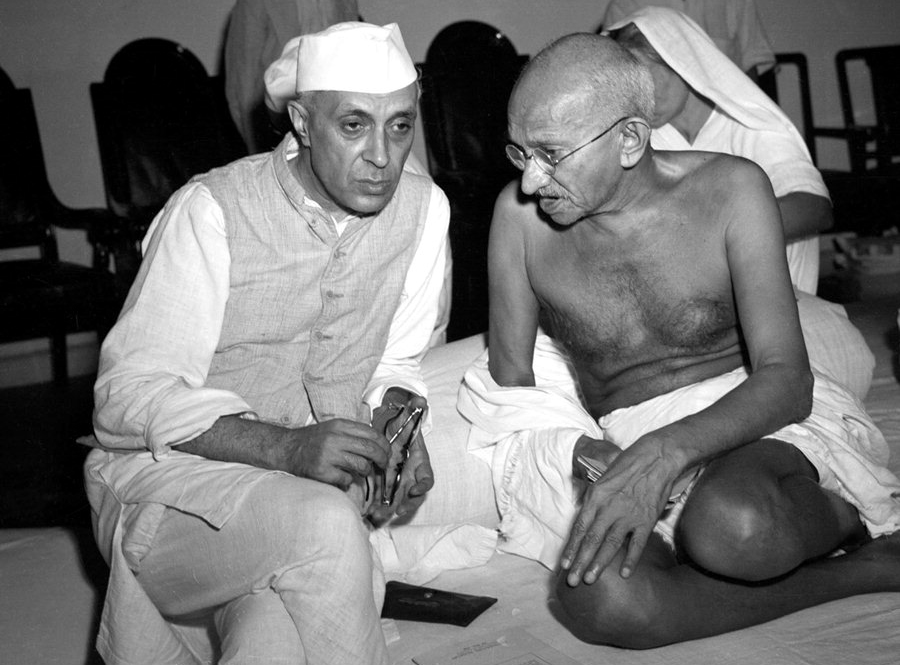
Forty-four years ago on May 27 the first Prime Minister of India died in harness. About Pandit Jawaharlal Nehru, Maulana Abul Kalam Azad wrote in his autobiography: ‘Jawaharlal asked me in despair, what other alternative there was to accepting partition?……..I told Jawaharlal that I could not accept his views.’ Azad added: ‘The Muslim League had accepted the Cabinet Mission Plan, and a satisfactory solution of the Indian problems seemed in sight. Unfortunately the position changed and Mr. Jinnah got a chance of withdrawing from the League’s earlier acceptance of the Plan…… I warned Jawaharlal that history would not forgive us if we agreed to partition. The verdict would then be that India was divided as much by the Muslim League as by the Congress.’ Partition was then inevitable.

In the 1946 July election of Congress President, Maulana Azad would not accept the high office. He desired unanimous election. The contest meant fighting over the opposite issues: Cabinet Mission Plan or Mountbatten Plan? As Vallabhbhai was adamant and would not withdraw, Azad withdrew himself. In my view Azad should not have withdrawn. In the contest he was sure to be re-elected. His was an error of judgment, nay his life’s blunder. The course of history would have been otherwise. There would have been no partition.

The majority in Congress was for the Poona Formula and Meerut Congress resolution of November 1946 – the ‘Congress Formula’ vis-a-vis Cabinet Mission Plan, and strongly against partition. Azad’s Working Committee would have given an altogether different course to the events. Maulana later confessed his error. India as a whole was in no mood to accept partition. So Vallabhbhai found slender support in the Congress. There was confusion – a deadlock. The Congress was caught on the horns of dilemma. Patel had no chance. At the end Jawaharlal was found to be the missing link. He was unanimously elected July 22, 1946. This weak link soon broke down.

I am tempted to ask, why Jawaharlal, who always soared high and who was a staunch, uncompromising opponent of partition of India up to the last, at last succumbed to Mountbatten? Thou too, Brutus!……Nehru did not hold Patel’s view; on the contrary, he was radically opposed to it. In fact, Nehru admitted that ‘Partition was wrong’, but he felt that it was ‘inevitable’, and that ‘it would be wisdom not to oppose what was bound to happen’, and that ‘it would not be wisdom to oppose Lord Mountbatten on this issue’! Jawaharlal accepted defeat, surrendered totally. He ‘believed’ that his friends, the Mountbattens ‘acted in India’s interests as zealously as any India could have done’, so wrote Allen Andrews under the caption, ‘The Fantastic Mountbattens’.

My own reading is: Jawaharlal Nehru might have pleaded that, in the then compelling circumstances ‘individuals did not count’; no ‘static’ thinking would do; ‘force of rapid events’ were compelling; the Congress must take ‘dynamic decision’ in the exigency of the situation that developed; etc. That was all playing to the gallery. But the fact remains that he completely succumbed to the overtures of Mountbatten. And, as a very shrewd politician that he was, he foresaw that it was ‘wisdom’ not to range himself against Patel, the coming hero of partition and therefore to be the sole leader of Congress as soon as partition became a fait accompli: A battle for leadership! In power politics ‘wisdom’ is dictated by majority of votes. Jawaharlal Nehru was after all a ‘democratic leader’! It is an open secret that this battle of leadership and wits between Nehru and Patel continued ad nauseam until the latter made his journey to the ‘bourne from which no traveller ever returns’. Behold, the partition resolution of June 14, 1947, was passed in the A.I.C.C. – the last resolution in pre-independence Congress, by 29 votes for Patel-cum-Nehru and 15 against! (My father, Maulana M. Tayyebulla, Assam Congress President voted ‘against’.) Too many abstentions and absentees….

With all the weaknesses that every political leader has, Panditji remains the most respected, loved, adored and remembered Prime Minister.

Comments

nayan's picture

Nehru was responsible for partition of India. He was selfish and power hungry.

Pages

Add new comment

Other Contents by Author

The 28th Assam Convention was held at the Hyatt Regency hotel in Boston, Massachusetts on Saturday, June 30 and Sunday, July 1 amidst much fun fare. For the first time ever in the history of Assam Association of North America (AANA) conventions, the Hon’ble Chief Minister of Assam addressed the gathering on June 30 in an attractive ‘Town Hall’ format meeting, where everyone got a chance to ask the Chief Minister, Mr.Tarun Gogoi about their home state Assam. The Chief Minister was accompanied by A.K.Sachan, IAS and Hemanga Sarma, IAS and answered questions on a variety of topics ranging from flood situation in Guwahati to NRI investment in Assam, education, AIDS/HIV etc....
Agartala: Gandhism is catching and fast. This time it is the turn of surrendered militants of National Liberation Front of Tripura (NLFT-BM) to follow the Gandhism path alleging that the State Government has still not fulfilled their demands. Mantu Koloi alongwith 72 armed cadres had surrendered before security forces in May, 2004 following an agreement with the State Government. But Koloi says that till date the State Government has not taken any steps towards the fulfilment of promises which were made at the time of their surrender.The former rebel leader said that as such they have been compelled to organize a semi-nude march towards the Governor House on July 25 to apprise Governor DN...
Indian companies are rapidly expanding their global footprint, often through acquisitions funded by canny investors who have recognised the competence of Indian managers and the skills they bring to the table. But there is a flipside to this. An estimated one-fifth of India’s current workforce from shop-floor workers to top managers which has played a crucial part in the transformation of Indian business will be out of the workforce by the year 2010. And the reason is that they would have passed India’s absurdly low retirement age of 58 in most corporate organizations and 60 in a few. It is a well know fact that it is felt that India’s much-touted ‘demographic...
GUWAHATI : Indian Bank opened its first all woman manned branch of in the GNB Road in the city. According to the Bank sources, this is the first all woman branch of Indian Bank in the country.The bank was inaugurated by Ms Sundara Rajan, Chairman-cum-Managing Director of Indian Bank. Ms Rajan speaking on the occasion had high expectations from the Branch and said that if the is model is successful, Indian Bank would look at opening many such branches in the Country. The Reserve Bank of India, Regional Director, Ms Sewali Choudhury was also present on the occasion.
Guwahati : Assam’s flood situation has taken a grim turn on Tuesday as the Brahmaputra and its tributaries are flowing at an alarming level. The situation has gone from bad to worse following incessant rainfall during the last 24 hours.Officials here say all surface communications in the worst-hit Dhemaji district are still remaining disrupted which has left lakhs of people displaced. With fresh rainfall in some places in the morning more areas in the district have come under the surging waters. The water levels had showed a receding trend on Monday. According to officials engaged in the relief works, the district administration is providing shelter to the marooned people in four...
As what is seen as a precedence for many such moves in the future, a proposal to raise the retirement age from 58 to 60 years for employees of profit-making central public sector enterprises (CPSEs) has been approved by the Union Cabinet. The ministries which are responsible for the administration of the respective companies would be empowered to approve the proposals of CPSEs to enhance the age of retirement of its employees from 58 to 60 years, provided that these companies have made net profits for the last three years continuously and should have positive net worth on a sustained basis, government officials said. “This benefit will be available to only those PSUs that have not...
There are floods in Balipara now. Reports have come in that there are twelve villages which are under water. Water is receding but the situation is still grim. Emergency services have been pressed into operation
GUWAHATI: Caught in a Catch-22 situation, Assam Chief Minister, Tarun Gogoi, is willing to hand over the probe into the killing of Phul Chand Ram to the CBI but has said that this will not stop the flow of investments into the state.Talking to the reporters on Monday, Mr Gogoi says his government will soon order a CBI inquiry into the crossfire which left the FCI executive director Dr Ram killed.“We are always against allowing rebel groups to hold people for ransom by kidnapping officials and setting conditions for their safe release. I rejected the plea of the Union agriculture minister Sharad Pawar to release ULFA top guns Mrinal Hazarika and Pallab Chetia for release of Dr Ram as...
Guwahati: In connection with the abduction and recovery of the dead bodies of the CCI Manager Kailash Jha and PWD junior Engineer Ajay Kumar Deka, the City Police has arrested five persons, inlcuding an Army officer, for kidnap and murder of Deka. They have been identified as Lance Naik Akon Kumar Das, Jitu Choudhury, Rinku Choudhury, Subhas Das and Amar Thapa. While Jitu and Rinku, both brothers, were arrested from Baksa district last night, Subhas Das and Amar Thapa, both surrendered ULFA rebels, were arersted from Pathsala, Barpeta today. Sources said that the late Deka took Rs. 7 lakh assuring to provide them jobs.Meanwhile the Prime Minister, Manmohan Singh has condemned the incident...
Mumbai : Sunita Bhuyan, daughter of famed violinist, Minoti Khaund has been carving her own niche in India’s cultural and corporate world. Bhuyan has been performing in various functions and meets in India alongwith her mother as well as independently. With corporates, she has been presenting workshops on music as a tool for holistic development of corporate executives across various international forums. Recently she had given a performance at NCPA in Mumbai about the influence of classical ragas on some of the Assamese folk music styles. “Bihu is a popular form of folk song as well as dance,” said Bhuyan, who explored the folk, devotional and contemporary music of...