Skip to content Skip to navigation

Remembering Panditji

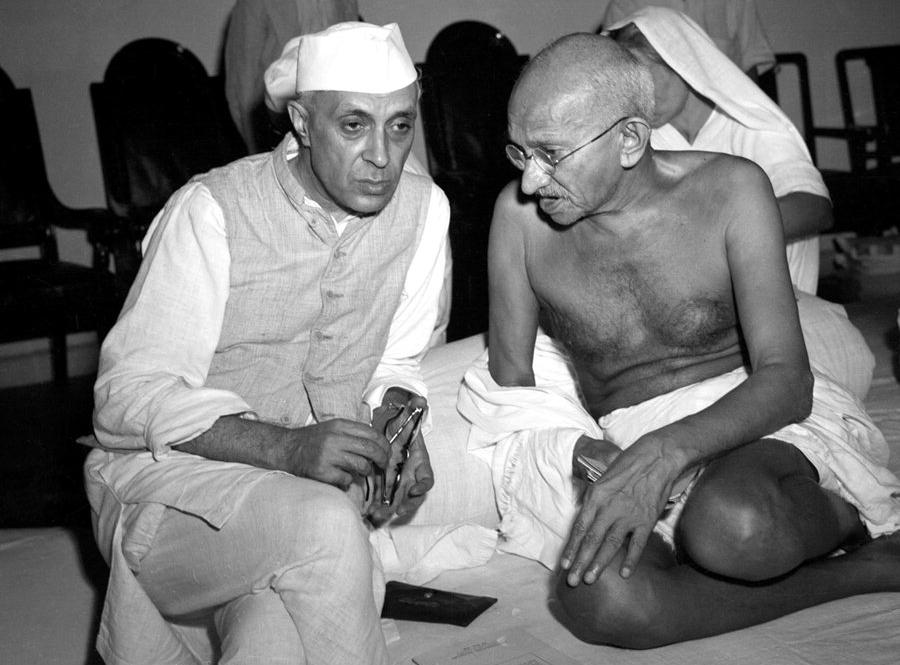
Forty-four years ago on May 27 the first Prime Minister of India died in harness. About Pandit Jawaharlal Nehru, Maulana Abul Kalam Azad wrote in his autobiography: ‘Jawaharlal asked me in despair, what other alternative there was to accepting partition?……..I told Jawaharlal that I could not accept his views.’ Azad added: ‘The Muslim League had accepted the Cabinet Mission Plan, and a satisfactory solution of the Indian problems seemed in sight. Unfortunately the position changed and Mr. Jinnah got a chance of withdrawing from the League’s earlier acceptance of the Plan…… I warned Jawaharlal that history would not forgive us if we agreed to partition. The verdict would then be that India was divided as much by the Muslim League as by the Congress.’ Partition was then inevitable.

In the 1946 July election of Congress President, Maulana Azad would not accept the high office. He desired unanimous election. The contest meant fighting over the opposite issues: Cabinet Mission Plan or Mountbatten Plan? As Vallabhbhai was adamant and would not withdraw, Azad withdrew himself. In my view Azad should not have withdrawn. In the contest he was sure to be re-elected. His was an error of judgment, nay his life’s blunder. The course of history would have been otherwise. There would have been no partition.

The majority in Congress was for the Poona Formula and Meerut Congress resolution of November 1946 – the ‘Congress Formula’ vis-a-vis Cabinet Mission Plan, and strongly against partition. Azad’s Working Committee would have given an altogether different course to the events. Maulana later confessed his error. India as a whole was in no mood to accept partition. So Vallabhbhai found slender support in the Congress. There was confusion – a deadlock. The Congress was caught on the horns of dilemma. Patel had no chance. At the end Jawaharlal was found to be the missing link. He was unanimously elected July 22, 1946. This weak link soon broke down.

I am tempted to ask, why Jawaharlal, who always soared high and who was a staunch, uncompromising opponent of partition of India up to the last, at last succumbed to Mountbatten? Thou too, Brutus!……Nehru did not hold Patel’s view; on the contrary, he was radically opposed to it. In fact, Nehru admitted that ‘Partition was wrong’, but he felt that it was ‘inevitable’, and that ‘it would be wisdom not to oppose what was bound to happen’, and that ‘it would not be wisdom to oppose Lord Mountbatten on this issue’! Jawaharlal accepted defeat, surrendered totally. He ‘believed’ that his friends, the Mountbattens ‘acted in India’s interests as zealously as any India could have done’, so wrote Allen Andrews under the caption, ‘The Fantastic Mountbattens’.

My own reading is: Jawaharlal Nehru might have pleaded that, in the then compelling circumstances ‘individuals did not count’; no ‘static’ thinking would do; ‘force of rapid events’ were compelling; the Congress must take ‘dynamic decision’ in the exigency of the situation that developed; etc. That was all playing to the gallery. But the fact remains that he completely succumbed to the overtures of Mountbatten. And, as a very shrewd politician that he was, he foresaw that it was ‘wisdom’ not to range himself against Patel, the coming hero of partition and therefore to be the sole leader of Congress as soon as partition became a fait accompli: A battle for leadership! In power politics ‘wisdom’ is dictated by majority of votes. Jawaharlal Nehru was after all a ‘democratic leader’! It is an open secret that this battle of leadership and wits between Nehru and Patel continued ad nauseam until the latter made his journey to the ‘bourne from which no traveller ever returns’. Behold, the partition resolution of June 14, 1947, was passed in the A.I.C.C. – the last resolution in pre-independence Congress, by 29 votes for Patel-cum-Nehru and 15 against! (My father, Maulana M. Tayyebulla, Assam Congress President voted ‘against’.) Too many abstentions and absentees….

With all the weaknesses that every political leader has, Panditji remains the most respected, loved, adored and remembered Prime Minister.

Comments

nayan's picture

Nehru was responsible for partition of India. He was selfish and power hungry.

Pages

Add new comment

Other Contents by Author

Indefinite curfew has been clamped in Haflong following a clash between a group of people and DHD(J) militants during the ongoing Dima Hasao bandh on Friday.Tension started in the hills town when a group of bandh supporters attacked a veterinary office and started pelting stones at the DHD(J) designated camp. A DHD(J) militant was injured in the attack. Other camp inmates also tried to retaliate forcing the security forces deployed there to resorted to blank firing to disperse the violent picketers.
Dispur on Friday announced a Rs 200-crore scheme to revive the field of agriculture in the flood ravaged scene.Agriculture Minister Nilamoni Sen said that the government had formulated the special programme to help the agriculture sector, for which funds would be made available by State and central government.According to him, the department had cancelled all forms of leave of all agriculture department officers for the next two months, till the time of rabi sowing, to make up for the loss of kharif crop due to floods.
Chief Minister Tarun Gogoi is scheduled to undertake another aerial survey of flood-hit areas in Sivasagar, Dibrugarh and Tinsukia districts on Saturday.Gogoi is expected to meet district administration officials from these districts on Saturday. Towards the evening he would be back to Guwahati. On his arrival, the chief minister is slated to hold a high level meeting of the officers to take stock of the relief operations.
Chief Minister Tarun Gogoi on Friday conducted an aerial survey of flood-hit districts on Friday.Gogoi laid thrust on relief and rescue of the marooned people. At the outsit he reached Jagiroad and visited the affected people in Moigaon where the victims alleged non receipt of relief materals. Then he left for Darrang, Sonitpur, Lakhimpur and Dhemaji apart from Kazaringa National Park and the Majuli.
The overall flood situation continues to improve on Friday. The water levels of the mighty Brahmaputra and its tributaries are receding.The death toll has gone upto 27. Six people have been remained traceless. Over 15 lakh people in 18 districts have been affected. Assam government has announced a 200 crore special scheme covering four lakh 10 thousand hectare crop lands which will benefit around 12 lakh flood affected population.
Aaranyak, one of the most prominent conservation group in the country has expressed its shock and deepest grievance at the recent incidences of poaching of four rhinos in the flood stricken Kaziranga National Park in just three days time. This is a massive setback to the efforts towards conservation and protection of this unique creature that finds an inherent place in the very heart of Assamese culture.We strongly feel that the management of the Assam Forest Department has not been up to the task of protecting the rhinos, especially in conditions of flooding of the Park. This, we feel, can be ascribed to a complete lack of coordination between the Forest Department and the Karbi Anglong...
World Tourism Day celebrated on September 27.
The Max Mueller Bhavan, New Delhi formally released a book, on September 18, titled “West meets East: Schopenhauer and India”, edited by Arati Barua under their specific program “Germany and India 2011-12 : Infinite opportunities”. Robin Mallick , Program director South Asia region formally released the book. Astrid Radunski, cultural counselor of the Embassy of Federal Republic of Germany in New Delhi, spoke about IDSS and its work. Professor Nirmalya Narayan Chakravorty , Member Secretary of Indian Council of Philosophical Research (ICPR) who Chaired the session, delivered a lecture on about the book . Professor Matthias Kossler, honorable President of the...
Security has been beefed up across the state following ULFA’s stepped up activities to make their presence felt. The outfit is trying to carry out a string of blast in the vital spots forcing security forces to be kept on high alert. Vehicles are being frisked to avoid any incident. In Guwahati, security forces have sealed the entry and exit routes. According to intelligence inputs, ULFA’s Paresh Baruah faction has recruited 1000 new cadres who are being trained by Manipur based People's Liberation Army. ULFA has also stepped up extortion activities in Upper Assam.
Former army chief Gen V K Singh on Monday said that BTAD violence is a fit case for the Armed Forces (Special Powers) Act to be applied. Talking to reporters in the sideline of a function, he said that army could have reached the spot early and that there was no need to wait. He further questioned the alleged delay in sending army to the riot hit spot.