
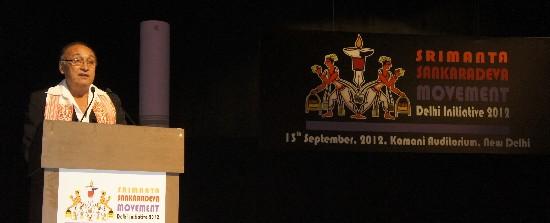
Fellow Citizens of Bharatvarsha and Friends, Hari Om.
You might think this opening statement a pompous beginning to this evening’s proceedings, but as we go along I will endeavour to explain how this is one of the most illuminating ways to address one’s people and how that light shone in Assam over 500 years ago and its effulgence burns to this day in the hearts and minds of every Assamese.
It is this spirit of enlightenment that we would like to present and radiate not just here, but throughout India, and to every corner of the globe where human and sincerely secular values have a meaning.
In all my life, this is perhaps my proudest moment. At a time when Assam burns because you think we cannot tolerate people of other ethnicities, look at me; I point at myself and compel you to recognize honest secularism. I was born a Bengali, will always remain one, but I owe all that I am today, in every sphere, to my upbringing from a little toddler to an adult, in Assam. And in recognition of my passionate love for the mati and manu, the soil and people of the valley, I stand before you, appointed the Brand Ambassador of a movement whose importance and relevance is unparalleled in modern Assamese and Indian cultural history.
Bharatvarsha was a loosely applied term in the Mahabharat when Bharat of Hastinapura ruled over our subcontinent and regions he conquered that stretched from Northwest Tibet to Afghanistan and Turkmenistan. However, the very concept faded with time until a wandering philosopher from Assam walked across Northern India, to the source of the Ganges and returned to his people in the cloistered valley of Assam and called for a union of all our people in a united Bharatvarsha. So now, my addressing you as Citizens of Bhartvarsha will make sense from a deep-rooted Assamese revival of the term. He preached Eka-Sarana-Nama-Dharma a monotheistic doctrine based on the Bhagvata Purana, at a time when a young 24 year old Guru Nanak was also exploring his own vision of Eka-Sarana-Nama-Dharma which he went on to preach throughout the world as “Ek Omkar Satnam”. It was the dawn of the Bhakti Era.
The 15th and 16th Centuries of the Common Era were without doubt the greatest in terms of how they moulded and shaped the beliefs, thoughts and aesthetics of mankind. Michelangelo was creating the Pieta and his immortal ceiling of the Sistine Chapel while Leonardo created the world’s most famous painting the Mona Lisa and his incredible mural of the Last Supper. That was when Martin Luther, an Augustinian monk, challenged the authority of the Pope and attacked several key doctrines of the Catholic Church and proclaimed that Christians would be saved not by scrupulously following ritual practices, but by faith and faith alone, Bhakti.
That was the time when Henry VIII led a scathing and vitriolic attack on Martin Luther and the Pope in Rome conferred the title of “Defender of the Faith”, upon Henry, for his allegiance. Not much later, that colourful monarch of England broke away from Catholicism and Rome to divorce his wife and marry Ann Boleyn. The Pope immediately excommunicated him, but the islanders of Britain conferred the same title of “Defender of the Faith” upon the King or Queen of England as their venerated leader of the Anglican Church. Calvin meanwhile reformed the church in France. That, friends, was the Reformation movement in Europe.
And here in our subcontinent, at exactly the same time, there were the beginnings of our own social and religious reforms, the likes of which this land had never seen before and will probably not witness again. Let me give you a few names of people who lived at the same time, in Bharatvarsha. It will make you sit up in your chairs and wonder at an era that has made a difference to the lives of many of us present here this evening: Surdas, Chandidas, Kabir, Vidyapati the Maithili Poet and Lyricist, Mirabai, Narsi Mehta the poet saint and Bhakta from Gujarat, Vallabhacharya the devotional philosopher from Andhra, Chaitanya Mahaprabhu of Bengal, Guru Nanak the world renowned propagator of the Bhakti movement and Sikhism, and finally the reformer, saint and poet, creative genius and consummate artist that we are assembled to glorify today, Mahapurush Srimanto Shankaradeva of Naungaun, in Assam.
Every one of these great souls is a household name in Bharatvarsha today and it fills our hearts with pride to reveal to you that the first modern, if medieval, visionary on our land, who ever called for a united Bharatvarsha amongst his people, shunned casteism and idol worship, and whose Naam Ghars, to this day 500 years later, have housed nothing but a Scripture, The Bhagavad, was Assam’s neo-Vaishnav Guru, and social reformer, Srimanto Shankaradeva.
A Nam Ghar is what you might call a temple or chapel, but it isn’t only that. Shanakaradeva built Naam Ghars where no idols would ever be worshiped, the inner sanctum would house a holy scripture, and where people of all faiths and castes and ethnicities would be welcomed as equals. In the morning the clash of Bortals, huge cymbals, to the soft accompaniment of the Mridnga, or khol, both designed specially by Shankaradeva, a Borgeet (a song celestial) would be softly sung to usher in a new day.
The Naam Ghar became a meeting place for the community and social issues and problems were discussed there, and solved there. It was in many ways the first example of a Panchayat System. To this day, throughout the length and breadth of Assam, in the Northern and Southern banks of the great Brahmaputra, and on islands in its waters, in towns, in villages, in tea gardens and forests there is a Naam Ghar in almost every five square mile area, that preserves the Bhakti cult and rich culture of unique dance and music of Assam. It is the greatest living tribute to the saint Shankaradeva.
But that’s just the beginning. Shankaradeva was equally fluent in Sanskrit, Assamese, and BrajaVali Bhasa or Brojobuli. As a little student, he composed a short poem using just consonants and the first vowel “Aw” and astonished his teacher. His gift for music and his sense of rhythm and movement astounded everybody. His teachers knew he was a special child.
Years later, on his return from a twelve year pilgrimage that took him to Northern India and was influenced greatly by his visit to the Living Lord Jagganath in Puri, and Kabir in Banaras, Shankaradeva composed his first “Borgeet”, a hymn, in the Raga Dhanasri, in 1493 CE. Dhanasri is a lilting happy raga that is performed at a time of day when weary farmers rest in the shade of Pipals and Banyans. It provided the setting for hymns by Guru Amar Das, Guru Ram Das, Guru Arjan Dev and Guru Tegh Bahadar, and forms an integral part of Guru Nanak’s Holy Guru Granth Sahib. Arguably, Shankaradeva’s Hymn was also, the first poem ever composed in Brajabuli Bhasa.
But it was the Kirtan Ghosa that Shankaradeva is most remembered for. It has a place in every Assamese home and is written in verse. It is a magical and mind-blowing transcreation (not translation) of the Bhagavad, in simple language, with simple imageries, for simple and ordinary people, with a “ghosa”, a refrain, that everyone can recite.
While in England and Europe Mystery plays based on the books of the Bible were being written for the stage, in Assam, Shankaradeva was writing dance dramas called Bhaonas and one act plays called Ankia Nat to be performed in the Naam Ghars. The Ankia Nat and the Jhumura popularized by Shakaradev’s chief Disciple and successor Madhabadev, were perhaps the first forms of cultural folk theatre in Bharatvarsha. The use of the Sutradhar was unique in its Brechtian stylization and the performances accompanied by antiphonal song, a “responsory” like a chorus speaking the mind of an audience.
It was amazingly similar to what was evolving across the seven seas in Europe more than a hundred years before the Globe and Shakespeare. But going a step farther, Shakaradeva himself painted backdrops and used them as drop-scenes behind the players, thus creating stage sets for the very first time. In 1468 his first play Chinha Yatra was a huge success and his famous Kaaliya Daman is performed to this day in many parts of India, including I’m told, in the National School of Drama, in Delhi.
There are only eight Classical Dance forms recognized by the Sangeet Natak Akademi: Bharata Natyam, Kuchipudi, Odissi, Mohiniyattam, Kathak, Kathakali, Manipuri and Sattriyaa. Only one of them can be traced to an individual as opposed to a people or culture. The Sattriyaa, or Xattriyaa Dance form, was created solely by Srimanto Shakaradeva.
He sang, he composed lyrics, painted sets and backdrops and also played the khol and even danced. His genius was undisputed and unparalleled in our nation’s cultural history. Today, we take the first step towards integrating his faith, his art and his music and dance with the rest of India and we humbly pray to you all to accept us as brethren who had been lost, not forsaken, in the northeastern realms of modern India.
Let me end talking about imageries and motifs, like the simple ones on this gamucha I have around my neck. I think of Tibetan Silk Lampas that were donated to a British Museum in 1905 and remained collecting dust for 85 years, until a similar fragment went under the hammer at Christies for over US$100,000.00. During his years of
persecution, and he had several, Shankaradeva spent a great deal of time in the Kingdom of Koch Behar, teaching scripture to the young Princes. One of them, Chilarai, was extremely fond of stories of the baby boy Krishna, and to please him, Shankaradeva promised to weave him a tapestry depicting all the stories of the naughty boy Krishna, in Vrindavan.
Shankaradeva set about designing and doing all the artwork himself and then employed weavers in a village called Tantikuchi, near Barpeta, to weave a forty yard long panel that would one day be called the “Vrindavani Vastra”. Just before he died, Shankaradeva, presented the tapestry to Chilarai and the ruler, his brother, Naranarayana, but mysteriously the silk tapestry disappeared and a valuable work of art was lost for 400 years till a British Officer found it in Tibet and gave it to a museum.
There can be no doubt that no one in our cultural history had so many facets, so many incomparable talents and above all a spirit to lift ordinary souls into the realms of divinity.
Shankaradeva lived to the ripe old age of 119 and you’ll be amused to hear that his most productive years were after he turned a hundred. We’re used to being governed by old people in this country but don’t you wish our feuding Parliamentarians could dance and sing and preach a casteless equality so we could all live in harmony as Shankaradeva had propagated and achieved, not without adversary or difficulty, 500 years ago ?
A few months ago I was asked by an Assamnese author to launch a book in Calcutta or Guwahati, I don’t remember which, but I had to turn down the request because I was busy doing something else of seemingly monumental importance at the time. Weeks later, I received a small parcel. But, busy as I always seem to be, the parcel remained unopened for a month. But life is stranger than one cares to admit and the powers that govern our fates are sometimes difficult to deny or ignore. A few weeks ago, I opened the parcel to discover Dr Bimal Phukan’s unbelievable, short and concise, and detailed and immensely readable biography of Srimanto Shankaradeva. 48 hours after I finished the book, I was made this incredible offer that has me standing here, before you, today.
For someone like me who struts and frets through the vicissitudes of life, this is a perfect climax to the joys of an imperfect existence.
Eka Naama Saranam – Hari Om
© Victor Banerjee - Thursday, September 13, 2012
Recorded video of the speech:
- Add new comment
- 47842 reads



Comments
Pages
Add new comment