
Skip to content Skip to navigation

Citizen Flags Data, Nutrition Gaps in HPV Vaccination Drive

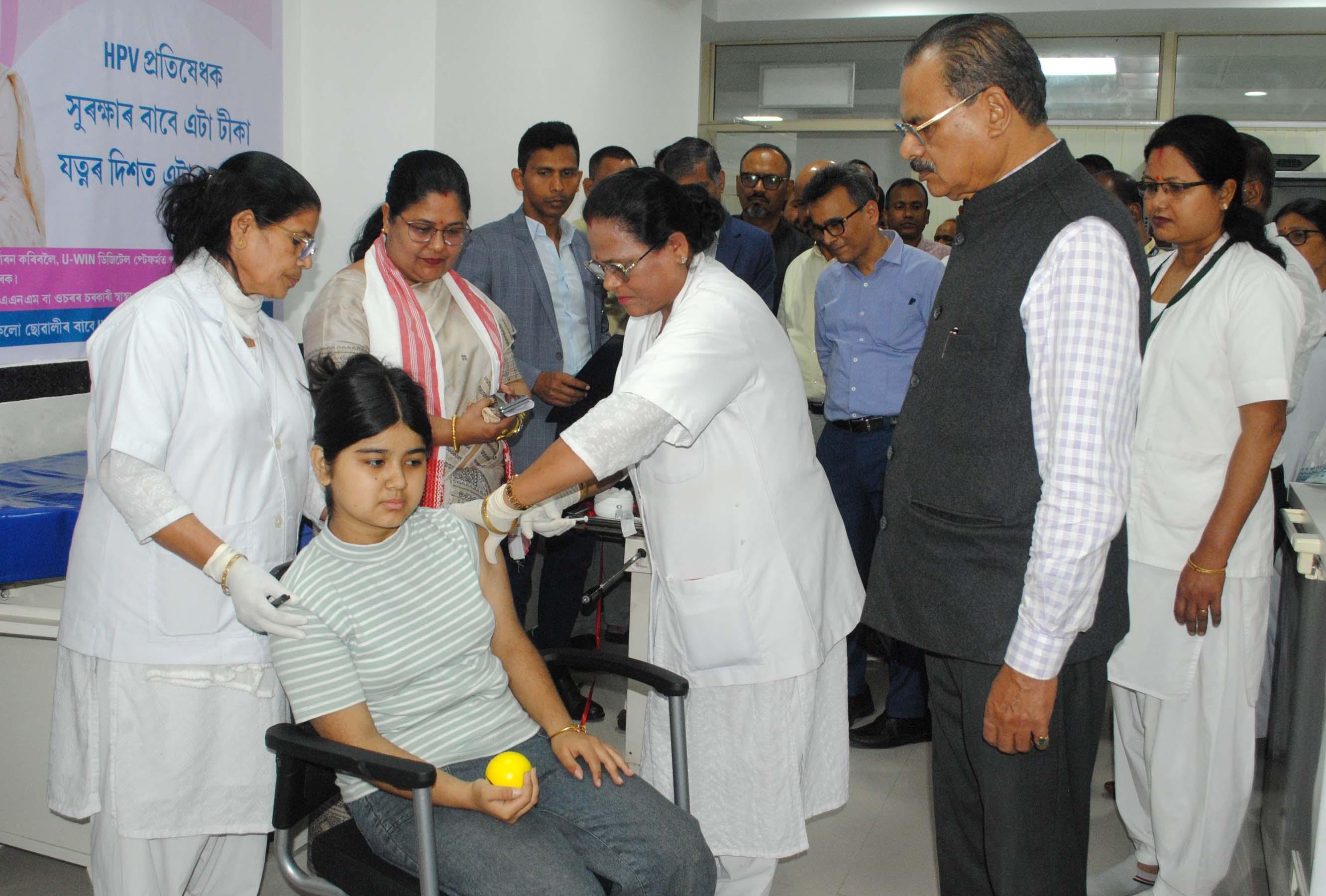
Chandra Mohan Patowary, Minister of Environment & Forests and Welfare, along with MP Bijuli Kalita Medhi, at the State Launch of the HPV Vaccination Campaign at Maternity & Child Hospital, Gauhati Medical College and Hospital, Bhangagarh, Guwahati, on February 28, 2026. The National and State Launch was virtually inaugurated by Prime Minister Narendra Modi. (Pix by UB Photos)

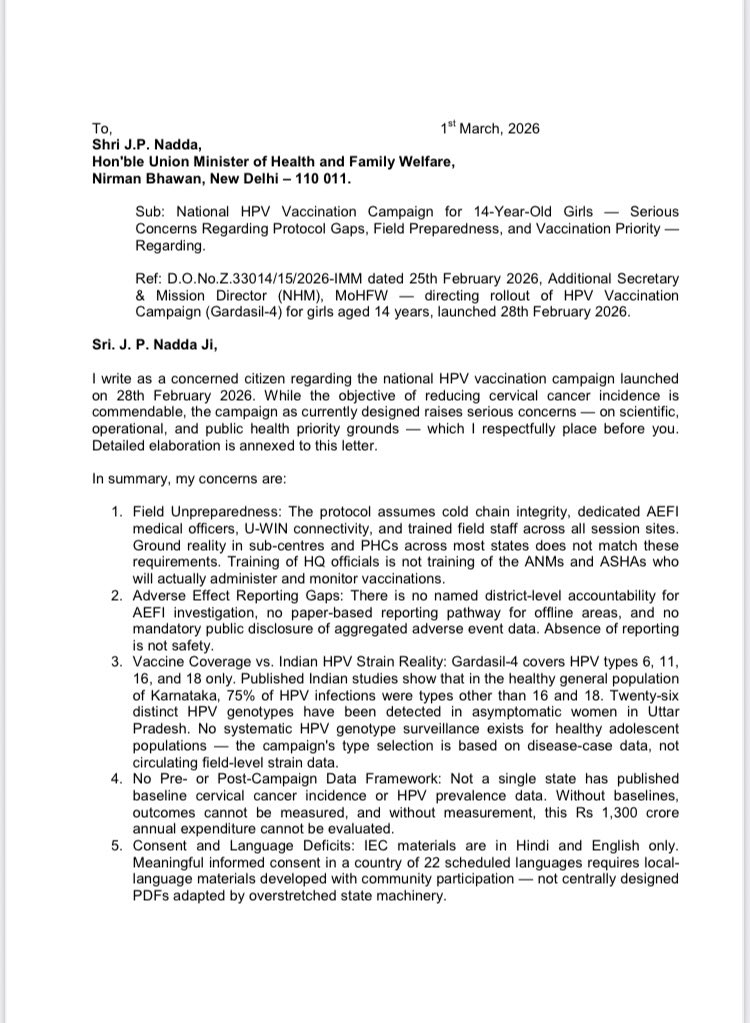
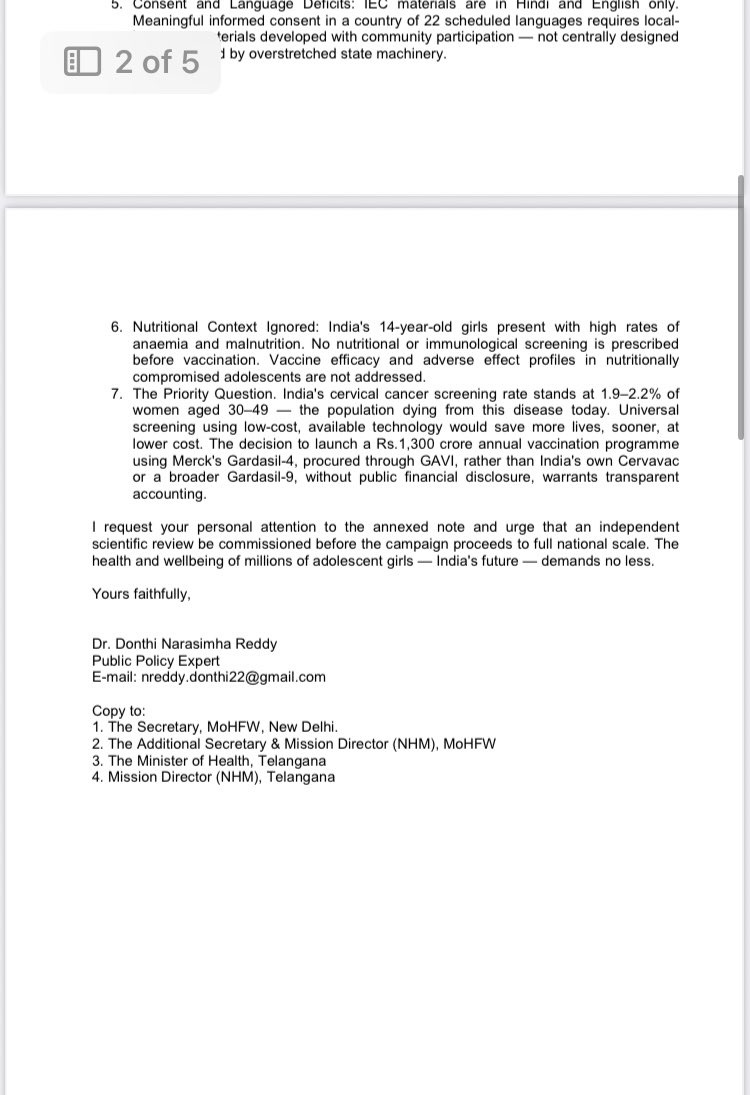
New Delhi, March 1: Concerns have been raised over the national HPV vaccination campaign launched on February 28, 2026, with a citizen questioning its scientific basis, operational preparedness, and public health prioritisation.

In a public statement, Donthi N. Reddy said that not a single state has published baseline data on cervical cancer incidence or HPV prevalence prior to the rollout. Without such baseline indicators, he argued, outcomes cannot be measured, and without measurable outcomes, the reported annual expenditure of ₹1,300 crore cannot be properly evaluated.

The campaign involves administration of the HPV vaccine Gardasil-4 to 14-year-old girls across the country, aiming to reduce future cervical cancer burden. While the objective has been widely acknowledged as important, critics say the absence of publicly available pre-campaign epidemiological benchmarks limits transparency and accountability.

Another issue highlighted is the health status of adolescent girls. India continues to report high levels of anaemia and malnutrition among teenage girls. The concerns raised point out that no nutritional or immunological screening has been prescribed before vaccination, and that vaccine efficacy and adverse event profiles in nutritionally compromised adolescents have not been specifically addressed in public communication.

Public health experts note that HPV vaccination has been adopted in several countries as a preventive strategy against cervical cancer. However, the concerns underscore the need for robust baseline data, ongoing monitoring, and clear communication to maintain public trust as the programme expands nationwide.

The Ministry of Health and Family Welfare has yet to issue a detailed response to these specific points.

_________________

Bihar HPV Vaccine Episodes Cited in Ongoing Safety Debate

New Delhi, March 1: A series of reported adverse events in Bihar schools between May and October 2025 has resurfaced in public debate as India expands its HPV vaccination campaign targeting adolescent girls.

A compilation circulated by Awaken India Movement on X in late October 2025 documented 10 separate incidents in which schoolgirls reportedly experienced sudden symptoms—primarily fainting, dizziness, nausea, breathing discomfort, or anxiety—shortly after receiving the HPV vaccine Gardasil-4 during school-based drives.

Reported Incidents Across Bihar (May–October 2025)

According to the compilation and subsequent media references, the following districts reported clusters of post-vaccination illness:

  • Dehri (Rohtas district), May 2025: A 14-year-old student reportedly fainted and was hospitalized.

  • Buxar, July 2025: Around 12 schoolgirls fell ill shortly after vaccination.

  • Banka, August 2025: Approximately 15–20 girls reportedly experienced dizziness and fainting; a later medical paper described transient neuropsychiatric symptoms in a small cluster.

  • Kishanpur, September 2025: 10 girls reported sick after vaccination.

  • Samastipur, September 2025: 2 girls fainted.

  • Bhagalpur, September 2025: Several girls reported post-vaccination illness.

  • Dinara, September 2025: 2 girls fell ill.

  • Gopalganj, September 2025: 3 girls fainted.

  • Bhojpur, October 2025: About 12 girls reportedly fell sick.

  • Samastipur (Vidyapati Nagar), October 2025: 6 girls reported illness following vaccination.

In addition, a widely discussed episode occurred in Saharsa district on October 17–18, 2025, where reports suggested that 30–35 girls from a middle school fainted or felt unwell shortly after vaccination. The incident drew national attention after comments by Sridhar Vembu, intensifying discussion around mass school-based immunisation policies.

Official Response and Medical Context

District administrations and civil surgeons consistently described these episodes as mild and transient, attributing them to syncope (fainting), anxiety reactions, hyperventilation, or mass psychogenic illness—phenomena documented globally during adolescent vaccination drives.

Health officials reported that affected students recovered with rest and observation, and no long-term harm or fatalities were confirmed in publicly available reports. International bodies such as the World Health Organization and the Centers for Disease Control and Prevention have previously stated that HPV vaccines maintain a strong safety profile, with fainting recognized as a rare but known short-term reaction among adolescents receiving injections.

Points of Contention

Despite official reassurances, activists and commentators have raised several concerns:

  • Perceived clustering of similar incidents across multiple districts.

  • Calls for independent investigations and transparent publication of findings.

  • Questions about informed consent in school settings.

  • Broader skepticism about mass vaccination campaigns and long-term risk communication.

  • Debate over balancing cervical cancer prevention benefits with public trust and implementation safeguards.

Supporters of the campaign maintain that HPV vaccination is a globally endorsed preventive measure against cervical cancer and that transient fainting episodes, while concerning in appearance, are not uncommon in adolescent immunization settings.

The Bihar episodes have become a focal point in the broader national discussion on HPV vaccine rollout, highlighting the importance of clear communication, robust adverse event monitoring, and sustained public engagement as the programme expands.

_________________

Legal Case Against Vaccine Manufacturer Added to Debate

The vaccine at the centre of India’s HPV immunisation campaign — Merck & Co.’s quadrivalent Gardasil HPV vaccine — has also been the subject of high-profile litigation in the United States. In January 2025, Merck faced its first jury trial over claims that it “wrongfully marketed” Gardasil as safe and misrepresented its benefits while downplaying risks, a lawsuit that could involve more than $8 billion in sales and damages. Jurors were asked to consider whether side-effect reports were withheld from regulators and whether marketing overstated the vaccine’s safety and effectiveness.

In the case, plaintiff’s attorney Mark Lanier told reporters:

“This case has monumental significance to public health and the ways we trust companies who produce vaccines.”

Merck denied the allegations, saying in official responses that “an overwhelming body of scientific evidence continues to support the safety and efficacy of our HPV vaccines.”

It’s worth noting that in a separate federal ruling in March 2025, a U.S. judge dismissed more than 200 related safety claims against Gardasil, concluding there was “a paucity of evidence” to support a causal connection between the vaccine and alleged adverse effects.
Add new comment

Other Contents by Author

The hills of West Karbi Anglong district in Assam witnessed a dramatic eruption of violence this week, underscoring deep frustrations over land rights and perceived governmental inconsistency. On December 22, 2025, protesters demanding the eviction of alleged encroachers from protected tribal grazing reserves torched the ancestral home of Karbi Anglong Autonomous Council (KAAC) Chief Executive Member Tuliram Ronghang in Dongkamukam and set fire to several shops in Kheroni Bazaar. The next day, despite prohibitory orders under Section 163 of the Bharatiya Nagarik Suraksha Sanhita (BNSS), clashes between opposing groups led to stone-pelting, injuring several people, including protesters,...
New Delhi: Senior journalist Sangeeta Barooah Pisharoty has created history by becoming the first woman to be elected President of the Press Club of India (PCI), marking a significant milestone in the institution’s long-standing legacy. Her election is being widely hailed as a landmark moment for gender representation and leadership in Indian journalism. A respected name in the profession, Pisharoty is known for her incisive reporting, editorial leadership and long-standing commitment to press freedom, ethical journalism and the welfare of media professionals. Over the years, she has earned wide credibility for her work on politics, governance and social issues. The Press Club of...
A two-day ‘People’s Consultation on Strengthening Humanitarian Response and Climate Resilience in the Brahmaputra Basin’ concluded today at Hotel Clubway Grand, Jorhat, with the adoption of the People’s Declaration for a Resilient Brahmaputra Basin. The event was organised by the North-East Affected Area Development Society (NEADS) in collaboration with the Inter Agency Group (IAG) of Assam and various local humanitarian civil society actors from across the Brahmaputra valley, with support from Start Network. The consultation brought together humanitarian practitioners, climate workers, community leaders, civil society organisations, youth groups and women’s collectives to deliberate on...
Guwahati: Curtains came down on the 9th Chalachitram National Film Festival at the Jyoti Chitraban premises in Kahilipara on 30 November 2025, as distinguished guests at the closing ceremony handed over awards, certificates, and cash prizes to the winning filmmakers in the presence of eminent film personalities, emerging director-producers and cine-goers. Organized by Chalachitram, a subsidiary of Vishwa Samvad Kendra-Assam, the two-day CNFF-25 showcased over 30 short features and documentaries across competitive and screening categories. ‘Koli’, directed by Jyotirmoy Mazumder, was adjudged the best short feature in the Northeast India category, while ‘Joba’, directed by Indira Baikerikar,...
The North-Eastern Hill University (NEHU) on Friday hosted the IIC Regional Meet 2025, drawing more than 500 participants from higher educational institutions across the Northeast. The day-long programme, organised under the Ministry of Education’s Innovation Cell (MIC) and the All India Council for Technical Education (AICTE), was held at the Multi-Convention Hall on the NEHU campus. The event commenced with the traditional lighting of the lamp, followed by an introductory address by Prof. Dinesh Bhatia, SPOC of the Regional Meet. Prof. G. Bez, Chairperson of the Meet, delivered the welcome speech, while Prof. I. Hussain, Dean of the School of Technology, NEHU, offered brief remarks....
Guwahati: Tirtha Prasad Saikia, Director of the North-East Affected Area Development Society (NEADS) — a local organization and an Indigenous Peoples’ Organization member of the International Union for Conservation of Nature (IUCN) based in Assam — has been elected to the Executive Body of the India National Committee (INC) of IUCN, representing the North-East India region. NEADS works at the intersection of humanitarian response, resilience building, climate action and environmental sustainability, adopting a nexus approach to address the human dimensions of environmental crises arising from both natural and human-induced disasters. The organization emphasizes community well-being...
Guwahati: The Pragjyotishpur Literature Festival (PLF) 2025 concluded this evening at Srimanta Sankardeva Kalakshetra, wrapping up three days of rich literary discussions, cultural insights, and powerful storytelling. Organized by the Sankardeva Education and Research Foundation, the festival began on 14 November with acclaimed author Shefali Baidya delivering the keynote address. On the final day, the organizers announced the recipients of this year’s prestigious PLF awards. Eminent researcher and author Moneswar Deori was named the recipient of the PLF 2025 Award, while promising young writer Srotashwini Tamuli, a researcher at Birangana Sati Sadhani State University, was declared the...
As the world gathers in Belém, Brazil, for the 30th United Nations Climate Change Conference (COP-30), the North-East Affected Area Development Society (NEADS) from Assam has stepped onto the global stage to ensure the voices of the region’s flood-affected and climate-vulnerable communities are heard. Representing NEADS as an Observer of the Start Network, Tirtha Prasad Saikia, the organisation’s Director, said the participation marks a crucial moment for the North-East, one of India’s most climate-sensitive regions. “We are here because climate change is not a distant issue for us — it’s our everyday reality,” said Saikia. “Assam’s communities have been battling floods, erosion,...
“Zubeen Garg was not just a singer — he was a phenomenon. A god in human form for millions,” said Manoj Kumar Das, management professional and commentator from Assam, in a heartfelt conversation reflecting on the life and legacy of the late music legend. Das, who had known Zubeen for more than two decades, recalled his early memories vividly. “He was just a simple, soft-spoken boy when I first met him — full of restless energy, always humming tunes. He could pick up any instrument, any rhythm, and turn it into something magical. But what stood out most was his humility. Despite his fame, Zubeen never carried an ego. He could be sitting on the ground with villagers one day and on stage...
Along with the rest of Assam, the people of Nazira observed Kati Bihu today with devotion and traditional fervor. The festival, which marks a crucial phase in the agricultural calendar, was celebrated with prayers for a prosperous harvest and protection from natural calamities. As the sun set, households across Nazira lit earthen lamps (chakis) before Tulsi plants and in the paddy fields, symbolizing hope and reverence for nature’s bounty. The flickering lights illuminated the night, reflecting the community’s collective faith in a good harvest season. Also known as Kongali Bihu, Kati Bihu is a more solemn and reflective celebration compared to other Bihus, emphasizing austerity,...