
Skip to content Skip to navigation

Flames of Frustration: Why Karbi Anglong's Eviction Crisis Exploded into Violence

The hills of West Karbi Anglong district in Assam witnessed a dramatic eruption of violence this week, underscoring deep frustrations over land rights and perceived governmental inconsistency.

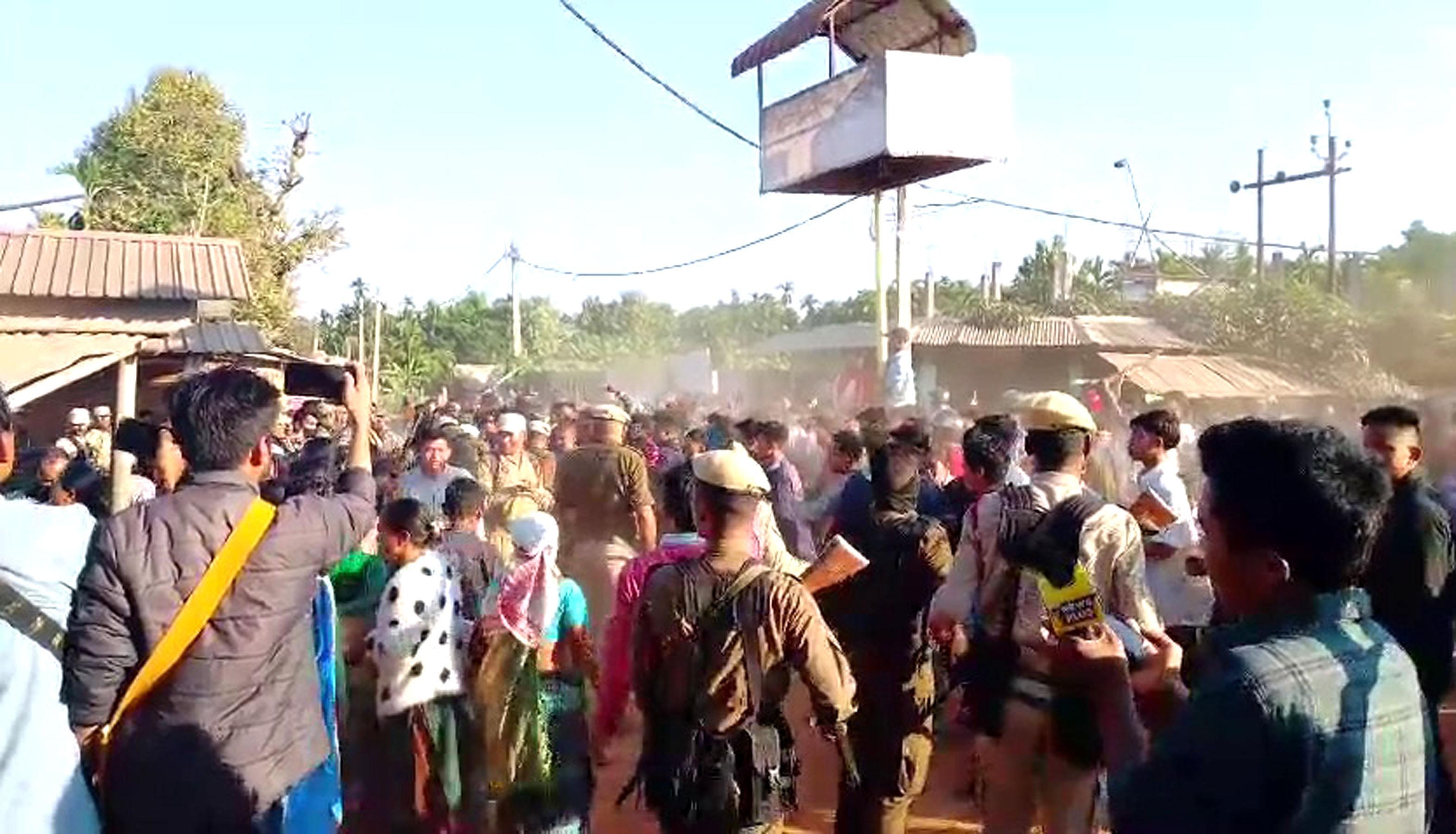
On December 22, 2025, protesters demanding the eviction of alleged encroachers from protected tribal grazing reserves torched the ancestral home of Karbi Anglong Autonomous Council (KAAC) Chief Executive Member Tuliram Ronghang in Dongkamukam and set fire to several shops in Kheroni Bazaar. The next day, despite prohibitory orders under Section 163 of the Bharatiya Nagarik Suraksha Sanhita (BNSS), clashes between opposing groups led to stone-pelting, injuring several people, including protesters, police, and journalists.

Security forces used lathicharge, tear gas, and blank firing to disperse crowds, while internet services were suspended in the region.

At the heart of the unrest is a long-standing demand by Karbi tribal organisations to reclaim Village Grazing Reserves (VGR) and Professional Grazing Reserves (PGR)—lands safeguarded under the Sixth Schedule of the Constitution for indigenous communities. The KAAC issued eviction notices in February 2024 targeting alleged illegal settlers, many from Bihar and other states, occupying thousands of acres.

However, a Gauhati High Court stay order halted the process, stalling action and breeding resentment. A two-week hunger strike by protesters in Kheroni escalated after rumours spread that strikers had been arrested (they were actually shifted to hospital for treatment), triggering the arson and clashes.

This incident stands in stark contrast to eviction drives in other parts of Assam throughout 2025. In districts like Goalpara, Dhubri, Nagaon, Lakhimpur, and Kokrajhar, the state government has aggressively cleared encroached lands—often government or forest reserves—displacing thousands from diverse communities, including Bengali-speaking Muslims (Miyas), Ahoms, Mishings, Morans, Bodos, and others who had settled for decades.

These operations, frequently backed by court orders and massive police deployments, have proceeded with limited large-scale resistance from the affected groups. Critics have accused some drives of serving corporate interests, such as clearing land for projects by Adani or Reliance, while others frame them as anti-encroachment measures.

Why, then, did Karbi Anglong explode while others remained relatively subdued?

Here, the protesters are not the evictees but the indigenous Karbis, who feel their constitutional protections are being ignored. They perceive the government's proactive enforcement elsewhere as evidence that action is possible when prioritised, yet in their Sixth Schedule area, legal hurdles and delays have allowed encroachments to persist. Reports suggest demographic shifts have reduced Karbi dominance in parts of the district, heightening fears of marginalisation akin to that faced by tribals in neighbouring states.

The government's response has been measured. Minister Ranoj Pegu engaged with protesters, leading them to call off the hunger strike on December 23 in exchange for assurances of tripartite talks involving the state, KAAC, and agitators—chaired by Chief Minister Himanta Biswa Sarma on December 26. Additional forces were deployed, and prohibitory orders imposed to restore calm, with no major fresh incidents reported since Monday night.

Yet, this episode exposes a troubling disparity in policy application across Assam's ethnic tapestry. When evictions target marginalised or minority settlers in the plains, the state acts decisively with judicial backing and force. In tribal hill districts, demands for similar protection meet inertia, fuelling desperation and violence. Such inconsistencies risk eroding trust in governance and exacerbating communal divides.

Violence, including arson targeting leaders or communities, is never justified—it undermines legitimate grievances and invites repression. Assam's leaders must ensure equitable enforcement of land laws, resolve pending court cases swiftly, and prioritise inclusive dialogue. Only through consistent justice and development can the state prevent recurring flames of frustration from consuming its fragile peace.

Author info

AT News's picture

Assam Times Staff. editor@assamtimes.org

Add new comment

Other Contents by Author

The Assam Pradesh Congress Committee on Friday launched the nationwide “Save MGNREGA Movement” in the state, opposing the Modi-led NDA government’s move to amend the MGNREGA Act and introduce a new law under the name “VB-G RAM G”. As part of the first phase of the agitation, press conferences were held simultaneously at district headquarters across Assam, including Kamrup Metropolitan, Sonitpur, Lakhimpur, Dhemaji, Tinsukia, Dibrugarh, Charaideu, Hailakandi, Darrang and Baksa. District Congress Committee presidents and senior party leaders addressed the media. In Guwahati, senior Pradesh Congress spokespersons Kushal Sharma, Rupak Das and Anita Devi addressed the press at the...
A strong call to unite the indigenous communities of Northeast India on a common platform was made at a roundtable discussion held on January 6 to mark the 21st death anniversary of noted nationalist leader Nibaran Bora. The discussion, titled “Crisis of Indigenous Peoples of Northeast India and Its Solutions”, resolved to carry forward Bora’s vision and ideology for safeguarding indigenous identity and rights. The meeting was attended by representatives of several indigenous organisations from Assam and other Northeastern states. Uncompromising nationalist leader Hasibur Rahman, a close associate of the late leader, delivered the keynote address, highlighting the growing threat to the...
Amid escalating political unrest ahead of its national elections scheduled for February 12, 2026, Bangladesh has recorded the killing of journalist Rana Pratap Bairagi, who has become the first journalist worldwide to be murdered this year. The global media safety and rights organisation Press Emblem Campaign (PEC) has strongly condemned the killing and demanded a thorough investigation to bring the perpetrators to justice. According to local media reports, Bairagi (45), a resident of Arua village in the Jessore region of southern Bangladesh, was fatally shot in the head by three assailants on January 5, 2026. The editor of the Bengali daily Dainik BD Khabar was found dead at Kopalia...
In a major crackdown on terror networks, a special NIA court in Guwahati has convicted Md. Kamruj Zaman, a key accused in a Hizb-ul-Mujahideen (HM) terror conspiracy case, and sentenced him to life imprisonment. Zaman, also known as Dr Hurairah and Kamaruddin, was awarded life imprisonment under Section 18 of the Unlawful Activities (Prevention) Act (UAPA), along with two additional sentences of five years’ simple imprisonment under other UAPA provisions. All sentences will run concurrently. The court also imposed fines in each case. The case relates to a 2017–18 conspiracy to set up an HM terror module in Assam to carry out terrorist activities and spread fear. NIA investigations...
An eerie silence is prevailing in Karbi Anglong and West Karbi Anglong districts following the death of two people belonging to different communities amid growing demand to evict the non tribals from the hills districts on Tuesday. Mobile internet has been suspended and the authority has imposed some restrictions on public gatherings to ensure peace and tranquility in the tribal dominated hills districts. Security forces are patrolling on the streets in the vulnerable areas to avert any untoward incident. But the tribal leaders and their followers have blamed it all on the government for allowing the non tribals to settle there which is contrary to the laid down rules. " We are...
Tension gripped West Karbi Anglong district for a second consecutive day on Tuesday as clashes between protesters and security forces in Kheroni area left two people dead and over 45 injured, including 38 police personnel. The deceased have been identified as a differently-abled youth from the Karbi community, who succumbed during police action to disperse agitators, and another individual who died in arson attacks on shops in Kheroni market. Reports indicate the violence involved stone-pelting, use of crude bombs, arrows, and bows by mobs, prompting police to resort to lathi-charge, tear gas, and blank firing. The unrest stems from long-standing demands by Karbi organisations for the...
New Delhi: Senior journalist Sangeeta Barooah Pisharoty has created history by becoming the first woman to be elected President of the Press Club of India (PCI), marking a significant milestone in the institution’s long-standing legacy. Her election is being widely hailed as a landmark moment for gender representation and leadership in Indian journalism. A respected name in the profession, Pisharoty is known for her incisive reporting, editorial leadership and long-standing commitment to press freedom, ethical journalism and the welfare of media professionals. Over the years, she has earned wide credibility for her work on politics, governance and social issues. The Press Club of...
A two-day ‘People’s Consultation on Strengthening Humanitarian Response and Climate Resilience in the Brahmaputra Basin’ concluded today at Hotel Clubway Grand, Jorhat, with the adoption of the People’s Declaration for a Resilient Brahmaputra Basin. The event was organised by the North-East Affected Area Development Society (NEADS) in collaboration with the Inter Agency Group (IAG) of Assam and various local humanitarian civil society actors from across the Brahmaputra valley, with support from Start Network. The consultation brought together humanitarian practitioners, climate workers, community leaders, civil society organisations, youth groups and women’s collectives to deliberate on...
Guwahati: Curtains came down on the 9th Chalachitram National Film Festival at the Jyoti Chitraban premises in Kahilipara on 30 November 2025, as distinguished guests at the closing ceremony handed over awards, certificates, and cash prizes to the winning filmmakers in the presence of eminent film personalities, emerging director-producers and cine-goers. Organized by Chalachitram, a subsidiary of Vishwa Samvad Kendra-Assam, the two-day CNFF-25 showcased over 30 short features and documentaries across competitive and screening categories. ‘Koli’, directed by Jyotirmoy Mazumder, was adjudged the best short feature in the Northeast India category, while ‘Joba’, directed by Indira Baikerikar,...
The North-Eastern Hill University (NEHU) on Friday hosted the IIC Regional Meet 2025, drawing more than 500 participants from higher educational institutions across the Northeast. The day-long programme, organised under the Ministry of Education’s Innovation Cell (MIC) and the All India Council for Technical Education (AICTE), was held at the Multi-Convention Hall on the NEHU campus. The event commenced with the traditional lighting of the lamp, followed by an introductory address by Prof. Dinesh Bhatia, SPOC of the Regional Meet. Prof. G. Bez, Chairperson of the Meet, delivered the welcome speech, while Prof. I. Hussain, Dean of the School of Technology, NEHU, offered brief remarks....