
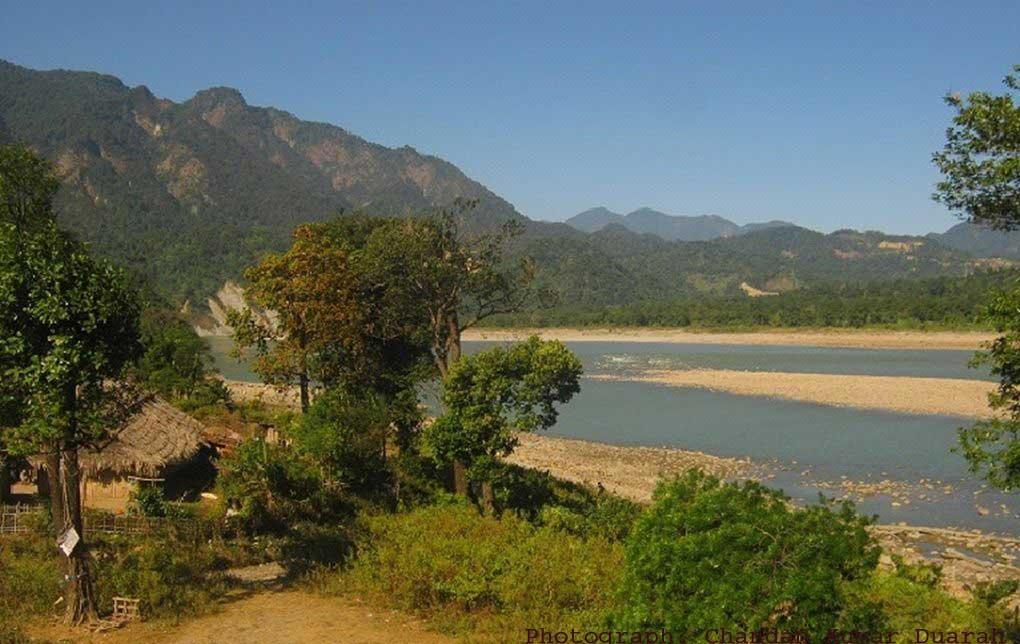
Only the Government of India and international pressure can persuade China to abstain from diverting water of Yarlung Zangbo. There must be a billater treaty between New Delhi and Beijing on Brahmaputra,said Chandan Kumar Duarah, a environmentalist and Senior Journalist in Asomiya Pratidin. The fear of Assam on diversion of water of the Brahmaputra was not baseless. China plans to divert waters of the river to drought effects Xinjiang and its Taklimakan desert. Chinese engineers have submitted plans of building a 1,000 km tunnel to divert from Tibet to arid region in the north of Tibet, reports Stephen Chen on Monday.
He says that the Brahmaputra may not die if China diverts the river water, but it will be a slow poison to kill the river system as well as ecosystem. 'But as riparian country and for the interest of millions of people in downstream, we and Bangladesh have equal right of water of Brahmaputra, Duarah said Assam Times today.
Duarah says that most of water in Brahmaputra are contributed from tributaries of Arunachal Pradesh and Assam. But Yarlung Zangbo, Brahmaputra as known in China, has a crucial ecological and geological role in India. So, diversion must be discussed with India and Bangladesh subjebjecting environmental and geological aspects. Since, China had already built a dam on the river at Zangmo and commissioned in 2010, multinationl pressure on China must be initiated to bring Beijing to the table. Both countries don’t have any water-sharing agreement. Duarah emphasise a Mekong River Commission like organisation for Brahmaputra covering China, Bangladesh, Nepal and Bhutan. The Mekong River Commission (MRC) is the only inter-governmental organisation that works directly with the governments of Cambodia, Lao PDR, Thailand and Viet Nam to jointly manage the shared water resources and the sustainable development of the Mekong River.
According to the report published in the South China Mornirng Post, the plan if approved, would have huge ramifications for downstream India and Bangladesh, envisages building the world's longest tunnel to carry billions of tons of water from the Brahmaputra to the arid Taklimakan desert in Xinjiang.
The Tibetan Plateau stops the rain-laden Indian Ocean monsoon from reaching Xinjiang, with the Gobi Desert in the north and the Taklimakan Desert in the south leaving more than 90 per cent of the region unsuitable for human settlement.
The Brahmaputra project’s enormous cost, engineering challenges, possible environmental impact and the likelihood of protests by neighbouring countries have meant it has never left the drawing board, but Chuanqing said China was now taking a quiet, step-by-step approach to bring it to life.
Researchers said building the Yunnan tunnel would be a “rehearsal” of the new technology, engineering methods and equipment needed for the Tibet-Xinjiang tunnel, which would divert the Yarlung Tsangpo River in southern Tibet to the Taklimakan Desert in Xinjiang.
“The water diversion project in central Yunnan is a demonstration project,” said Chuanqing, who has played a key role in many major Chinese water tunnel projects, including the one in Yunnan. “It is to show we have the brains, muscle and tools to build super-long tunnels in hazardous terrains and the cost does not break the bank.”
The Yunnan tunnel and support facilities will take eight years to build at an estimated cost of 78 billion yuan (US$11.7 billion). It will carry more than three billion tons of water each year from northwestern Yunnan to the province’s dry centre and directly benefit more than 11 million people, according to the provincial government. The Yunnan Daily said the tunnel would create 3.4 million jobs, more than 30,000 hectares of new farmland and give the local economy a 330 billion yuan boost.
The solution they came up with was inspired by subway trains, whose carriages are connected by elastic joints. In the tunnel, Chuanqing said, flexible materials that were also waterproof and strong would be used to bind concrete pipes together when they passed through fault zones.
Sangri county featured a large, relatively flat valley that was ideal for the engineering project. An artificial island would be built in the middle of the river to create rapid turbulence, which could filter out sediment, and direct water to a well. The well could control the amount of water flowing into the tunnel.
Wang, the researcher at the State Key Laboratory of Hydraulics and Mountain River Engineering at Sichuan University in Chengdu, said the tunnel would mostly be underground and would be built in many sections. In some places, large boring machines with drill heads around 15 metres wide would be lowered through wells to drill tunnels from opposite directions.
The proposed Shangri- Xinjiang tunnel, which would drop down from the world’s highest plateau in multiple sections connected by waterfalls, would “turn Xinjiang into California”, one geotechnical engineer said. China’s longest tunnel is the eight-year-old 85km Dahuofang water project in Liaoning province, while the world’s longest tunnel is the 137km main water supply pipe beneath the city of New York.
But the cost would be astronomical. According to Wang’s estimate, each kilometer of tunnel would cost at least one billion yuan due to the difficult terrain and taxing altitude of the Tibetan Plateau. He opines that in five to 10 years from now, the technology will be ready and the cost affordable, and the temptation of the benefits will be difficult to resist.
Past diversion proposals were shelved because of high costs, environmental concerns and issues in technical feasibility. Questions remain on the plan's feasibility, with Wang Wei, a researcher at the State Key Laboratory of Hydraulics and Mountain River Engineering at Sichuan University in Chengdu who was involved in drafting the plan, telling the SCMP it would cost "one billion yuan" for each kilometre of tunnel, which would place the cost at an astronomically prohibitive $1 trillion Yuan-five times the cost of the Three Gorges dam.
Zhou Shiqiao, a researcher at the Chinese Academy of Sciences’ Institute of Tibetan Plateau Research in Beijing, said the government should study the feasibility and environmental impact of the different proposals extensively before giving the final nod.
But another leading Chinese researcher who is developing a similar 600 km water tunnel in Yunnan as a demonstration project told the paper that China "would definitely go ahead with the project one day." Wang said the project would also prompt protests from India and Bangladesh, which lay downstream. But compared to other proposals, which would require the construction of massive dams on the river, the underground tunnels would leave Tibet’s natural landscape largely unscathed.
Chinese media fears if the government approves the Brahmaputra tunnel, this would have huge ramifications for India and Bangladesh. India has already expressed concerns about a dam that was built upstream in Zangmu, Tibet, in 2010, which China says is a run of the river dam for hydro-power generation that doesn't store large volumes of water and hence has a limited impact on downstream flows. Since then, three other dams have been given the green light on upper and middle reaches.
- 9950 reads


Add new comment