
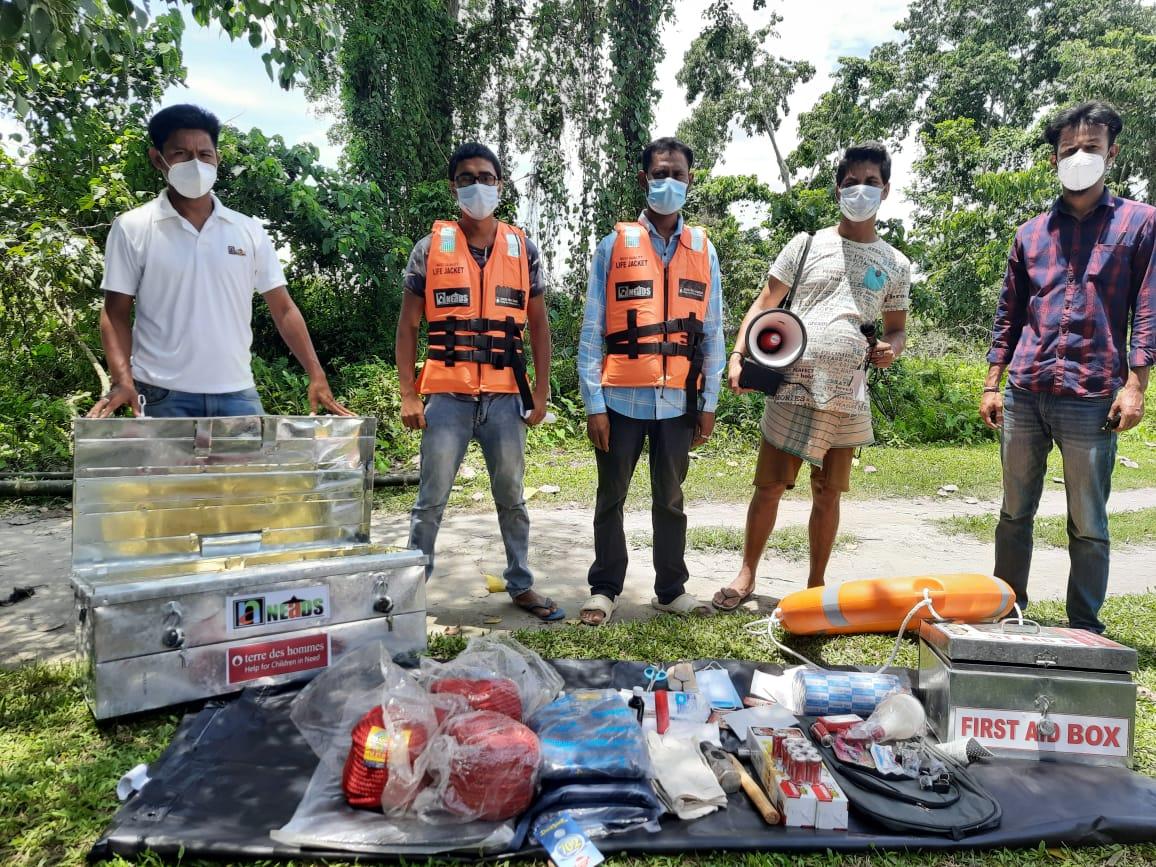
At a time when people of Assam are battling with the COVID-19 pandemic, the same are also preparing how to tackle the multiple waves of rising flood situation. Many rivers have started to flow above warning marks gradually causing threat to communities’ lives and livelihood. Flood in times of COVID are in fact challenging, and this worsens the capacity of people to cope. Severe flooding in the northeast Indian state of Assam has submerged croplands and villages, pushing thousands of people into relief camps.
Last year, days of heavy rainfall over the week caused riverbanks to burst. State authorities said that the floods have affected at least 6 million people in 30 of Assam’s 33 districts, with more rain predicted in the coming days. The coronavirus pandemic has exacerbated the disaster’s impacts on a population that was already struggling with lost jobs amid COVID-19 lockdowns. Floods are common in Assam and other parts of South Asia during the ongoing monsoon season, which usually lasts through October. But this year, the pandemic has escalated risks on multiple fronts. The immediate and long-term impacts of COVID-19 cripple people’s resilience and intensify the poverty spiral among them.
North-East Affected Area Development Society (NEADS) is a grassroot development organisation working with poor people in their struggle against humanitarian crisis, exploitation and poverty. The organisation is recognised for its work on humanitarian response & advocacy, disaster risk reduction, climate change adaptation, human rights and sustainable development. NEADS is committed to address issues of poverty and social exclusion, also working together to improve the lives of people affected by disasters in the state.
Initiative to increase people’s resilience and adaptive capacity to floods
Being located in the floodplain along the riverbank of Brahmaputra, and its tributaries Gelabil and Dhansiri, the area Mahuramukh and its vicinity which falls under Bokakhat block of the district Golaghatis highly prone to water induced disasters such as flood and riverbank erosion. Floods affect all aspects of land, lives, and livelihoods of communities living in the areas to a large degree, leaving people homeless and displaced, destroy crops, damage public property and infrastructures which cripple people’s resilience and intensify the poverty.
With the aim to increase community’s capability to anticipate and prepare for disasters and promoting a culture of prevention and preparedness through enhancing knowledge and innovation,NEADS has been working on increasing affected peoples resilience and adaptive capacity to disaster floods. The project is funded by Mercy Relief, a non-governmental humanitarian organization of Singapore.
The project which was started during September 2020 is now being implemented in a total of eight villages under Disoi & Uttar Mahura G.P. under Bokakhat block where around 4500 people are being targeted as direct beneficiaries. The core trust areas of the project are to build community capacity in disaster risk management, promoting flood-resistant Water, Sanitation and Hygiene (WASH), resilient livelihood initiative, disaster preparedness and its mainstreaming in local government.
As part of the intervention, NEADS has been institutionalizing the flood affected people to community level disaster mitigation institutions. This grassroot institutional mechanism is to prepare community to meet emergencies like flood and the allied disasters faced by them. NEADS has been undertaking vulnerability and capacity assessment of the targeted villages, prepare village contingency plan, held risk mapping and safety planning, establish community resource centre for education, information and awareness on disaster risk reduction.
In promoting flood-resistant Water, Sanitation and Hygiene (WASH), the organisation is working on installation of flood – resistant handpumps and sanitation structures, imparting community level training and awareness on public health in emergencies, undertaking water chlorination drive, proving various inputs support tools and equipments and water treatment units to most vulnerable families. NEADS has been initiating sensitisation programmes on children risks and their safety in school and also promote child centred public health preparedness.
Besides, seeking to build preparedness for effective response and recovery in agriculture, livestock and other allied livelihood generation activities. NEADS is extending assistance of post flood agriculture, providing inputs to farmers including women for restoration of livelihood.
Annual disasters in the projected area have an enormous impact on development. With every flood or other forms of allied disasters, there is a significant impact on various sectors of development like agriculture, housing, health, education and infrastructure. This impact in a serious social and economic setback to the development and poverty reduction programmes of the community. Hence, such systematic approach of identifying, assessing and reducing the risks of such disasters will help people in terms of building their local capacities in responding to humanitarian crisis in communities.
Mission to strengthen resilience and sustainable adaptation to climate change in flood-affected areas of Majuli island
Because of the peculiar location amidst the active floodplains of the Brahmaputra, Majuli island of Assam gets inundated in normal to severe floods every year. The impacts of climate change are also severe for thousands of indigenous peoples living in the island which poses a serious threat to them. Floods and river erosion affect all aspects of land, lives, and livelihoods of communities living in the areas to a large degree, leaving them homeless and displaced, destroy crops which cripple people’s resilience and intensify the poverty.
With the aim to increase community’s resilience and capability to anticipate and prepare for disasters in a changing climate and promote culture preparedness through multisectoral prevention and adaptation mechanism, NEADS is working in partnership with Terre Des Hommes (TDH), Germany which is funded by Federal Ministry for Economic Cooperation and Development (BMZ).
The project which was started during December 2020 is now being implemented in a total of ten villages under Majuli development block, where around 9500 people are being targeted. The core trust areas of the project are to establish a community-based early warning and prevention system,build peoples capacity in disaster risk management, promoting flood-resistant WASH, resilient livelihood, disaster preparedness and institution building.
“To establish a community-based early warning and prevention system in the villages, currently NEADS has been strengthening the capacities of affected people, organizing vulnerable communities and building village level disaster management institution and emergency task forces. NEADS is planning to work out on Participatory Assessment of Climate & Disaster Risks (PACDR), conduct disaster simulation exercise and mock drills in communities and strengthen collaboration between community as first responders and other forecast & resource providers.” Hemanta Phukon, Project Coordinator of NEADS stated.
He also cited that in the area of emergency food security and vulnerable livelihood, the project is creating opportunities for the local communities to gain knowledge and opportunities to develop sustainable and diversified sources of income. NEADS has been supporting poor farmers for restoration of livelihood through promotion of early harvesting crops, promote traditional weaving and effective livestock rearing, impart training for farmers ‘capacity building on organic farming, livestock management, integrate sustainable farming practices and flood-resistant agriculture crops.
Tirtha Prasad Saikia, Joint Director of NEADS stated in his remark that disaster advocacy and mainstreaming will be one of the core intervention under the project, the effort is be to advocate for end-to-end risk information systems, implement advocacy actions to influence institutional policies and plans towards a more supportive environment for community led risk reduction action. NEADS will work to ensure that development actions in communities are disaster-responsive, socially inclusive and take into account to the needs of the most vulnerable.
“Climate change is a cross-cutting theme that extends across multiple development programmes of NEADS. With this intervention the effort would be to build a system that is increasingly community- driven, risk-informed, needs-based and increasingly focused on reducing risk and anticipation, so that affected communities act ahead of any predictable crises like floods. NEADS will be prepared and resourced to act early and quickly in response to any unpredictable crises in the region” Tirtha further added.
REBUILDING SCHOOLS AFFECTED BY CHRONIC FLOODS IN JORHAT & GOLAGHAT
Last year several waves of floods in Assam not only ravaged the lives, livelihoods and community infrastructures but also gave a severe blow to the educational institutions. The deluge had damaged 2,278 elementary schools and 306 secondary schools across the state. Based on the preliminary assessment and information collated from communities, panchayats and district administration, it is known that a total of 103 schools are damaged in the districts of Golaghat and Jorhat.
NEADS has been starting a post disaster intervention with the ongoing project ‘Assam Flood Response 2020 Restoration of WASH in Schools’.
The objective of the project is to restore and make the schools functional and child friendly by rebuilding school infrastructure with adequate WASH facilities in both the targeted districts of Jorhat and Golaghat of Assam.
The project was started in the month of October 2020 and now being implemented in a total of 25 lower and upper primary schools under Central Jorhat, Bokakhat and Dhekial education blocks of both the districts where around 1250 school going children are being targeted as direct beneficiaries and 2000 families are as indirect beneficiaries.
The financial support of the project is provided by NSE Foundation which undertakes the development activities of the National Stock Exchange of India with a broad vision to enhance the well-being of underprivileged and marginalised communities. RedR India is the technical partner of this initiative which is a humanitarian aid and a non-profit organisation that build capacities and specialists for humanitarian and disaster risk reduction work.
The proposed project aims to rebuild and revitalise through new construction and renovation of infrastructure in schools. As part of the school WASH programme, NEADS is working on establishing new sanitation facilities, renovate and restoration of existing water sources, build raised hand-pump with elevated platform, set-up water distribution system, support hand-pump repair kit and develop IEC materials. The project has also given thrust on hazard friendly school WASH facilities guidance document for children. In school infrastructure development the organisation is taking up initiative of school retrofitting works. The focus will also be on behavior change communication so that the upgraded school infrastructure is operated and maintained properly, used by the students and teachers and it remains sustainable. NEADS is working in close coordination with the local administration and relevant departments at various levels.
Disaster like floods are having a huge impact on education, causing untold damage to thousands of schools, destroying infrastructure and other learning materials. Many schools have been completely destroyed while others have suffered various degrees of damage. Since 2019, emergency floods in Assam have put the future of several thousand students of at peril as 15000 schools in the state have received massive infrastructural damage. We are making our efforts in rebuilding the severely disrupted schools in communities so that children return to their education and safe spaces amid all crises.
- 20535 reads




Add new comment