
Skip to content Skip to navigation

Stolen Lands, Broken Lives: How Assam’s Khilonjiya Pay the Price for Corporate Development

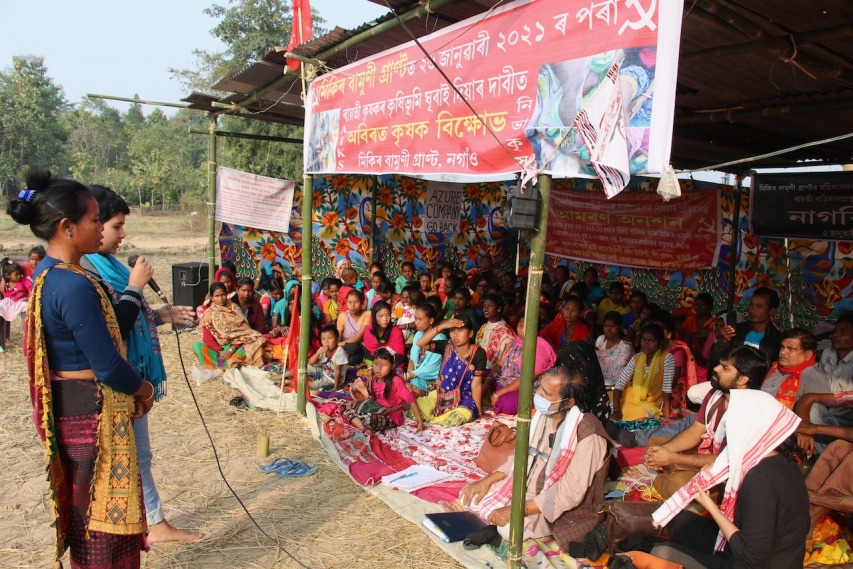
In Assam, the land of the Brahmaputra, tea gardens, and vibrant indigenous cultures, a troubling pattern has emerged. The state’s push for development—solar plants, thermal power stations, cement factories, and urban restoration—has come at a devastating cost to its original inhabitants, the Khilonjiya. These indigenous communities, including Karbi, Bodo, Dimasa, and Adivasi, are being displaced from their ancestral lands to make way for wealthy industrialists and corporate giants like Adani. While rich outsiders are welcomed with open arms, the Khilonjiya bear the burden of uprooted lives, lost livelihoods, and erased heritage. This blog chronicles few recent land disputes, exposing the stark inequality between corporate gain and indigenous loss.

The Khilonjiya’s Burden: A Timeline of Displacement

Mikir Bamuni Grant, Nagaon – October 2020

In Nagaon’s Samaguri Circle, Khilonjiya Karbi and Adivasi tenant farmers were evicted from 276 bighas (91 acres) of farmland to accommodate a 15 MW solar plant by Azure Power Forty Pvt Ltd. With just one day’s notice in March 2020, their rights under the Assam Tenancy Act (1971) were ignored. On October 8, 2020, bulldozers destroyed crops, backed by police and CRPF. Fourteen villagers were arrested, and women faced violence, with one miscarriage linked to police brutality. The land, once sustaining generations, now serves corporate interests

Impact: Khilonjiya farmers were rendered landless, their heritage erased for a private firm’s profit.

Silsako Beel, Guwahati – May 2022 to June 2025

In Guwahati’s Silsako Beel, a vital wetland, over 1,000 Khilonjiya Assamese families were evicted in phases (May 2022, February and September 2023) to restore ~350–800 bighas for flood management. By April 2025, 1,203 homes were demolished, and in May–June 2025, institutions like Ginger Hotel were cleared, signaling urban development favoring elite interests. Promised compensation (₹10 lakh for RCC houses, ₹5 lakh for Assam-type, ₹1 lakh for kutcha) reached only ~550 families by June 2025 due to bureaucratic hurdles. A magisterial probe is investigating fairness, but Khilonjiya voices remain sidelined.

Impact: Indigenous families face displacement and uncertainty, while urban elites benefit from “restored” spaces.

Kaziranga Animal Corridors, Nagaon & Golaghat – February 2022

Khilonjiya settlers in Kaziranga’s animal corridors (e.g., Amguri, Harmati) received eviction notices in 2022 to protect wildlife, a move prioritizing conservation over people. Many, displaced earlier by erosion, protested, demanding justice. A 2017 eviction saw two Khilonjiya protesters killed by police, with ~₹15 crore later paid as compensation.

Impact: Khilonjiya families were sacrificed for ecological goals, while tourism benefits outsiders.

Rampur Dorabeel, Kamrup – April–May 2025

In Kamrup, 150 bighas of Khilonjiya grazing land near Dorabeel wetland was proposed for a logistics park by M/S New Kolkata International Development Pvt Ltd in April 2025. Supporting ~30,000 residents, including 3,000+ livestock-rearing families and 2,000 fishers, the land is central to festivals like Suwari and Magh Bihu. On May 18, ~300 villagers formed the Dorabeel Grazing Field Protection Committee to resist, citing risks to 200+ bird species and river dolphins.

Impact: Khilonjiya livelihoods and culture face erasure for a corporate park benefiting external investors.

Parbatjhora, Kokrajhar (BTAD) – May–June 2025

In the Bodoland Territorial Area District, ~3,600 bighas of Khilonjiya Bodo land in Parbatjhora was allotted for a 1,800 MW thermal power plant by Adani and APDCL, despite Forest Rights Act recognition. Protests led by the Bodoland Tribal Protection Forum on May 18, 2025, decried health risks and rights violations. BTR CEM Pramod Boro claimed on June 16 that issues are being addressed, but Khilonjiya resistance persists.

Impact: Over 150 Bodo families risk losing ancestral lands to a billionaire’s project.

Dima Hasao, Umrangso – June 2025

In Dima Hasao, ~9,000 bighas of Khilonjiya land were proposed for Adani’s Mahabal Cement Pvt. Ltd. mega cement plant, bypassing Sixth Schedule protections. The National Commission for Scheduled Tribes issued a notice on June 17, 2025, after an Indigenous Peoples Party petition flagged risks to 14,000+ Karbi, Dimasa, Naga, and Adivasi families. Limestone mining tenders without consultation fueled protests.

Impact: Khilonjiya tribes face displacement for Adani’s profit, threatening ecosystems and rights.

Goalpara, Rakhyasini Pahar – June 2025

In Goalpara, an eviction drive was planned at Rakhyasini Pahar, possibly for wetland development, affecting Khilonjiya families. An X post suggested a link to the Hasila Beel operation, but details are unclear, and the query’s mention of 68 families in Guwahati may be a misattribution.

Impact: Potential displacement of Khilonjiya families for unspecified development favoring external interests.

The Injustice: Khilonjiya vs. Industrialists

The Khilonjiya, Assam’s soul, are being pushed out to welcome industrialists like Adani, whose projects—cement plants in Dima Hasao, thermal plants in BTAD—promise wealth for a few. Over 1,000 families lost homes in Silsako, 14,000 face risks in Dima Hasao, and 30,000 in Rampur stand to lose livelihoods. Environmental damage is staggering: Dorabeel’s wetland risks losing 200+ bird species; mining in Umrangso threatens ecosystems. Cultural heritage—Bodo traditions, Assamese festivals—is eroded, while legal protections like the Sixth Schedule and Forest Rights Act are ignored.
Deaths are rare but tragic. In Mikir Bamuni, a miscarriage followed police violence. In Kaziranga (2017), two Khilonjiya were killed by police, a chilling precedent. Meanwhile, industrialists face no such burdens, handed Khilonjiya lands with state support, bypassing Free, Prior, and Informed Consent.

Resistance and Hope

Khilonjiya communities are fighting back. The Dorabeel Committee, Bodoland Protection Forum, and Indigenous Peoples Party lead protests, from Guwahati’s streets to Dima Hasao’s hills. The canceled Karbi Anglong solar project (2025) proves resistance works. Yet, the state’s bias toward corporates persists, demanding urgent reform.

Assam’s Khilonjiya deserve to thrive on their lands, not be displaced for corporate greed. Let’s stand with them to reclaim justice.

Author info

AT News's picture

Assam Times Staff. editor@assamtimes.org

Add new comment

Other Contents by Author

The Assam Pradesh Congress Committee on Friday launched the nationwide “Save MGNREGA Movement” in the state, opposing the Modi-led NDA government’s move to amend the MGNREGA Act and introduce a new law under the name “VB-G RAM G”. As part of the first phase of the agitation, press conferences were held simultaneously at district headquarters across Assam, including Kamrup Metropolitan, Sonitpur, Lakhimpur, Dhemaji, Tinsukia, Dibrugarh, Charaideu, Hailakandi, Darrang and Baksa. District Congress Committee presidents and senior party leaders addressed the media. In Guwahati, senior Pradesh Congress spokespersons Kushal Sharma, Rupak Das and Anita Devi addressed the press at the...
A strong call to unite the indigenous communities of Northeast India on a common platform was made at a roundtable discussion held on January 6 to mark the 21st death anniversary of noted nationalist leader Nibaran Bora. The discussion, titled “Crisis of Indigenous Peoples of Northeast India and Its Solutions”, resolved to carry forward Bora’s vision and ideology for safeguarding indigenous identity and rights. The meeting was attended by representatives of several indigenous organisations from Assam and other Northeastern states. Uncompromising nationalist leader Hasibur Rahman, a close associate of the late leader, delivered the keynote address, highlighting the growing threat to the...
Amid escalating political unrest ahead of its national elections scheduled for February 12, 2026, Bangladesh has recorded the killing of journalist Rana Pratap Bairagi, who has become the first journalist worldwide to be murdered this year. The global media safety and rights organisation Press Emblem Campaign (PEC) has strongly condemned the killing and demanded a thorough investigation to bring the perpetrators to justice. According to local media reports, Bairagi (45), a resident of Arua village in the Jessore region of southern Bangladesh, was fatally shot in the head by three assailants on January 5, 2026. The editor of the Bengali daily Dainik BD Khabar was found dead at Kopalia...
In a major crackdown on terror networks, a special NIA court in Guwahati has convicted Md. Kamruj Zaman, a key accused in a Hizb-ul-Mujahideen (HM) terror conspiracy case, and sentenced him to life imprisonment. Zaman, also known as Dr Hurairah and Kamaruddin, was awarded life imprisonment under Section 18 of the Unlawful Activities (Prevention) Act (UAPA), along with two additional sentences of five years’ simple imprisonment under other UAPA provisions. All sentences will run concurrently. The court also imposed fines in each case. The case relates to a 2017–18 conspiracy to set up an HM terror module in Assam to carry out terrorist activities and spread fear. NIA investigations...
An eerie silence is prevailing in Karbi Anglong and West Karbi Anglong districts following the death of two people belonging to different communities amid growing demand to evict the non tribals from the hills districts on Tuesday. Mobile internet has been suspended and the authority has imposed some restrictions on public gatherings to ensure peace and tranquility in the tribal dominated hills districts. Security forces are patrolling on the streets in the vulnerable areas to avert any untoward incident. But the tribal leaders and their followers have blamed it all on the government for allowing the non tribals to settle there which is contrary to the laid down rules. " We are...
Tension gripped West Karbi Anglong district for a second consecutive day on Tuesday as clashes between protesters and security forces in Kheroni area left two people dead and over 45 injured, including 38 police personnel. The deceased have been identified as a differently-abled youth from the Karbi community, who succumbed during police action to disperse agitators, and another individual who died in arson attacks on shops in Kheroni market. Reports indicate the violence involved stone-pelting, use of crude bombs, arrows, and bows by mobs, prompting police to resort to lathi-charge, tear gas, and blank firing. The unrest stems from long-standing demands by Karbi organisations for the...
The hills of West Karbi Anglong district in Assam witnessed a dramatic eruption of violence this week, underscoring deep frustrations over land rights and perceived governmental inconsistency. On December 22, 2025, protesters demanding the eviction of alleged encroachers from protected tribal grazing reserves torched the ancestral home of Karbi Anglong Autonomous Council (KAAC) Chief Executive Member Tuliram Ronghang in Dongkamukam and set fire to several shops in Kheroni Bazaar. The next day, despite prohibitory orders under Section 163 of the Bharatiya Nagarik Suraksha Sanhita (BNSS), clashes between opposing groups led to stone-pelting, injuring several people, including protesters,...
New Delhi: Senior journalist Sangeeta Barooah Pisharoty has created history by becoming the first woman to be elected President of the Press Club of India (PCI), marking a significant milestone in the institution’s long-standing legacy. Her election is being widely hailed as a landmark moment for gender representation and leadership in Indian journalism. A respected name in the profession, Pisharoty is known for her incisive reporting, editorial leadership and long-standing commitment to press freedom, ethical journalism and the welfare of media professionals. Over the years, she has earned wide credibility for her work on politics, governance and social issues. The Press Club of...
A two-day ‘People’s Consultation on Strengthening Humanitarian Response and Climate Resilience in the Brahmaputra Basin’ concluded today at Hotel Clubway Grand, Jorhat, with the adoption of the People’s Declaration for a Resilient Brahmaputra Basin. The event was organised by the North-East Affected Area Development Society (NEADS) in collaboration with the Inter Agency Group (IAG) of Assam and various local humanitarian civil society actors from across the Brahmaputra valley, with support from Start Network. The consultation brought together humanitarian practitioners, climate workers, community leaders, civil society organisations, youth groups and women’s collectives to deliberate on...
Guwahati: Curtains came down on the 9th Chalachitram National Film Festival at the Jyoti Chitraban premises in Kahilipara on 30 November 2025, as distinguished guests at the closing ceremony handed over awards, certificates, and cash prizes to the winning filmmakers in the presence of eminent film personalities, emerging director-producers and cine-goers. Organized by Chalachitram, a subsidiary of Vishwa Samvad Kendra-Assam, the two-day CNFF-25 showcased over 30 short features and documentaries across competitive and screening categories. ‘Koli’, directed by Jyotirmoy Mazumder, was adjudged the best short feature in the Northeast India category, while ‘Joba’, directed by Indira Baikerikar,...