Skip to content Skip to navigation

GIZ report showing impact of Covid-19 on women-led businesses

The Covid-19 crisis in India has posed severe challenges to small and growing businesses in the country, widening the pre-existing gender gaps and diminishing considerable developments achieved within the women entrepreneurship ecosystem in the past decades.

In a bid to shed light on the unique and disproportionate impact of the pandemic on women-led businesses, GIZ has recently come out with a detailed report. The report titled “Women Entrepreneurs’ Resilience in Times of Covid-19” was based on GIZ’s Project Her&Now.  The Her&Now project is implemented by GIZ (Deutsche Gesellschaft für Internationale Zusammenarbeit) on behalf of the German Federal Ministry for Economic Cooperation and Development (BMZ) and  the Ministry of Skill Development and Entrepreneurship (MSDE), Government of India.

The findings of the report will be based on a study conducted in December 2020. The data will be collated based on interviews of 211 women entrepreneurs operating across a diverse field of sectors.

Speaking about the report, Project Head Ullas Marar says says, “Given that the pandemic is far from being over and there are high possibilities we may have to tackle a third wave and subsequent waves in the near future, it has become imperative to understand the ways in which women-led enterprises (as well as the women entrepreneurs themselves) responded to the pandemic when it began, because we believe a lot of lessons and learnings lie there."

"Keeping that in mind, we have prepared, and are now glad to release the report -- “Women Entrepreneurs’ Resilience in Times of Covid-19” – which we believe will be of great help for the key stakeholders in deriving best practices, learnings and opportunities for the wider ecosystem of women entrepreneurship in India", he added.

The report comprises three main sections: 

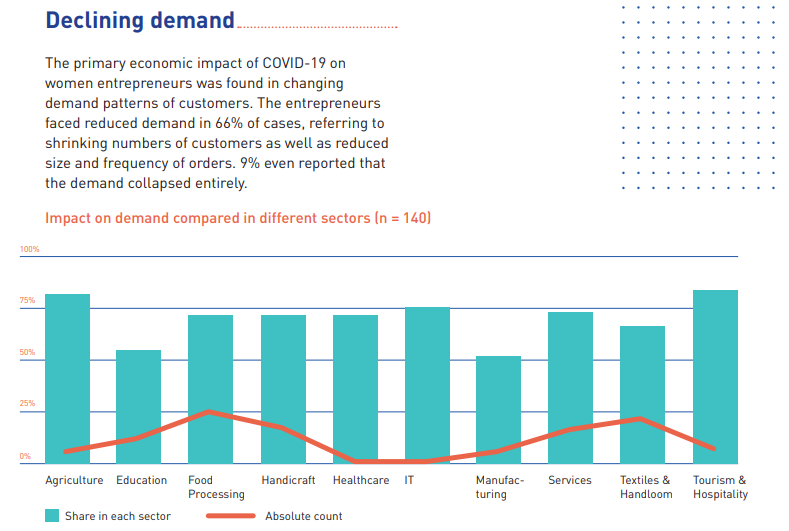
Impact of Covid-19 on women entrepreneurs: This section reveals that for most of the women entrepreneurs, their customer demand was being most affected in the aftermath of the pandemic, followed by issues relating to working capital and operational processes. Several entrepreneurs also struggled with accessing the marketplace, retaining employees and receiving supplies in time. A smaller share of the respondents experienced negative impacts relating to inventory.

Responsive measures by women entrepreneurs: This section highlights the key measures that women entrepreneurs took to counter operational disruptions, such as: efforts to market digitally, diversifying distribution channels, adjusting the product/service offering, re-adapting operations or revising the financial model, investing in business development, optimizing the supply chain, revising the pricing strategies, among others. By using either a few or most of these measures, many among the interviewed entrepreneurs were able to turn the Covid-19 induced challenges within their business environment into opportunities, reveals the report.

Conclusion: This section contains six important conclusions that can be drawn from the findings of the report and attempts to outline the optimal way forward for the women’s entrepreneurship ecosystem in India. 

Add new comment

Other Contents by Author

The number of journalists killed worldwide has surged dramatically in the first half of 2025, according to the Press Emblem Campaign (PEC). Since January, 86 media workers have been killed across 26 countries, marking a 16% increase compared to the same period last year. Gaza: Epicenter of the Crisis The ongoing conflict in Gaza is the primary driver behind this spike. At least 31 Palestinian journalists were killed in six months by the Israeli army, accounting for more than a third of the global toll. “The Israeli government is directly responsible for this tragedy, which targets civilians reporting on the situation in Gaza. The Israeli soldiers involved in these war crimes must...
Guwahati: – A transformative capacity-building workshop, “Learning from the Land: Participatory Knowledge Harvest from Assam and Meghalaya,” was held at Tata Institute of Social Sciences (TISS), Guwahati Off-Campus, on Friday, June 27, 2025. Organized by TISS in collaboration with UNDP-SGP, the event brought together over 50 NGOs from Assam and Meghalaya to exchange grassroots knowledge and strategies for sustainable land use, agroecological practices, and environmental conservation. The workshop aimed to empower local communities by enhancing skills in biodiversity conservation, land restoration, rural development, sustainability, and climate change adaptation. Prof. Jagannath Ambagudia...
Guwahati: The Assam Pradesh Congress Committee (APCC) has accused the BJP-led state government under Chief Minister Himanta Biswa Sarma of driving tea garden workers into a severe health crisis, with the average worker’s body weight dropping below 50 kg due to malnutrition and anemia. In a press conference on Wednesday at Rajiv Bhawan, APCC Working President Roselina Tirkey, joined by tea tribe leaders Raju Sahu, Etowa Munda, and Pranjal Ghatowar, condemned the government for neglecting workers’ welfare and plotting to dismantle Assam’s tea industry. Raju Sahu emphasized the alarming health decline, stating that malnutrition and anemia have rendered many tea workers unfit to donate blood...
In Assam, the land of the Brahmaputra, tea gardens, and vibrant indigenous cultures, a troubling pattern has emerged. The state’s push for development—solar plants, thermal power stations, cement factories, and urban restoration—has come at a devastating cost to its original inhabitants, the Khilonjiya. These indigenous communities, including Karbi, Bodo, Dimasa, and Adivasi, are being displaced from their ancestral lands to make way for wealthy industrialists and corporate giants like Adani. While rich outsiders are welcomed with open arms, the Khilonjiya bear the burden of uprooted lives, lost livelihoods, and erased heritage. This blog chronicles few recent land disputes, exposing the...
Guwahati: Expressing concern over the Sivasagar crude-oil well gas leakage in the last few days, a northeast India based forum of graduate engineers have urged both Oil and Natural Gas Corporation (ONGC) and Oil India Limited (OIL) to come clear about the so-called ‘abandoned’ wells, which have the potential to harm human life, property and environment, as the concerned private parties operating such wells often do not come forward to take responsibility.  All Assam Engineers Association (AAEA), in a statement, also appealed to the Union government in New Delhi to hold the concerned ONGC/OIL  officials accountable for any disaster at an oil or gas well after having declared it '...
On May 26, 2025, Gaurav Gogoi, a three-time MP and son of former Chief Minister Tarun Gogoi, was appointed President of the Assam Pradesh Congress Committee (APCC). His appointment marked a generational shift in Assam’s Congress leadership and was seen as a strategic move to reinvigorate the party ahead of the 2026 Assembly elections. Gogoi’s clean image, recent Lok Sabha victory from Jorhat by a margin of 1.44 lakh votes, and appeal among youth positioned him as a serious contender against Chief Minister Himanta Biswa Sarma. Gogoi's appointment replaces Bhupen Kumar Borah and is backed by a team of working presidents including Jakir Hussain Sikdar, Roselina Tirkey, and Pradip Sarkar....
Assam, a state rich in natural resources, has faced recurring nightmares from its oil and gas industry, with devastating impacts on its people and environment. The Baghjan gas leak of 2020, operated by Oil India Limited (OIL), and the ongoing ONGC gas leak in Sivasagar (June 2025), operated by Oil and Natural Gas Corporation (ONGC), are stark reminders of the human cost of industrial mishaps. This blog post delves into the profound effects on common people in both incidents, compares their timelines for containment, and highlights the urgency of addressing systemic issues to prevent future tragedies. The Baghjan Gas Leak (2020): A 173-Day Ordeal On May 27, 2020, a catastrophic blowout...
The Tai Ahom Indigenous Rights Forum convened its Executive Committee Meeting today at the Tai Educational and Cultural Centre in Boiragimoth, Dibrugarh. The meeting was presided over by Chow Sanjib Rajkonwar, President of the Forum, and saw the active participation of executive members, advisors, and regional representatives from across Assam. The gathering served as a vital platform to deliberate on the strategic direction of the Forum, with a special focus on aligning the movement for Tai Ahom rights with the principles enshrined in the United Nations Declaration on the Rights of Indigenous Peoples (UNDRIP) 2007. The Forum reaffirmed its unwavering commitment to advocating for the...
New Delhi: The Supreme Court on Monday declined to accept a plea by All BTC Minority Students’ Union (ABMSU) raising concerns over the state’s “indiscriminate” move to detain and deport suspected foreigners. A Bench of the top court comprising Justices Sanjay Karol and Satish Chandra Sharma asked ABMSU to move the the Gauhati High Court. In writ petition, the organisation questioned the growing pattern of deportations by the Assam Government through informal “push back” mechanisms, without any judicial oversight or adherence to the safeguards envisaged by the Constitution.
Guwahati: Rains in Assam have stopped. But the water level of the Brahmaputra and its tributaries have yet to recede rendering over 4 lakh people homeless in as many as 17 districts of the state. In Cachar district alone over 1 lakh been have been rendered homeless because of the 4 day long incessant rains. Sribhumi district also witnessed no less misery of 90,000 people to be followed by Nagaon district where over 65,000 people have been affected. A huge area of Lakhimpur district has come under the surging water after the Ranganadi dam released its excess water pushing thousands of families in brimful misery. Assam Chief Minister Himanta Biswa Sarma is on a stock taking visit to the...