

Kaziranga, Development and Dissent: When Does a Protest Become a Threat?
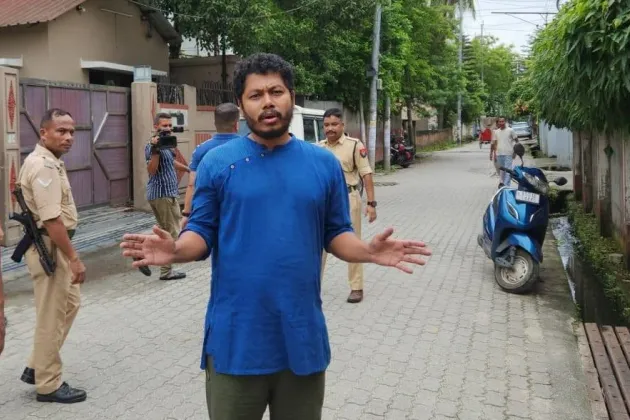

The controversy over a proposed luxury resort near Kaziranga is no longer only about a tourism project.
It has become a larger test of how Assam pursues development, how disputes over land are handled, how citizens can challenge government decisions—and how the State responds when those challenges turn into organised protest.
At the centre is Pranab Doley , convenor of the Greater Kaziranga Land and Human Rights Protection Committee, who has been a prominent opponent of the proposed project at Inglay Pathar, also reported as Ingle Pathar, in the Hatikhuli area near Kaziranga .
The Assam government has defended high-end tourism as a source of economic activity and employment. Opponents, meanwhile, have raised questions over land rights, the claims of local families and the ecological implications of development in the wider Kaziranga landscape.
The dispute then moved from public opposition to police action.
A case, Bokakhat Police Station Case No. 108/2026 , was registered in connection with events surrounding a June 28 gathering and protest. According to police accounts reported by the media, the case includes allegations involving unlawful assembly, rioting, criminal trespass, obstruction of public servants, criminal intimidation and other offences. Police have alleged that protesters entered the project site, removed survey materials, threatened workers and that a woman police officer was injured. These are police allegations and remain subject to investigation and judicial scrutiny.
Doley was subsequently arrested in connection with the case.
He and others arrested in the matter were granted bail by the Golaghat sessions court on July 29. The following day, the Assam government invoked the National Security Act, 1980 , resulting in his continued detention.
That sequence raises a legitimate public-interest question:
What was the basis for moving from ordinary criminal proceedings to preventive detention?
A project—and the questions beneath it
The proposed development has been described in official and media accounts as a luxury or five-star resort project near Kaziranga. According to reporting based on project and company records, the Assam Tourism Development Corporation signed an MoU with the Saraf group in 2023 for a proposed investment in a luxury resort project, while subsequent company documents referred to rights over leased land near Kaziranga. The exact branding and operating arrangements require care: Hyatt has reportedly stated that it has not entered into an agreement to brand or operate the proposed project at Inglay Pathar/Hathikuli.
The land dispute is equally contested.
The Assam government has maintained that the land belongs to the State and has earmarked portions for the proposed Tea Tribes Museum and hotel project. Some Adivasi families, however, have said they cultivated the land for generations and possess documents supporting their claims. These competing claims have led to protests and legal disputes.
That makes the underlying records crucial.
What is the exact ownership and classification of the land? Who possessed or used it? What process led to its earmarking for development? What claims were raised by local families, and how were those claims decided?
These are questions of public record, not merely political argument.
Assam Times asks the government:
Will the Assam government place the complete land and project record relating to the proposed resort before the public?
If the land decisions and project approvals were lawful, the documentary basis for them should withstand public scrutiny.
Development for whom?
The government's case for tourism-led development also deserves to be heard.
Kaziranga is one of Assam's most important tourism destinations. A major hospitality project can potentially generate employment, business for local suppliers and opportunities for transport operators, guides and other tourism-linked services.
But public interest requires another question:
Who receives the benefits, and who bears the costs?
Where families claim long-term possession, cultivation or customary rights over land, those claims must be examined according to the law and available records. Where the government disputes those claims, it should explain the legal basis of its position.
Calling a project "development" does not remove the need to answer questions about land, consultation and due process.
Nor does opposing a project establish that every action taken in the name of protest was lawful.
Both questions must be examined separately.
Kaziranga is more than a line on a map
There is also the question of location.
Kaziranga's ecological importance extends beyond the core image of the national park. The wider landscape includes floodplains, adjoining areas and wildlife movement routes that have long been central to debates over conservation and development.
That does not mean that every development project near Kaziranga is illegal or environmentally damaging.
But it does require a clear answer:
What studies, statutory assessments and regulatory processes were relied upon before selecting this site for a major tourism project?
If the site lies outside a prohibited or restricted zone, the government can say so. If statutory approvals or environmental clearances are required, the relevant documents should establish that they were obtained. If authorities concluded that the project would not cause unacceptable environmental harm, the basis of that conclusion should be open to scrutiny.
Kaziranga is too important for either side to substitute evidence with slogans.
From protest to criminal case
This is where the reporting must be particularly careful.
Doley was not publicly accused merely of holding an opinion against the project . The police case, as reported, contains allegations of specific acts during the June 28 events.
Those allegations have to be tested.
The right to protest does not protect violence, assault, destruction of property or other criminal conduct. If evidence establishes that such offences were committed, those responsible can be investigated and prosecuted.
But the opposite principle is equally important:
Opposition to a government project, by itself, is not the same thing as proof of criminal conduct.
The public therefore needs answers to two separate questions:
What exactly happened during the protest?
And:
What evidence specifically connects each accused person to the offences alleged?
Those answers should ultimately come from the FIR, investigation records, available video and other evidence, and the courts—not from political labels.
Bail—and then preventive detention
The sequence after Doley's arrest has brought the controversy under wider scrutiny.
He was granted bail by the Golaghat sessions court. The following day, the State invoked the NSA. The reported detention order stated that the government was satisfied that his activities were allegedly prejudicial to the maintenance of public order and the security of the State, and that there was a real and imminent possibility of such activities continuing if he were released.
According to reporting based on the government communication and the grounds relied upon, the NSA action was based on allegations and material extending beyond the single June protest.
That distinction is important.
Assam Times is not claiming that Pranab Doley was detained under the NSA simply because he opposed the proposed resort.
The State's reported grounds must be examined on their own terms.
But the public sequence is also clear: Doley, a prominent opponent of the project, was arrested in connection with the protest-related case, granted bail and then preventively detained under the NSA.
That creates a legitimate question for the government:
What specific material persuaded the State that ordinary criminal proceedings and the conditions imposed by the court were insufficient, making preventive detention necessary?
The answer matters because preventive detention is among the most serious powers available to the executive.
The questions for the government
Assam Times is putting these questions to the Assam government and the authorities concerned:
What is the complete legal and administrative history of the land earmarked for the proposed project?
What records establish its ownership, classification and present status?
What process preceded its allotment, lease or earmarking for tourism development?
What happened to the competing claims of families who say they had cultivated or possessed the land?
What statutory environmental or regulatory assessments were applicable, and what did they conclude?
What evidence does the police rely upon regarding the alleged offences during the June 28 protest?
What material specifically links Pranab Doley to those alleged acts?
And after bail:
What were the specific grounds for invoking the NSA, and why did the government consider preventive detention necessary?
These are not questions against development.
They are questions that should accompany the exercise of public power.
The larger question
The Supreme Court has recently dealt with allegations concerning police action against protesters in a separate case involving the CJP-led protests. That matter is factually and legally different from the Kaziranga case, and Assam Times draws no comparison between the allegations in the two cases.
The principle, however, is larger than either dispute.
A democracy must distinguish between peaceful dissent and unlawful conduct . The State has a duty to act against genuine violence and threats to public order. At the same time, citizens have constitutional freedoms to express disagreement and participate in lawful protest.
The difficult question in every disputed case is whether that line has been properly drawn—and whether those exercising coercive power can demonstrate the evidence on which they acted.
That question becomes especially important when the dispute concerns development projects backed by the State.
The proposed resort may proceed, change or face further legal and administrative scrutiny. Land claims will have to be judged on records and law. The allegations against protesters must also be tested through due process.
No activist is above the law because he claims to be protesting for a cause.
But public authorities are not above scrutiny because they invoke development in support of a project.
If citizens believe a project threatens their land, livelihood, community or environment, can they stand up and say no?
If their opposition remains peaceful and within the law, where does their right to dissent end?
And what must the State demonstrate before that dissent is treated as a threat to public order or security?
Those are questions Assam Times puts to the people exercising power.
Comments (0)
No comments yet. Be the first to share your thoughts.
Leave a Comment