

Flash floods from Nagaland hills devastate Upper Assam, rail link to Dibrugarh disrupted as rescue operations intensify
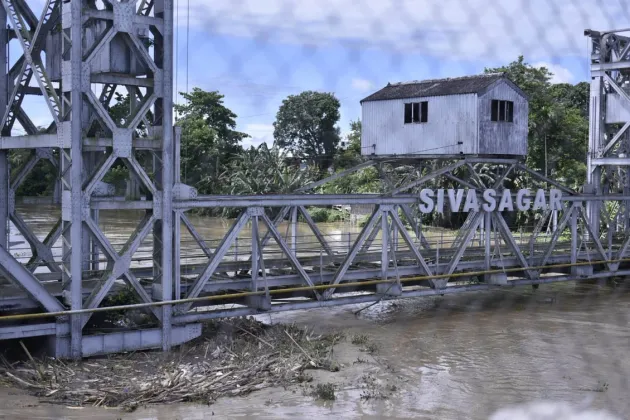

GUWAHATI, July 21, 2026 — Upper Assam is facing one of its worst flash flood emergencies in recent years after incessant rainfall over the Nagaland hills sent massive volumes of water cascading into the plains, inundating vast areas of Sivasagar, Charaideo and Jorhat districts, disrupting rail connectivity, damaging tea estates and forcing thousands of families to flee their homes.
Unlike the annual floods caused by the overflowing Brahmaputra, the present crisis has been triggered largely by sudden surges in hill-fed rivers and streams originating in Nagaland. The fast-moving floodwaters entered low-lying areas with little warning, submerging villages, roads, agricultural land and public infrastructure across Upper Assam.
The flood situation has deteriorated rapidly since Sunday, prompting the Assam government to place the Indian Army and the Indian Air Force on standby while deploying senior ministers to oversee rescue and relief operations in the worst-affected districts.
According to official estimates, more than 3.6 lakh people have been affected across 15 districts, with Sivasagar, Charaideo and Jorhat emerging as the worst-hit areas. Nazira subdivision alone has reported over 57,000 affected residents, while several tea estates remain under water, raising concerns over crop losses and the livelihoods of thousands of tea workers.
The sudden influx of water from the Nagaland catchments overwhelmed rivers including the Dikhow and several smaller hill streams, inundating large parts of Nazira, Amguri, Sonari, Mariani and adjoining areas. Residents described water entering homes within minutes during the early hours, leaving little time to move belongings or livestock to safety.
Videos and photographs circulating on social media showed submerged residential areas in Nazira, extensive flooding around Sonari, inundated markets and roads, and villages cut off from road communication. Local reports indicate that many families have taken shelter in temporary relief camps or on elevated roads and embankments after their homes went under water.
The floods have also severely disrupted transportation across Upper Assam. Northeast Frontier Railway suspended train movement on the flood-affected Simaluguri section after railway tracks and the station yard were submerged. As a result, rail connectivity between Dimapur and Dibrugarh has been severely affected, with more than 30 passenger and express trains either cancelled, diverted or short-terminated. Thousands of passengers were stranded before railway authorities arranged road transportation and alternative train services wherever possible.
Road connectivity has also suffered in several locations as floodwaters overtopped highways, district roads and rural communication networks, isolating many villages. The inundation has affected access to relief supplies in some remote localities.
The Assam government has assigned Cabinet ministers Ajanta Neog, Bimal Bora, Keshab Mahanta and Sushanta Borgohain to monitor rescue and relief operations in Sivasagar, Charaideo and Jorhat districts. State Disaster Response Force (SDRF), National Disaster Response Force (NDRF), district administration personnel and local volunteers have been conducting round-the-clock rescue operations using boats to evacuate stranded residents.
Chief Minister Himanta Biswa Sarma stated that the safety of affected people remains the government's highest priority and that all available resources have been mobilised for rescue, relief and rehabilitation. The Army and Air Force have been kept on standby should the situation require large-scale evacuation.
Meanwhile, concerns continue to emerge from several flood-hit villages regarding shortages of drinking water, food and fodder for livestock. Social media posts from affected residents and public representatives have highlighted extensive damage to houses, agricultural fields and domestic animals, while urging faster delivery of relief materials to isolated villages.
The tea industry has also suffered a major setback. Large stretches of tea plantations in Nazira, Amguri and adjoining areas remain submerged, disrupting estate operations and threatening crop production during a crucial period of the season.
Disaster management officials warn that the situation remains fluid as the flood in Upper Assam depends not only on local rainfall but also on continuing precipitation over the Nagaland hills. Additional heavy rainfall upstream could trigger fresh surges in the hill rivers flowing into Assam, prolonging the crisis even if rainfall decreases over the affected districts themselves.
The present disaster once again highlights the growing vulnerability of Upper Assam's foothill districts to extreme rainfall events originating outside the Brahmaputra basin. Experts have repeatedly pointed out that flash floods generated in neighbouring hill states require stronger inter-state hydrological monitoring, improved early-warning systems and coordinated basin-level flood management to minimise future losses.
As rescue operations continue and water levels fluctuate across the region, thousands of affected families remain dependent on emergency assistance while authorities race to restore transport links, provide relief and prevent further loss of life.
Comments (0)
No comments yet. Be the first to share your thoughts.
Leave a Comment