

Justice Ujjal Bhuyan stresses rule of law at GCU Foundation Day
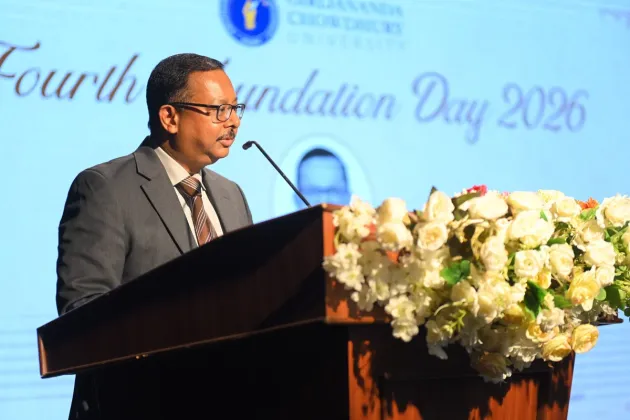

GUWAHATI, October 19, 2026 — Supreme Court judge Justice Ujjal Bhuyan on Saturday stressed that the executive cannot assume the judiciary’s role in determining guilt and awarding punishment, warning that such actions undermine the rule of law and constitutional safeguards.
Addressing the fourth Foundation Day celebration of Girijananda Chowdhury University (GCU) in Guwahati, Justice Bhuyan said the law must apply equally to everyone, regardless of social status, influence or position.
“No person, howsoever mighty or powerful, is above the law. It also means that no person, howsoever humble, is beneath the protection of law,” he said.
Referring to the Supreme Court’s observations on punitive demolitions, he questioned the legality of executive authorities imposing punishment without a trial before a competent court. He explained that investigation, prosecution and adjudication are separate stages, with investigating agencies collecting evidence, prosecutors presenting charges and courts determining guilt or innocence.
Allowing investigating agencies to act as prosecutors, judges and executioners would strike at the foundations of the justice system, he said, adding that checks and balances remained essential even after the enactment of the new criminal laws in 2023.
A key highlight of the event was the inauguration of a Legal Aid Clinic on the university campus by Justice Bhuyan. The facility is expected to promote legal awareness and improve access to legal assistance.
Universities must foster constitutional awareness
Justice Bhuyan called on educational institutions to nurture critical thinking, constitutional awareness and responsible citizenship. Education, he said, must equip students to question authority, assess evidence and engage in reasoned debate rather than merely accumulate information.
“A student who learns to respect evidence is less likely to succumb to superstitions. A student who learns to reason is less likely to be swayed by hatred or propaganda,” he said.
Describing teachers as the first custodians of the rule of law, he stressed the importance of ethical reasoning, independent judgment and respect for diversity. Universities must also help students distinguish between what is technically possible and what is ethically justified.
“Diversity is not a problem, but strength,” he said, advocating respect for differences and rejecting divisions based on identity.
Constitution and scientific temper
Referring to the landmark Kesavananda Bharati v. State of Kerala judgment of 1973, Justice Bhuyan discussed the basic structure doctrine, which prevents Parliament from using its amendment powers to destroy the Constitution’s essential features.
He identified parliamentary democracy, judicial independence, separation of powers, judicial review and the rule of law as key elements of the constitutional framework. He urged citizens to understand their rights and demand accountability from public authorities.
Justice Bhuyan also highlighted Article 51A of the Constitution, which calls upon citizens to develop scientific temper, humanism and a spirit of inquiry and reform.
Warning against the dangers of superstition, misinformation and unquestioning acceptance of claims, he said universities must encourage students to challenge unsupported assertions and distinguish verifiable evidence from false information.
Concluding his address, he urged educational institutions to prepare young people to safeguard constitutional freedoms and democratic values, emphasising that informed citizens must be able to disagree while respecting one another’s rights and dignity.
The programme was attended by Gauhati High Court judges Justice Kalyan Rai Surana and Justice Rajesh Mazumdar; Kamrup District and Sessions Judge Gautam Baruah; Bar Council of Assam chairman Chinmoy Chowdhury; and former Assam Advocate General Professor Dr Ramesh Chandra Borpatragohain. GCU Vice-Chancellor Kandarpa Das and Dr Niju Moni Das, associate professor, dean in-charge and head of the Centre for Legal Studies, were also present.
Comments (0)
No comments yet. Be the first to share your thoughts.
Leave a Comment