
Skip to content Skip to navigation

The First Indian Leader trying to Prevent Partition of India

x

Error message

  • Notice: Undefined index: DraggableCaptchaAnswer in draggable_captcha_generate_refresh() (line 197 of /home/assam1/web/assamtimes.org/public_html/sites/all/modules/draggable_captcha/draggable_captcha.module).
  • Notice: Undefined index: DraggableCaptchaCodes in draggable_captcha_generate_refresh() (line 197 of /home/assam1/web/assamtimes.org/public_html/sites/all/modules/draggable_captcha/draggable_captcha.module).
  • Notice: Trying to access array offset on value of type null in draggable_captcha_generate_refresh() (line 197 of /home/assam1/web/assamtimes.org/public_html/sites/all/modules/draggable_captcha/draggable_captcha.module).

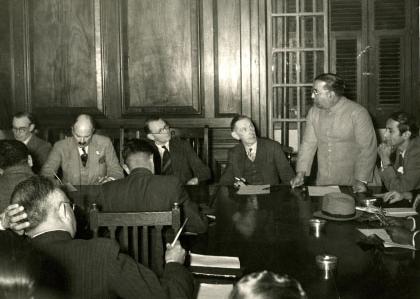
Please look at the 1946 photo from the London Parliamentary Archive --- the individual standing, with left face seen in the photograph, with clenched fists on the table, is Gopinath Bardoloi. Please look at the scare on the face of the Member of the British Cabinet Mission.


Partition of India in August 1947 is an unforgettable tragedy where a million innocent people lost their lives and belongings.


British Administration put up two plans, one after the other, for Partition of India. The first plan, known as "Cabinet Mission Plan" (AKA "Grouping Plan") was presented by a British Cabinet Mission in March 1946. One Indian leader, Gopinath Bardoloi, known as "Gopinath of Assam", thwarted that plan with help from Mahatma Gandhi. Some Indian leaders, led by Jawaharlal Nehru (who became very angry at "Gopinath of Assam") did not mind partition of India in order to grab political power.


A second plan to partition India was forwarded by Bengali leaders in April 1947 who wanted to dissect India to carve out an independent Bengal --- this ignonimous plan was known as "Suhrawardy-Sarat Bose Plan".


One year after the British Cabinet Mission Plan, the British Viceroy Lord Mountbatten, arrived India with the third proposal known as "Mountbatten Plan" in June -July 1947. Fully supported by Nehru, India was partioned on August 15, 1947 by the Mountbatten Plan. Subsequent communal riots claimed millions of lives and unimaginable, unforgettable suffering.


If this matter is discussed with a verified time-line, the truth will come out that "Gopinath of Assam" was the only Indian leader besides Mahatma Gandhi who stopped Partition of India ---- proving the true "Assamese Grit" that is needed by the Assamese again today for the survival of Assam.


Himendra Thakur
Boston, USA


Photo has been taken from this page.

Comments

Pallavi Barua's picture

Today, Assam has Nehru Stadium, Nehru Park, etc. These have been named after a person who didn't provide any helping hand to Gopinath Bordoloi when he was fighting against Assam being clubbed with erstwhile East Pakistan (now Bangladesh)in 1947. The only thing which mattered to Pt. Nehru was the Prime Minister's chair. On assumption of the office of the PM, Nehru thought of using Assam as a dumping yard for refugees from erstwhile East Bengal (now Bangladesh). Here is an excerpt from a letter which Nehru wrote to Gopinath Bordoloi, "...If Assam adopts an attitude of incapacity to solve the refugee problem, then the claims of Assam for financial help obviously suffer."
Ajoy Warisa's picture

How is assam different from bangladesh now? 38 years of infiltration - what is left of assam? when will New Delhi awake from its slumber?
Anwar A. Ansari's picture

By accepting the Cabinet Mission Plan unanimously and unconditionally, Jinnah and his Muslim League had drawn a curtain to all that had gone before. Then Indian National Congress gave its approval, not unanimous, And then, according to Abul Kalam Azad, happened something that changed the course of history - Nehru's repudiation of the agreement by declaring "we are unfettered by any agreement". By unanimously approving the Cabinet Mission Plan, Jinnah and his Muslim League had put a lid on everything past. I have read a lot of books and articles on the subject of 'Partition of India'. None, repeat none, carries this episode of Nehru's 10 July press conference. And all books and articles give quotations from Abul Kalam Mazda's 'India Wins Freedom'. Again, none, repeat none, gives the passages that I have given in my article, below. Why? Abul Kalam Azad, giving account of the A.I.C.C.'s passing the resolution to approve the Cabinet Mission Plan, says: "Now happened one of those unfortunate events which changed the course of history. On 10 July, Jawaharlal held a Press Conference in Bombay in which he made a statement which in normal circumstances might have passed almost unnoticed, but in the existing atmosphere of suspicion and hatred, set in train a most unfortunate series of consequences. Some Press representatives asked him whether with the passing of the Resolution by A.I.C.C., the Congress had accepted the Plan in toto, including the composition of the interim Government. "Jawaharlal stated in reply that Congress would enter the Constituent Assembly 'completely unfettered by agreements and free to meet all situations as they arise.' (Inverted comas of the author) "Press representatives further asked if this meant that the Cabinet Mission Plan could be modified. "Jawaharlal replied emphatically that the Congress had agreed only to participate in the Constituent Assembly and regarded itself free to change or modify the Cabinet Mission Plan as it thought best. "I must place on record that Jawaharlal's statement was wrong. It was not correct to say that Congress was free to modify the Plan as it pleased. ................................................................. These matters could not be changed unilaterally by Congress without the consent of other parties to the agreement. "The Working Committee felt that it faced a dilemma. On the one side, the prestige of the Congress President was at stake. On the other, the settlement ....... was in danger. To repudiate the President's statement would weaken the organization but to give up the Cabinet Mission Plan would ruin the country. Finally, we drafted a Resolution which made no reference to the Press Conference but reaffirmed the decision of the A.I.C.C. "His Excellency the Viceroy, with the approval of His Majesty's Government, has invited the President of the Congress to take proposals for the immediate formation of an interim Government and the President of the Congress has accepted the invitation. Pandit Jawaharlal Nehru will shortly visit New Delhi to discuss this proposal with His Excellency the Viceroy." A few passages further, Abul Kalam Azad says: My comments: Lord Wavell, the Viceroy, had earlier declared that whichever party first accepted the plan, would be invited to form the Interim Government. That gutless Viceroy went back on his promise and bypassing Jinnah in blatant deceit invited the President of the Congress instead to form the Interim Government, who had already repudiated the Cabinet Mission Plan and whose catalogue of mistakes had ruined the unity of India. The gutless, supine and myopic leadership of the Indian National Congress could not see woods from the trees and, in all lunacy, went on to pass a resolution which begins unashamedly by shoving all the blame on the Muslim League. They were so blinded by their selfish interest that they could not see the impending catastrophe by not calling a spade a spade and, as Abul Kalam Azad has recorded, completely omitted even the mention of the bone of contention: the notorious 10 July Nehru Press Conference. The imbecile leadership of Indian National Congress came out in full force to cover up the Himalayan blunder of Nehru rather than rectifying it, which blunder according to Azad changed the course of history (of India). What a farce! What a farce!! The display of lunacy did not stop there. Lord Wavell, in utter insanity, called upon Jawaharlal Nehru, who had repudiated the Cabinet Mission Plan agreement, to form the Interim Government of India. And then all those lunatics, Congress leadership, Wavell and all, went on to blame Mr. Jinnah for the partition. What hypocrisy! What hypocrisy!! It is not Jinnah who brought about the partition of India; it is the duo of the gutless, spineless, unashamed Jawaharlal Nehru and the self-opinionated, egoistic Lord Mountbatten (now in control) who brought about the partition and the destruction upon India. These two demagogues, Nehru and Mountbatten, preferred the ruination of the country over the false prestige of the Congress President. (It still remains an enigma that Nehru had earlier gone to Malaysia and met Mountbatten, the Supreme Commander. Mountbatten, a soldier in uniform on active war service, then made a momentous political statement of great significance by calling Nehru “the future Prime Minister of India”.) Going by the account of events given by Azad that changed the course of history, there is only one single reason of the disastrous partition of India: The display of Nehru's obnoxious & foul diplomacy at the time!!! And the Indian National Congress going along with it. Thus, united India was sacrificed at the altar of false prestige of the President of Indian National Congress. Events have proved Gopinath was a shortsighted man. Anwar Ansari, Harrow, Middlesex, England.
Himjyoti Talukdar's picture

Is somewhere mentioned that the person addressing the meeting is Gopinath Bordoloi? According to few sources He's Baba Saheb Ambedkar. Request author to clarify the issue with sources. 

Pages

Add new comment

Other Contents by Author

Over 300 youths marched through the streets of Sivasagar town on Wednesday to protest government failure to take action on the army jawan involved in the recent molestation in Demow. Baring their pants, the young protesters representing 22 organizations marched through the streets of the town. Later they held a meeting outside the Deputy Commissioner's office. They were joined by hundreds of bystanders. Then they were stopped from entering the DC's office premises by police personnel who set up barricades. The organizations include ATASU, TMPK, AASU, AJYCP, KMSS) and Brihattar Asomiya Parishad. They said that they would continue the agitation programme till all till the demands are met.
The CPI(M) has accused Dispur of a huge failure in firmly dealing with the situation to stop escalating violence in Assam. It asked the government to take immediate steps to restore law and order. In a statement, the called the failure a monumental one of the Congress-led Government.
Delhi on Wednesday directed Dispur to nab the ring leaders involved in ethnic clash in BTAD areas. Further, it ruled out a Bangladeshi hand in the entire episode where 42 people lost their lives. According to Union Home Secretary R K Singh, 2,000 central security personnel have been deputed to guard Guwahati-bound trains and railway tracks which were disrupted.Singh said that the international border is sealed and that it was impossible for any intruders to foment trouble from across the border. Around 2,500 paramilitary personnel have reached Assam to assist the local administration.
In a bid to bring the situation under control in Kokrajahr, Chirang and Dhubri, the Centre is all prepared to talk to the leaders of the both warring factions. According t sources, two senior home ministry officials are all set to hold talks with the Bodo leaders and minority leaders on Wednesday or Thursday in Dhubri and Kokrajhar. Around 1,500 more paramilitary personnel have been rushed in with orders to shoot at sight.
Around 1,50,000 people fled their homes at the height of the group clash after it erupted on Friday last. The displaced people, mostly, have taken shelter in government schools and buildings. Over 10,000 people in these trouble torn districts have escaped to neighbouring West Bengal. Trucks carrying essential supplies are remaining stranded halfway. In Guwahati, Chief Minister Tarun Gogoi held a meeting of government officials, including the chief secretary, to monitor the situation.
In the continuing orgy of violence, 6 more people were killed taking the death toll to 41 in Kokrajhar and Chirang districts on Wednesday. Kokrajhar district administration has relaxed curfew from 8 in the morning to 12 noon. But only to be reimposed indefinitely. Curfew has also been extended indefinitely in Chirang and Dhubri districts.With 13,000 troops, army staged flag march in Kokrajhar, Chirang, Dhubri and Bongaigaon district in presence of a magistrate.
An all party delegation of the Assam legislative assembly is on a stock taking visit to Kokrajhar on Wednesday.Indefinite curfew is still in force in some parts of Dhubri and Chirang. Army and Para military forces have intensified patrolling in the violence hit districts. Union Home Secretary R.K. Singh had earlier said that he has been in continuous touch with the Chief Secretary and the Assam Director General of Police.
The orgy of violence ravaging three districts of lower Assam spreads to the Bengal border. Thousands of people from scores of villages are fleeing to safer places in West Bengal during the last couple of days. Around 1,500 more paramilitary personnel have been deployed in Kokrajhar, Chirang and Dhubri districts with shoot at sight orders. More than 1 lakh people have been displaced. These displaced people, mostly, shifted to 55 relief camps. The Army staged a flag march on Wednesday morning in Dhubri, Kokrajhar, Chirang and Bongaigaon, the first since violence began four days ago.
The Army on Wednesday began flag marches in a bid to ring the situation under control. Moreover, night curfew are still in force three days after it was clamped to control the situation. Tensions between Bodos and Muslims over control of land and settlements have been simmering for a long time. The violence has spread to 400 villages in the Bodoland Territorial Administered Districts.
Violence spreads diabolic tentacles in five lower Assam districts killing at least 38 besides displacing around 1 lakh people till Wednesday. Four more people were killed in two incidents of shoot outs in Chirang district taking up the death toll to 40. There are reports of fresh incidents in both the districts where hundreds of abandoned houses were burnt down in scores of villages in Kokrajhar, Chirang and Dhubri districts. It was learnt that Meghalaya governor RS Mushahary’s native village was also not spared.