
Skip to content Skip to navigation

Regional workshop on food sovereignty held

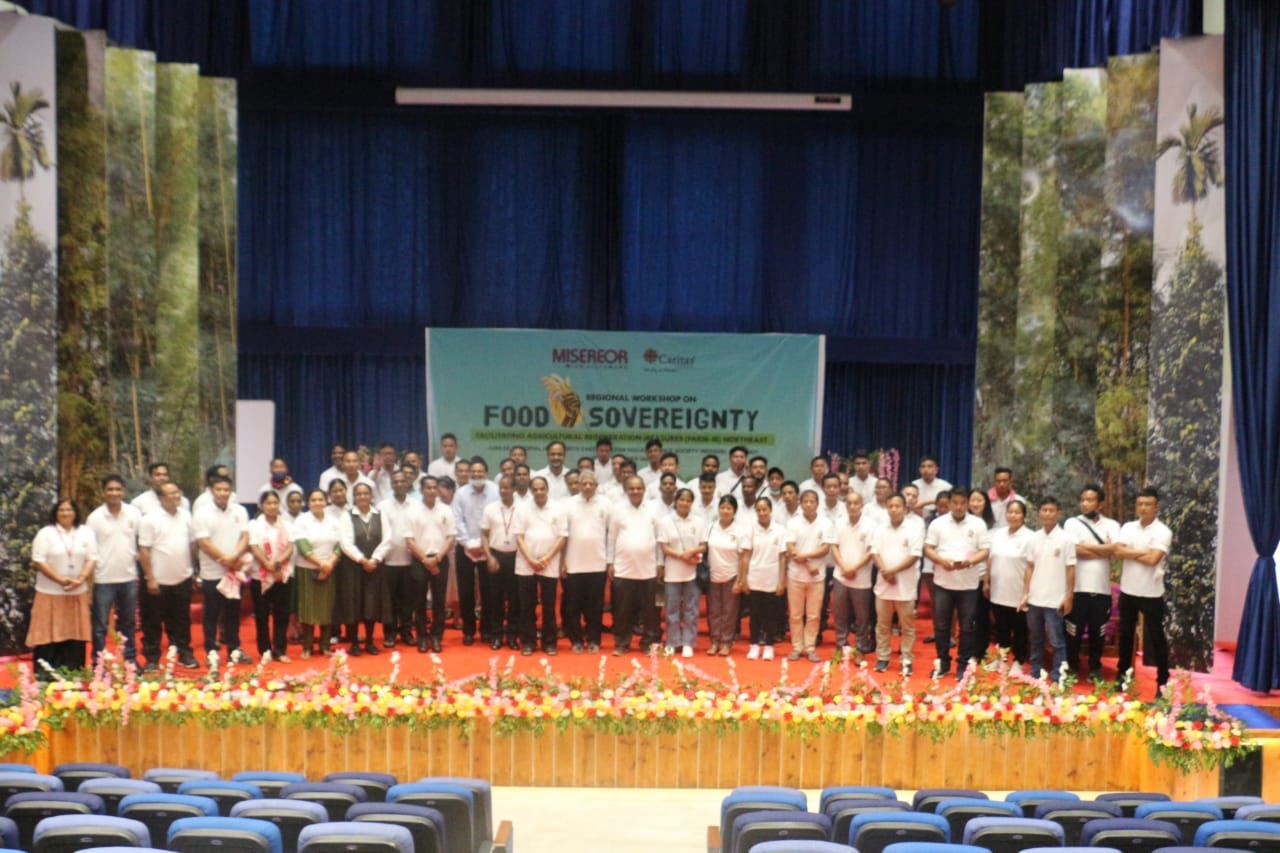
Guwahati: “My home is where my food is grown” was the talking point of two days regional workshop on Food Sovereignty concluded in Guwahati which was held on October 26 to 27 and organized by Caritas India at Silver Jubilee Memorial Conference Hall of Northeast Diocesan Social Service Societies, Guwahati. Altogether 76 participants of 16 partner organisations from all seven states participated. 16 farmers stalls were installed by 16 partner organisations to showcase their organic farm produce as well as wild edibles under the FARM NE banner.

Dr. Rituraj Phukan was the Chief Guest to grace the occasion along with Dr. Pranab Bujarbarua, Assistant Professor, Department of Botany,  Jusmita Borah, Environment Expert, Assam Inland Water Transport Project, Govt of Assam and Mrinal Gohain, Regional Manager ActionAid, Fr. Dr. Sabastian, Director NEDSSS Guwahati. To accompany the honorable guest speakers, Rev Dr Jolly Puthenpura Assistant Executive Director, Devi Kalyani Pattnaik Chief Operations Lead, Pradipta Chand Lead-Climate Adaptive Agriculture and Food Sovereignty along with the Northeast Regional Caritas India team members were among them.

While sharing on the food and climate crisis, Dr Rituraj Pukhan raised concern over the present food habits by quoting a song “My home is where my food is grown” which drew the attention of the participants that we are not eating what we are growing. While sharing his message, he emphasizes the importance of local seasonal food including wild edibles and encourages people to grow their own food. Growing your own food helps to maintain good health by reducing food miles, food waste and external dependency on the market for inputs. He showed the comparison of summer temperature from 1936 to 2021 and showed that the last 7 years were the hottest years.

Rev Dr Jolly Puthenpura shared the current national situation in the context of food and farm biodiversity, where smallholder farmers are among the most vulnerable groups to climate change. They have been hit hardest by climate change considering their small and fragmented landholdings. Scaling-up for resilience and adaptation through smallholder led integrated farming systems, Caritas India has initiated adaptive models considering different agro-ecological climatic conditions of the region in consultation with the relevant regional research stations to ensure smallholder’s production, income, nutrition, resilience, and farmers control in the face of climate threats. Facilitating Agriculture and Regeneration Measures (FARM) is one of those flagship programmes of Caritas India, which is being implemented in 7 states with 12,365 small and marginal farm families. FARM has been able to create a remarkable impact on the lives of small farm families where smallholders are taking the lead in creating sustainable models of agricultural development by enhancing their incomes.

Sharing about the Caritas India’s initiative under the climate adaptive agriculture and food sovereignty theme, Pradipta Kishor Chand has presented three evidence-based models on climate resilient agriculture, community managed food and nutrition and a small-scale value chain of small-farm-agri-food. He shared the relevance, effectiveness, and impact of smallholder owned models experimented with in smallholder adaptive farming and biodiversity networks.

Dr. Pranab Bujarbarua emphasized the promotion of local farm biodiversity by diversifying small farms with maximum local varieties inclusive of cereals, pulses, oil seeds and vegetables to invite pollinators and predators for better farm production. While speaking on this, he also stressed on the wild edibles and leaves having great nutritional values and specific characteristics to be used as bio-pest repellents which are natural and no harm to the local biodiversity. Dr. Jusmita Borah, giving her presentation on resilient communities made participants think about how our resources are going to become extinct. 


Add new comment

Other Contents by Author

A heartfelt felicitation ceremony was held in Lumding to honor Naga woman Mrs. T. Machapakla Ao, the visionary founder of the Assamese medium school in the town. The event, organized by the fortnightly publication Matir Manuh, celebrated her pivotal role in establishing the school in 1956—a milestone in Lumding’s educational history. Prominent speakers at the event included Rajkumar Baishya (Chief Editor, Matir Manuh), Deepak Mena (Executive President), Minati Sharma (Director Member), Prashant Hatimota (General Secretary), Sujata Sharma (Social Media Secretary), Anup Arandhara (Secretary, Mung-Dun-Chung Kham, Assam, NE India), Dr. T. Lima Jamir (President, Nagaland Indigenous People’s...
In recent years, Assam has witnessed a series of eviction drives that have displaced thousands, predominantly targeting Muslims of East Bengali origin. These individuals, often referred to as 'Miyas', have faced allegations of being 'illegal immigrants' despite possessing valid Indian documentation. The state's actions have raised concerns about the underlying motives and the implications for democracy and human rights. Political Motive Behind Evictions Experts argue that these eviction drives are strategically timed ahead of elections to create a divisive narrative. The ruling BJP is accused of attempting to foster a Hindu-Muslim divide, with some local organizations already holding...
In a move that has sparked anger and unease, police in Diphu have detained Karbi youth leader and social activist Lichong Rongphar for spearheading protests demanding eviction of alleged illegal settlers from VGR (Village Grazing Reserve) and PGR (Professional Grazing Reserve) lands in Karbi Anglong. The irony is stark: while Chief Minister Himanta Biswa Sarma’s government is carrying out aggressive eviction drives in the plains—Lakhimpur, Dhubri, Goalpara and Uriamghat—similar demands raised in Karbi Anglong are being met with police crackdowns instead of action. Rongphar had been leading a series of mass protests, insisting that Bengali and Bihari settlers occupying VGR and PGR...
On the auspicious occasion of the birth centenary of Bharat Ratna Dr. Bhupen Hazarika, the Assam government has handed over the legendary singer’s neglected residence at Kuthori, Kaziranga, to local residents for preservation. For the past five years, the house—once vibrant with the maestro’s harmonium, tabla, and compositions—had fallen into disrepair, leaving fans and admirers disheartened. Although the government had acquired the property at a cost of ₹2.51 crore from Fatik Nyog five years ago, no concrete conservation efforts had been initiated since. Responding to repeated demands from villagers, the government announced today that the residence will be developed into a cultural...
The University of Science and Technology Meghalaya (USTM) celebrated the 100th birth anniversary of Bharat Ratna Dr. Bhupen Hazarika with a vibrant cultural programme at its Central Auditorium. Themed “Voice of Bhupen Hazarika: Voice of the People; Leading to a Harmonious Society,” the event featured visual presentations, floral tributes, and lively performances by students and faculty. Prasanta Rajguru, Editor-in-Chief of Prag News, delivered the keynote, highlighting five iconic songs of the maestro and their historical relevance. Actor Kamal Singh presented a special tribute performance, while dignitaries including Dr. Aparna Buzarbaruah graced the occasion. The celebration...
In a landmark wildlife discovery, the elusive Pallas’s Cat has been documented for the first time in Arunachal Pradesh during an extensive high-altitude survey jointly conducted by the Department of Environment, Forest & Climate Change, Government of Arunachal Pradesh and WWF-India. The survey, carried out between July and September 2024, involved 136 camera traps across 2,000 sq km of rugged terrain in Tawang and West Kameng districts. It not only produced the first photographic record of Pallas’s Cat in the state, but also revealed the presence of five other wild cats — snow leopard, common leopard, clouded leopard, leopard cat, and marbled cat — at elevations above 4,200 metres...
In a historic gathering that marks a new chapter in Moran political mobilization, the Moran community today formally launched its new political platform, Jatiya Gan Mancha (National People’s Forum), at a mass assembly held at Kakopathar public ground. The event was convened under the aegis of leading Moran organizations, including the Assam Moran Sabha, All Moran Students’ Union, Moran Mahila Parishad, Moran Sahitya Sabha, Moran Art & Culture Development Centre, and the Moran National Educational Development Forum. The assembly commenced with ceremonial tributes to the community’s forebears, accompanied by devotional songs and cultural performances, setting a solemn and festive tone...
The Asom Gana Parishad (AGP) loves to wear the mantle of regionalism. It proudly recalls its birth from the Assam Agitation and the sacrifices of 855 martyrs. Yet every fresh controversy over the Citizenship (Amendment) Act (CAA) exposes the party for what it has become: a political outfit addicted to power, reduced to theatrics whenever Assamese identity is threatened. The script is depressingly familiar. In 2019, when CAA protests shook Assam, AGP staged a high-decibel drama—ministers resigned, alliance with the BJP was declared broken, the party promised to stand with the people. Two months later, under the cover of midnight negotiations, AGP crawled back into power, its leaders...
Arunachal Pradesh law teacher Gemini Loriak has shaken the internet with a viral classroom talk that cuts deep into India’s collective conscience. In her fiery remarks, she dismantles the stereotype of India as a “lawless country,” declaring that it is not the absence of laws but the refusal of citizens to follow them that creates chaos. Loriak points to everyday hypocrisy: bribing to bypass queues, fastening seatbelts only when police are in sight, dismissing domestic violence as a “private matter,” normalizing harassment, and celebrating VIP culture while preaching equality. Quoting the Constitution—Article 14 on Equality, Article 21 on the Right to Life with Dignity, and Article...
In a swift development following public outrage, Assam Police have arrested three officials of Bhartia Infra Projects Ltd (BIPL) after the tragic death of a three-year-old boy who fell into an uncovered drain at the Arya Nagar flyover construction site in Guwahati. The incident, which occurred earlier this week, triggered shock across the city and led to demands for accountability from both the company and government authorities. According to reports, the toddler, identified as Sunit Kumar, slipped into an unguarded drain within the construction zone. CCTV footage and eyewitness accounts later revealed several exposed manholes and drains left unattended at the site. The flyover work had...