

'Passport Reduced to a Bus Ticket': Justice Madan Lokur Questions Citizenship Narrative, Burden of Proof
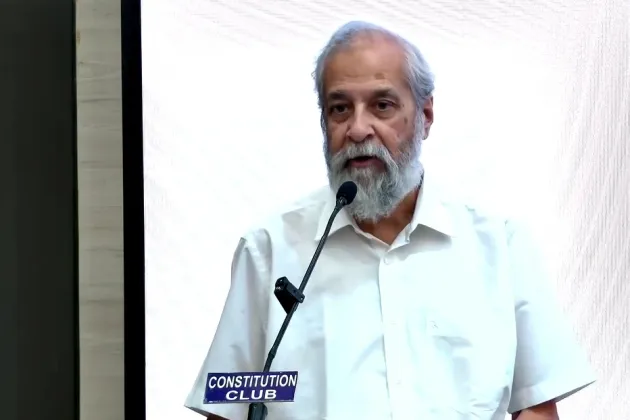

GUWAHATI, July 10: Former Supreme Court judge Justice Madan B. Lokur has raised serious constitutional concerns over the ongoing debate surrounding citizenship verification, electoral roll revisions and the legal status of Indian passports, arguing that treating a passport merely as a travel document undermines both statutory law and constitutional protections.
Speaking at a public discussion on citizenship, the Election Commission's Special Intensive Revision (SIR) exercise and constitutional rights, Justice Lokur said the interpretation that an Indian passport does not establish citizenship effectively reduces the document "to a bus ticket."
"If the government's position is that a passport is only a travel document, then the passport is effectively reduced to a ticket—not even an airline ticket but perhaps a bus ticket—which merely allows you to travel from one place to another and nothing more," he said.
His remarks come amid a nationwide debate over citizenship documentation following the Election Commission's ongoing Special Intensive Revision of electoral rolls and questions surrounding documentary proof of citizenship. The discussion also follows public statements by officials that an Indian passport should be treated only as a travel document rather than conclusive proof of citizenship.
Passport and citizenship
Referring to the Passports Act, 1967, Justice Lokur argued that the law clearly distinguishes between a passport and a travel document.
Quoting the preamble of the Act, he noted that it provides for the issuance of "passports and travel documents" to regulate the departure from India of "citizens of India and other persons," indicating that Parliament intentionally treated the two as separate legal instruments.
"The Passports Act defines both a passport and a travel document separately. Parliament does not use meaningless or superfluous words. To say that a passport is nothing but a travel document is, in my view, a complete misreading of the Act," he said.
He acknowledged that Section 20 of the Passports Act allows the Government to issue a passport to a non-citizen in exceptional circumstances, but questioned how often that provision has ever been used.
"I would be surprised if there is anybody who has been given an Indian passport while admittedly not being a citizen of India," he observed.
Article 19 rights linked to citizenship
Justice Lokur warned that the implications extend beyond voting rights.
He explained that while Articles 14 and 21 of the Constitution apply to every person, Article 19—which guarantees freedoms including speech, movement and the right to carry on an occupation—is available only to citizens.
"If a person is treated as not being a citizen because they fail to satisfy documentary requirements, then that person stands deprived of all the freedoms guaranteed under Article 19," he said.
He described this as a constitutional issue requiring far greater public debate than a routine administrative exercise.
Burden of proof reversed
Justice Lokur also criticised what he described as the reversal of the legal burden of proof in citizenship-related verification.
"The presumption should be that I am a citizen of India. Somebody else must establish that I am not. I should not be required to prove that I am a citizen before exercising my constitutional rights," he argued.
According to him, the Election Commission's current approach effectively shifts that burden onto individual citizens.
Questions over the SIR exercise
The former judge questioned whether the Election Commission had demonstrated the legally required "reason to believe" before undertaking a nationwide Special Intensive Revision.
He noted that the phrase "reason to believe" has acquired a well-established legal meaning through decades of judicial interpretation under laws such as the Income Tax Act and the Prevention of Money Laundering Act.
"What was the reason? When electoral rolls were revised only months earlier, what changed to justify another nationwide revision? Those reasons have not been made public," he said.
Justice Lokur further argued that electoral roll updating is intended to be a continuous statutory process rather than an extraordinary exercise undertaken after long intervals.
"If there has been no meaningful revision for twenty years, then either the Election Commission has not been performing its statutory duty, or it now seeks to correct decades of inaction within a few months," he remarked.
Constitutional institutions and accountability
Justice Lokur also cautioned against treating the Election Commission's powers under Article 324 as unlimited.
Referring to earlier Supreme Court rulings, he said Article 324 operates only where the law is silent and cannot override statutory provisions already enacted by Parliament.
"The Election Commission cannot become an imperium in imperio—an authority beyond scrutiny," he observed.
Welfare benefits and disenfranchisement
Justice Lokur expressed concern over reports that exclusion from electoral rolls could also affect access to welfare benefits in some states.
He argued that depriving individuals of voting rights, constitutional freedoms and welfare entitlements simultaneously could have severe consequences, particularly for economically vulnerable citizens.
"Somebody has to be held accountable when constitutional rights are taken away," he said while calling for greater judicial scrutiny of the broader consequences of citizenship-related verification exercises.
Justice Lokur concluded by urging the Supreme Court to examine not only the legality of administrative measures but also their constitutional and human consequences.
"The law cannot be viewed in isolation. One must also examine the consequences of actions taken under the law," he said.
Comments (0)
No comments yet. Be the first to share your thoughts.
Leave a Comment