

At Eye Level
(1)
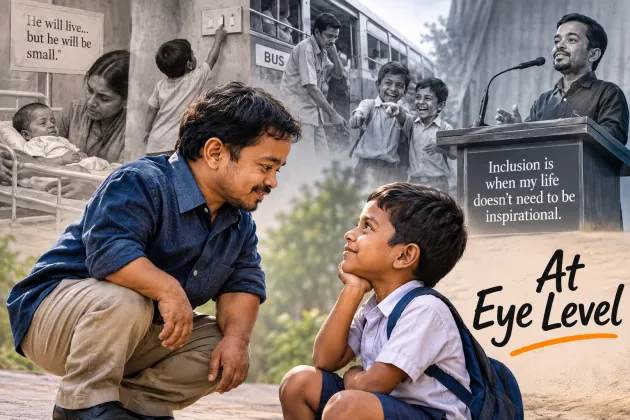
When Arun was born in the district hospital, the doctor did not look at him for long.
He looked at the chart instead, then at Arun’s mother, and finally away. The ceiling fan clicked rhythmically above them, as if keeping time with something left unsaid.
“He will live,” the doctor said finally. “But… he will be small.”
Small.
The word stayed in the room long after the doctor left.
Outside, a peon shouted for chai. A woman laughed somewhere in the corridor. Life continued at full height.
Arun lay wrapped in a white cloth, his fists tightly clenched, as if already holding on.
Arun learned early that the world was not built for him.
In rented houses, switchboards were always beyond his reach. Chairs pressed painfully against the backs of his legs. In buses, conductors sighed loudly before lifting him up, announcing the effort to everyone around.
“Arre, sambhal ke,” they said, half warning, half performance.
In temples, the bell rope dangled just beyond his fingers. Strangers rang it for him, smiling proudly, as if their generosity could cancel out his humiliation.
By the time Arun was five, he understood that his body did not belong only to him.
In markets, people stared openly. Children pointed and asked questions that adults should have stopped. Some laughed. Others smiled too much.
Laughter always came from above.
Arun learned precision at school.
Precision in walking… careful, controlled, never hurried.
Precision in speaking… soft, measured, never demanding.
Precision in existing… visible enough to be tolerated, never enough to disturb.
During morning assembly, he was placed at the front because of his height, not his merit.
“Arun is very brave,” teachers said, loudly, warmly, and unnecessarily.
His uniform was always altered by a tailor who charged extra and never met his eyes. Shoes were difficult to find in the right size. His socks slipped down constantly.
At lunch, Arun ate quickly.
He hated the way people watched him chew, as if eating itself required an explanation. He learned to swallow without tasting.
Once, during games period, a boy asked him, genuinely curious, “Tu kya karega?”
What will you do?
Arun looked at the field, at boys running freely, their bodies colliding without apology.
“I’ll keep score,” he said.
The boy nodded immediately.
Decisions, once made, were rarely revisited.
(2)
His father left when Arun was eight.
There was no shouting. No dramatic scene. One afternoon, his father went out and did not return.
Neighbours spoke in half-sentences. His mother stopped asking questions.
She worked longer hours stitching blouses, pricking her fingers repeatedly without complaint. At night, she massaged oil into Arun’s legs, her hands lingering longer than necessary.
“Tu thak gaya hoga,” she said.
You must be tired.
Arun wanted to tell her that he was not tired.
He was afraid.
As he grew older, he watched other boys stretch upwards, their bodies unfolding naturally. Their voices deepened. Their shoulders broadened. The world adjusted around them.
His body changed very little.
Puberty came unevenly, awkwardly. Desire arrived fully formed and entirely unwelcome.
Arun learned to look away quickly. To fold his feelings inward. To discipline even his desires.
Once, in college, a girl laughed when she realised he liked her.
“I didn’t think people like you…” She stopped, embarrassed. “You know… could feel that way.”
The sentence stayed with him longer than the laughter.
That night, Arun rode the last bus home, standing near the door, watching streetlights blur past. He pressed his forehead against the cool metal and counted the stops.
He did not cry.
He had learned that crying required a privacy his life rarely afforded him.
(3)
Work demanded better masks.
Phone interviews went well. The voices on the other end were encouraging. Then he entered the rooms.
Chairs scraped. Smiles tightened.
“You’re very capable,” they said. “But this role needs presence. Field work. Movement.”
Presence again.
As if he had chosen to be absent.
He was offered desk jobs without futures, responsibilities without authority. Colleagues spoke kindly to his face and over his head in meetings.
Once, after a presentation, his idea was praised, then repeated by someone else and applauded properly.
Arun smiled throughout.
At night, alone in his one-room flat near the highway, he lay listening to traffic and wondered what it felt like to take up space without apologising.
Sometimes he stood before the mirror and tried to imagine himself taller.
The mirror did not cooperate.
Arun wanted to prove himself somehow, in some way.
There is no examination for dignity. No reservation for endurance. No medal for surviving humiliation quietly.
People praised him loudly and chose him rarely.
Independence, when forced upon him, tasted like punishment.
Anger visited him occasionally, but never stayed. It required an energy he no longer had.
Grief stayed.
It sat beside him during meals. It followed him into sleep.
(4)
Arun started reading extensively.
He began sharing his thoughts at public gatherings, speaking about positive ideas and possibilities. He learned to hold an audience's attention, even as he sensed the sceptical smiles scattered among the listeners.
Perhaps they were thinking:
Waah… this fellow can at least do something. His words mean something, even if his size does not.
At a government seminar on accessibility, held in a dusty auditorium with flickering lights, a bureaucrat casually asked, “What does inclusion really mean?”
The room went still.
Heads turned towards Arun instinctively, as though spectators were expecting a performance.
He felt the familiar pressure… to inspire, to reassure, to make everyone feel good about themselves.
His throat tightened.
Then he stood.
“Inclusion,” he said, his voice steady despite the trembling inside him, “is when my life doesn’t need to be inspirational.”
Someone coughed.
“It’s when my ambitions don’t surprise you. When my failures aren’t blamed on my body. When I’m not invited only to be looked at.”
His voice cracked on the last sentence.
He sat down quickly.
No applause came.
For the first time, Arun was grateful for the silence.
The change that followed was small but irreversible.
Arun stopped apologising.
Stopped smiling in advance.
Stopped thanking people for not being cruel.
He began saying no.
No to token roles. No to pity. No to gratitude demanded before dignity.
Some people withdrew their warmth. Others called him bitter.
He accepted both.
Bitterness, he learned, was what truth tasted like when spoken without sugar.
(5)
Years later, Arun stood on a low stage in a community hall in a district town. Ceiling fans whirred. Plastic chairs creaked.
He was there because he had built something real, something that worked quietly and efficiently.
He was introduced by name.
Not by height.
Not by condition.
He spoke briefly about design, accessibility and dignity as a matter of structure, not sympathy.
The applause came slowly, then steadily.
Afterwards, a small boy approached him, clutching his mother's dupatta.
The boy reminded Arun of himself at that age: alert, careful, already tired.
“Uncle,” the boy whispered, “do people always laugh?”
Arun knelt until they were at eye level.
“Yes,” he said honestly. “Some people always will.”
The boy's eyes filled with tears.
“But you don't disappear,” Arun added softly. “That's the important part.”
The boy nodded, wiping his face with his sleeve, holding on to the sentence.
That night, alone, Arun stood before the mirror.
He saw the body that had been stared at, corrected and dismissed. A body that had carried him through classrooms, offices, buses and years of silence.
For years, he had compared himself to normalcy, as if being normal were a moral achievement.
Tonight, his mother's voice echoed faintly in his head.
Tu thak gaya hoga.
He touched the glass.
He had not grown taller.
But the world, finally, had been forced to meet him where he stood.
And that was not kindness.
It was justice.
Comments (0)
No comments yet. Be the first to share your thoughts.
Leave a Comment