
Skip to content Skip to navigation

Rescued rhino calf relocated to Manas

Purabi elephant calf

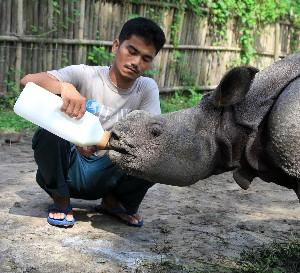
A rescued rhino calf, Purabi, under care at Centre for Wildlife Rehabilitation and Conservation (CWRC) was moved to Manas National Park today, to join an orphaned rhino calf being hand-reared there. This is being done to increase the rehabilitation prospects of the latter calf which has been deprived of company of its kind since its mother was poached early this year.

“We have been rescuing rhino calves at Kaziranga in various circumstances and most of them are now successfully hand raised at CWRC. At due course of time all these calves go back to the wilderness again,” said NK Vasu, Chief Conservator of Forest and Director, Kaziranga National Park.

Purabi was separated from her mother during the floods in 2012 in Kaziranga, a UNESCO World Heritage Site. She was rescued by Assam Forest Department and local people near Haldibari area and admitted to CWRC. Since then she has been under care at CWRC located near Kaziranga National Park of Assam, India. CWRC was established in 2002 in a joint initiative of Assam Forest Department and WTI-IFAW partnership.

The other calf, named Dwimalu, a male, was just a few weeks old when rescued. The mother was one of the wild rhinos translocated under the government’s Indian Rhino Vision 2020. Since April, he is being hand-reared by the Forest Department authorities assisted by IFAW-WTI in Manas.

At Manas, both these calves will be hand-reared together for a couple of years and eventually released there.

“We welcome this move of shifting another rhino calf from CWRC to Manas. We are committed to restore Manas’s glory with such initiatives,” said Anindya Swargiary, Field Director of Manas Tiger Reserve.

“In wildlife rehabilitation, it is always advisable to hand-raise orphan calves together in the initial stages of their rehabilitation procedures to avoid the stress level of the calves,” explained Dr Rathin Barman, Deputy Director, WTI and in-charge of CWRC, Kaziranga, on the reason for the move of Purabi from CWRC.

IFAW-WTI has been assisting the Forest Department and Bodoland Territorial Council authorities to repopulate Manas with rhinos as part of their ‘Bringing Back Manas’ (to its former glory) initiative. The rhino reintroduction in Manas was kickstarted with the move of Mainao, a female rhino rescued from the floods and rehabilitated here. She was moved to Manas in 2006 making her the first rhino to step foot in this UNESCO World Heritage Site since its entire population was wiped out during the years civil unrest that ended in early 2000s.

Add new comment

Other Contents by Author

Three smooth-coated otter pups rescued from the floods in Kaziranga National Park last week are currently being hand-reared at the Centre for Wildlife Rehabilitation and Conservation (CWRC).The pups, all male, yet to open their eyes, were found floating on hyacinth leaves by local people in Mahpora (Dagaon) from the fringes of the National Park, last Friday.“The people apparently found the pups while they were fishing. They handed over the pups to the Forest Department staff, who called us to collect them as they could not locate the mother or their den,” said Dr Anjan Talukdar, International Fund for Animal Welfare – Wildlife Trust of India (IFAW-WTI) veterinarian.The pups are being bottle...
Marking a significant milestone for conservation of Amur falcons in the northeast Indian state of Nagaland, three villages in Wokha district have pledged to save the migratory raptor in Doyang Reservoir - its largest roosting site in the country. With mass annual hunt potentially threatening the species, a resolution has been cleared by the villages to penalise offenders, this year onwards.Village Council Members (VCM) of Pangti, Asshaa and Sungro signed a tri-party Memorandum of Understanding with the Wildlife Trust of India (WTI) and the Wokha-based NGO Natural Nagas, to assist the Nagaland Forest Department to stop the wide-scale hunt which was brought to light last year.Tens of...
A sub-adult wild tusker stranded in human-dominated area in Nagaon district of Assam was successfully translocated to the wild. The exhaustive two-day rescue operation was carried out by the Forest Department assisted by IFAW-WTI team, local elephant experts, mahouts and phandies, with local police and paramilitary forces fencing the crowd of thousands.The tusker was separated from its herd, was disoriented and had been taking shelter for over 70 days in and around Kaki Reserve Forest. It had been caught in conflict with people, resulting in damage to property and crops and even casualty of a farmer; it was also treated for gunshot injuries by the authorities assisted by...
A seven-year old male leopard is being shifted today to the Nagaland Zoological Park from the Centre of Wildlife Rehabilitation and Conservation (CWRC), near Kaziranga National Park. The Assam Forest Department and International Fund for Animal Welfare -Wildlife Trust of India (IFAW-WTI) run CWRC had been taking care of the leopard since 2006, after he was found alone in a tea garden by locals and handed over to the authorities. "When we get any animal at CWRC, our first choice is to look into rehabilitation back in the wild. However, rehabilitation is not an easy option for large carnivores, considering the need for extensive space as they are territorial animals, and...
The International Fund for Animal Welfare - Wildlife Trust of India (IFAW-WTI) has provided 35 boats to the Kaziranga National Park authorities to assist in anti-poaching patrolling in the flood-prone UNESCO World Heritage that houses more than 70% of the world's greater one horned rhinoceros.The boats are largely aimed at providing assistance to the local field staff in their patrolling (anti poaching) activities during the floods in Kaziranga National Park.  Every year the park faces flooding of the Brahmaputra river, causing many animals to wander out in search of higher grounds. Many that are caught in the floods are rescued and rehabilitated by the Forest...
As preparations to tackle potential flood emergencies are on at the Centre for Wildlife Rehabilitation and Conservation (CWRC), good news poured in for the rehabilitators, as yet another rhino hand-reared here gave birth to a healthy calf in the wild in Manas National Park.The female rhino, named Jamuna, was rescued as a three-month-old calf during the annual floods in the famed Kaziranga National Park in June 2004, by the Assam Forest Department. She was admitted to the Assam Forest Department and IFAW-WTI run CWRC near Kaziranga for hand-raising and rehabilitation. In 2007, she along with another female calf, Ganga, was moved to Manas NP.With this, all three female rhinos...