Skip to content Skip to navigation

The First Indian Leader trying to Prevent Partition of India

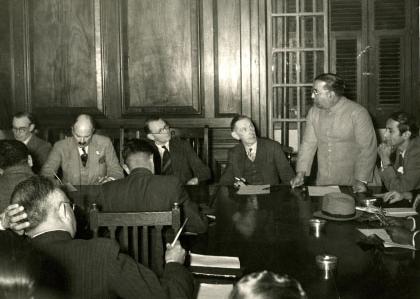
Please look at the 1946 photo from the London Parliamentary Archive --- the individual standing, with left face seen in the photograph, with clenched fists on the table, is Gopinath Bardoloi. Please look at the scare on the face of the Member of the British Cabinet Mission.


Partition of India in August 1947 is an unforgettable tragedy where a million innocent people lost their lives and belongings.


British Administration put up two plans, one after the other, for Partition of India. The first plan, known as "Cabinet Mission Plan" (AKA "Grouping Plan") was presented by a British Cabinet Mission in March 1946. One Indian leader, Gopinath Bardoloi, known as "Gopinath of Assam", thwarted that plan with help from Mahatma Gandhi. Some Indian leaders, led by Jawaharlal Nehru (who became very angry at "Gopinath of Assam") did not mind partition of India in order to grab political power.


A second plan to partition India was forwarded by Bengali leaders in April 1947 who wanted to dissect India to carve out an independent Bengal --- this ignonimous plan was known as "Suhrawardy-Sarat Bose Plan".


One year after the British Cabinet Mission Plan, the British Viceroy Lord Mountbatten, arrived India with the third proposal known as "Mountbatten Plan" in June -July 1947. Fully supported by Nehru, India was partioned on August 15, 1947 by the Mountbatten Plan. Subsequent communal riots claimed millions of lives and unimaginable, unforgettable suffering.


If this matter is discussed with a verified time-line, the truth will come out that "Gopinath of Assam" was the only Indian leader besides Mahatma Gandhi who stopped Partition of India ---- proving the true "Assamese Grit" that is needed by the Assamese again today for the survival of Assam.


Himendra Thakur
Boston, USA


Photo has been taken from this page.

Comments

Pallavi Barua's picture

Today, Assam has Nehru Stadium, Nehru Park, etc. These have been named after a person who didn't provide any helping hand to Gopinath Bordoloi when he was fighting against Assam being clubbed with erstwhile East Pakistan (now Bangladesh)in 1947. The only thing which mattered to Pt. Nehru was the Prime Minister's chair. On assumption of the office of the PM, Nehru thought of using Assam as a dumping yard for refugees from erstwhile East Bengal (now Bangladesh). Here is an excerpt from a letter which Nehru wrote to Gopinath Bordoloi, "...If Assam adopts an attitude of incapacity to solve the refugee problem, then the claims of Assam for financial help obviously suffer."
Ajoy Warisa's picture

How is assam different from bangladesh now? 38 years of infiltration - what is left of assam? when will New Delhi awake from its slumber?
Anwar A. Ansari's picture

By accepting the Cabinet Mission Plan unanimously and unconditionally, Jinnah and his Muslim League had drawn a curtain to all that had gone before. Then Indian National Congress gave its approval, not unanimous, And then, according to Abul Kalam Azad, happened something that changed the course of history - Nehru's repudiation of the agreement by declaring "we are unfettered by any agreement". By unanimously approving the Cabinet Mission Plan, Jinnah and his Muslim League had put a lid on everything past. I have read a lot of books and articles on the subject of 'Partition of India'. None, repeat none, carries this episode of Nehru's 10 July press conference. And all books and articles give quotations from Abul Kalam Mazda's 'India Wins Freedom'. Again, none, repeat none, gives the passages that I have given in my article, below. Why? Abul Kalam Azad, giving account of the A.I.C.C.'s passing the resolution to approve the Cabinet Mission Plan, says: "Now happened one of those unfortunate events which changed the course of history. On 10 July, Jawaharlal held a Press Conference in Bombay in which he made a statement which in normal circumstances might have passed almost unnoticed, but in the existing atmosphere of suspicion and hatred, set in train a most unfortunate series of consequences. Some Press representatives asked him whether with the passing of the Resolution by A.I.C.C., the Congress had accepted the Plan in toto, including the composition of the interim Government. "Jawaharlal stated in reply that Congress would enter the Constituent Assembly 'completely unfettered by agreements and free to meet all situations as they arise.' (Inverted comas of the author) "Press representatives further asked if this meant that the Cabinet Mission Plan could be modified. "Jawaharlal replied emphatically that the Congress had agreed only to participate in the Constituent Assembly and regarded itself free to change or modify the Cabinet Mission Plan as it thought best. "I must place on record that Jawaharlal's statement was wrong. It was not correct to say that Congress was free to modify the Plan as it pleased. ................................................................. These matters could not be changed unilaterally by Congress without the consent of other parties to the agreement. "The Working Committee felt that it faced a dilemma. On the one side, the prestige of the Congress President was at stake. On the other, the settlement ....... was in danger. To repudiate the President's statement would weaken the organization but to give up the Cabinet Mission Plan would ruin the country. Finally, we drafted a Resolution which made no reference to the Press Conference but reaffirmed the decision of the A.I.C.C. "His Excellency the Viceroy, with the approval of His Majesty's Government, has invited the President of the Congress to take proposals for the immediate formation of an interim Government and the President of the Congress has accepted the invitation. Pandit Jawaharlal Nehru will shortly visit New Delhi to discuss this proposal with His Excellency the Viceroy." A few passages further, Abul Kalam Azad says: My comments: Lord Wavell, the Viceroy, had earlier declared that whichever party first accepted the plan, would be invited to form the Interim Government. That gutless Viceroy went back on his promise and bypassing Jinnah in blatant deceit invited the President of the Congress instead to form the Interim Government, who had already repudiated the Cabinet Mission Plan and whose catalogue of mistakes had ruined the unity of India. The gutless, supine and myopic leadership of the Indian National Congress could not see woods from the trees and, in all lunacy, went on to pass a resolution which begins unashamedly by shoving all the blame on the Muslim League. They were so blinded by their selfish interest that they could not see the impending catastrophe by not calling a spade a spade and, as Abul Kalam Azad has recorded, completely omitted even the mention of the bone of contention: the notorious 10 July Nehru Press Conference. The imbecile leadership of Indian National Congress came out in full force to cover up the Himalayan blunder of Nehru rather than rectifying it, which blunder according to Azad changed the course of history (of India). What a farce! What a farce!! The display of lunacy did not stop there. Lord Wavell, in utter insanity, called upon Jawaharlal Nehru, who had repudiated the Cabinet Mission Plan agreement, to form the Interim Government of India. And then all those lunatics, Congress leadership, Wavell and all, went on to blame Mr. Jinnah for the partition. What hypocrisy! What hypocrisy!! It is not Jinnah who brought about the partition of India; it is the duo of the gutless, spineless, unashamed Jawaharlal Nehru and the self-opinionated, egoistic Lord Mountbatten (now in control) who brought about the partition and the destruction upon India. These two demagogues, Nehru and Mountbatten, preferred the ruination of the country over the false prestige of the Congress President. (It still remains an enigma that Nehru had earlier gone to Malaysia and met Mountbatten, the Supreme Commander. Mountbatten, a soldier in uniform on active war service, then made a momentous political statement of great significance by calling Nehru “the future Prime Minister of India”.) Going by the account of events given by Azad that changed the course of history, there is only one single reason of the disastrous partition of India: The display of Nehru's obnoxious & foul diplomacy at the time!!! And the Indian National Congress going along with it. Thus, united India was sacrificed at the altar of false prestige of the President of Indian National Congress. Events have proved Gopinath was a shortsighted man. Anwar Ansari, Harrow, Middlesex, England.
Himjyoti Talukdar's picture

Is somewhere mentioned that the person addressing the meeting is Gopinath Bordoloi? According to few sources He's Baba Saheb Ambedkar. Request author to clarify the issue with sources. 

Pages

Add new comment

Other Contents by Author

Guwahati : There was another high profile kidnapping in Assam. Cement Corporation of India (CCI) official Kailash Nath Jha and his security officer, Madan Kumar Bora were abducted at gun point by suspected militants at a place which falls under Bilai outpost of Bokajan Police Station, about 300 kilometres from Guwahati on Sunday. Police Officials suspect the Karbi Longri National Liberation Front (KLNLF) to be involved in the kidnapping. The KLNLF has very close links to the ULFA as well and hence officials have not ruled out the hand of ULFA in the kidnapping as well. CCI has a cement plant at Bokajan. CCI officials were not available for comments. This high profile kidnapping comes at a...
Way back in the late 1960s, there were two individuals in the then sleepy town of Jorhat who were making and dreaming music in the confines of their homes. The young boys used to go to the local music school, perform in programmes in Assam and create music with rich melodies. Gradually they started capturing the heart and soul of Assam and came to be known as Jitu-Tapan. It so happened that one day the great Mohammad Rafi visited Jorhat in Assam for a show and on the same show there was an orchestra that was presented by the young duo of Assam. Rafi was more than impressed. He called both of them the next day and requested them to teach and compose Assamese songs for him. And “...
Arunachal Pradesh is one of the naturally beautiful states of India situated in the foothills of the Himalayas and there we have the Pakke Wild life sanctuary which is fast developing as a hot spot for Tourists. The River Bhareli (known as Kameng in Arunachal Pradesh) is on the northern and western sides of the sanctuary, to the east is the Pakke River and to the south lies the Nameri National Park of Assam. In this sanctuary the endangered Black Panther species is available. The Wild Life Institute of India (W.I.I.), Dehradun and the forest department of Arunachal Pradesh detected the presence of the Black Panther through camera trapping. This collaborative programme that works for tiger...
Nameri National Park: Aranyak is a biodiversity conservation society of North-East India. It organized a workshop on Eco-Camp of Nameri National Park (a tourist resort) on tiger conservation and its problem in NNP. The Brahamaputra valley in Assam is an important stronghold of the Royal Bengal Tiger (Panthera Tigris) in India and facing serious anthropogenic threats that may lead to extinction in future. The Nameri National Park is one of the designated tiger reserves in Assam. As per the latest tiger census carried out by Forest Department, approximately 37 tigers were found in the park. This accounts for 10.6% of the total tiger population of Assam. The organizer invited a variety of...
Guwahati: Noted tea industrialist Hemendra Prasad Barooah has revealed in a new book about being traced by the ULFA to Philadelphia, about his English acquaintance involved in the Great Train Robbery in the UK, and about the search for Dr Bhupen Hazarika's lost Rolex watch one dark night on a street near Sivasagar. The planter, a multifarious personality, who has remained away from media glare, shares many intimate details of his life with eminent journalist Wasbir Hussain in 'Life and Times: Story of an Assamese Tea Baron', an authorized biography. The book, published by Spectrum Publications, Guwahati/New Delhi, was released by chief minister Tarun Gogoi at a function in a...
Talap : Reports have come in that there was an exchange of fire between ULFA and SULFA in Talap on Thursday . The Sulfa member, Sriman Chetri managed to escape unhurt. This may be precedence for many such instances in the future.
Guwahati : AJYCP, Gorkha Association , have withdrawn the economic blockade that had been in force against Nagaland from last Friday. Post discussions with the Government authorities, the Organsiations have withdrawn the economic blockade.Notably, post the Naga aggression on Assamese villages which had left 3 people dead, the AJYCP, Gorkha Association alongwith the AASU and some other groups had come together to enforce a economic blockade on the roads leading to Nagaland. AASU had earlier withdrawn from the economic blockade on humanitarian grounds on 11thof July 07.
Sibasagar: There was a false alarm at Sibasagar when police received a call informing them that one Mr Dilip Chetri a ULFA member was on his way to the Indian Bank to deposit a large sum of money there. Police and Army personnel descended on the Bank and waited for almost three hours but no one turned up. Investigations are on.
Dhemaji: Floods are in full flow in Dhemaji. Almost 40,000 people have been displaced after a breach in the embankment of the Jiadhol river. 25 villages are reported to be under water and the people have been stranded at various places. People have taken refugee in schools and colleges. Military helicopters are also dropping food and other essentials, officials said on Friday. A government spokesman said that nearly 120 villages in all in Dhemaji are affected since Thursday. This is the second spate of floods to hit Assam this year after the lull in floods last year
Nasscoms had launched the Assessment and Certification Programme (NAC) for the BPO sector which is a great success. Nasscom is now in the process of launching a similar testing and accreditation offer, NAC Tech, for the IT services, according to Mr Kiran Karnik, Chairman of Nasscom. The NAC was launched as a pilot last year for the BPO sector to ensure transformation of a “trainable” workforce into an “employable” workforce. The pilot was first rolled out in Rajasthan where 2,500 people took the NAC test. By the year-end, NAC for BPO will be rolled out in various States, including Tamil Nadu, Gujarat, Chandigarh, Andhra Pradesh, West Bengal and the North eastern...