
Skip to content Skip to navigation

Why not Hasina tendering an apology to Hindus!
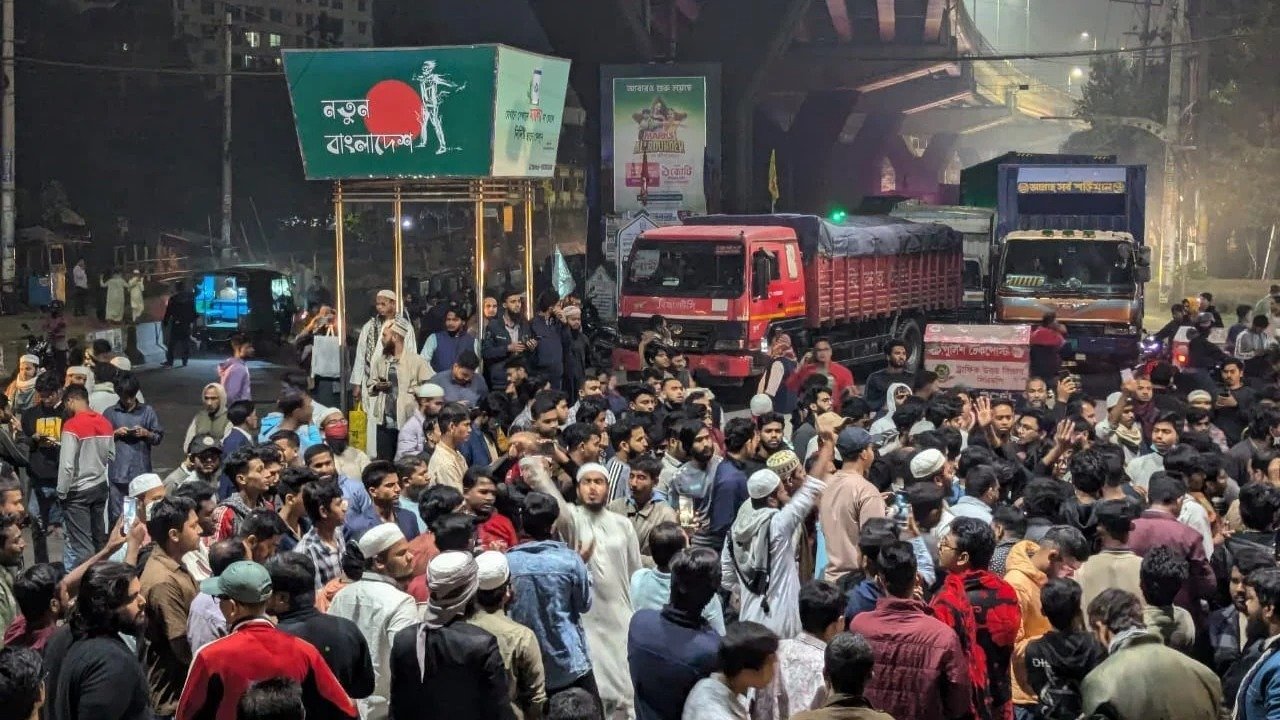
Bangladesh, which recently witnessed turmoil following the demise of a young radical leader Sharif Osman Bin Hadi amid anti-India rhetoric, now gradually returns to normalcy, as the south Asian nation also prepares for its next general election scheduled  for 12 February 2026. The highly sought after polls, as the sitting Prime Minister Sheikh Hasina faced an overthrow in the backdrop of a student-led mass uprising in July-August 2024, however misses the participation of Hasina’s party Awami League, which used to rule the Muslim majority country of 170 million people for several years.

The ousted premier along with thousands of  her party men continue to stay in neighbouring India even after she faces  a death sentence by a Bangladeshi court for her crimes against humanity during last year’s rebellion that resulted in the casualties of over 1400 individuals including the minors. Ignoring repeated official communiqués from the current interim regime led by Nobel laureate Dr Muhammad Yunus in Dhaka, India still remains non-committal over her repatriation. It caused a strain on diplomatic relations between Dhaka and New Delhi, and lately Bangladesh’s bilateral ties with the billion plus nation have only worsened.

Many anti-Hasina campaigners rumoured that the Hadi’s killers entered the Indian territory soon after the shooting attack in Dhaka on 12 December, following which the Inqilab Mancha leader was later flown to Singapore for advance-treatment but he  succumbed to injuries on 18 December evening.  The prime accused Faisal Karim Masud, who was associated with Chhatra League, the student wing of Awami League, continues to be traceless and a large section of Bangladeshi nationals believe with no justification that he was receiving support & hospitality from New Delhi.  Thus the entire fury went against India and motivated elements stepped up activities targeting the Hindu families in different parts of Bangladesh.

Meanwhile, the horrific mass killing of Deepu Chandra Das, 27, a garment worker in Bhaluka of Mymensingh locality by an angry mob alleging an unconfirmed derogatory remarks against the Islam on 18 December, and Uttam Kumar Barman, 45, a grocery shop  owner of Rangpur locality with same allegation of blasphemy on 13 December aroused massive protests in India. The agitators demonstrated their anger in front of all Bangladesh diplomatic missions demanding justice to the victims and ensuring security to the non-Muslims in the country.  The interim government firmly stated that the killing of the Mymensingh worker was a heinous criminal act with no justification. Recently, education adviser Prof CR Abrar visited the family of Deepu to convey the government’s sympathy and assurance of support during this difficult time. He reaffirmed the authority’s unwavering commitment to the rule of law and informed that over 10 people were arrested in connection with the crime.

In a recent report, the Brussels-based International Crisis Group (ICG) pointed out that Hasina’s presence in India has been a major factor in the simmering tensions between the two neighboring countries. Almost immediately after taking office, the interim government began pushing for Hasina’s extradition under a 2013 treaty, but the Indian officials were never likely to agree to send her back, added the report. Probably New Delhi did not prefer to  ‘look like an unreliable ally to other governments in the region’ by her extradition and hence it staunchly supports Hasina. Dr Yunus personally urged Prime Minister Modi to prevent the disgraced premier from making political statements while in India, warning that her interventions in Bangladeshi politics emerged as an unfriendly gesture. His remarks were not well received by New Delhi and  Bangladesh further aggrieved for allowing thousands of Awami League activists to undertake political activities from Kolkata and New Delhi, stated the conflict prevention organization.

Recently, Hasina came out with a critical comment over the current turmoil in Bangladesh accusing the Yunus-led interim government as a failed entity. She termed the tragic killings as a reflection of lawlessness that has become the norm  where the interim government either denies it or remains powerless to address it. Alleging that the current authority put ‘extremists’ in top positions, released convicted terrorists from prison and allowed international terrorists to play roles in public life, Hasina also blamed it for the strained relations with India.

Hasina also rejected any call to return back to Bangladesh ‘to face political assassination’ until a legitimate government is installed in Dhaka that supports an independent judiciary. She did not forget to offer thanks to New Delhi for its continued hospitality since her departure from Dhaka last year. India’s stand on Hasina’s stay is clear which is  guided by its civilizational ethos and humanitarian tradition of offering refuge to individuals facing circumstances of grave distress or existential threat. New Delhi had earlier sent a strong message demanding justice for Deepu saying that India remains concerned over the deteriorating security situation in Bangladesh affecting the religious minorities.

But the question that arises is, why Hasina should not tender an apology to the Sanatani Hindu society as she too failed to protect the Hindus and other minority families as well as their religious institutions (but pretending to be their saviour always) during her long tenure as the premier of Bangladesh. Initially she was reported to prepare moving to a third country, but till date none has offered asylum to the lady and not even appreciates New Delhi for rescuing Hasina from a possible death in Ganabhawan on  5 August 2024. Hasina  remains compelled to stay in a Hindu majority country for more than a year as no nation across the world has come forward supporting Hasina in her time of distress. Should it not be her first priority to beg forgiveness from the Hindus in Bharat!

Author info

Nava Thakuria's picture

Senior journalist based in Guwahati.

Add new comment

Other Contents by Author

After months of uncertainties, the Press Council of India (PCI) recently got its chairman, but the space of 13 working journalists remains vacant till date. Justice Ranjana Prakash Desai, who served as the PCI chairman from 17 June 2022 to 16 December 2025, assumed the charge on 24 April 2026 once again. The retired judge of the Supreme Court of India was nominated for another term of three years. But the quotas for working journalists remain vacant as seven members, to be represented by professional scribes (other than editors) and six members, to be represented by journalist-editors, are yet to be picked up to complete the 15th council (https://presscouncil.nic.in/CurrentMemberPCI.aspx...
After Assam, Keralam and Puducherry (union territory), the State legislative assembly elections are knocking at the doors of  Tamil Nadu and West Bengal in the second half of April 2026. Meanwhile, the millions of voters have shown an extraordinary commitment to electoral politics as they participated in the largely peaceful single-phase assembly polls on  9 April recording a high voters’ turnout. Assam recorded 85.96% voter participation  in 126 assembly seats, where Puducherry showcased over 90% voting in 30 constituencies followed by Keralam (140 seats) with nearly 80% turnout. Assam’s 2.50 crore electorates (including 1.25 crore female voters and 6.4 lakh first-timers...
As Assam goes to the single-phase polling  tomorrow (9 April 2026), nearly 2.49 crore registered voters (including 5.75 lakh young/first time voters) will exercise their franchise to elect 126 representatives for the State legislative assembly. Under the guidelines of  Election Commission of India, all types of campaigning had already came to a halt at 5 pm on Tuesday (48 hours prior to voting) where the authority urged all candidates, political parties, and media outlets to strictly follow the guidelines. The same timeline is made applicable for Kerala and Pondicherry as well, whereas Tamil Nadu will vote on 23 April, and West Bengal going for polling on 23 and 29 April next....
Landlocked Himalayan nation Nepal prepares for its ninth national election  on 5 March, which was necessitated with the collapse of its government in Kathmandu during September last year following an anti-corruption mass uprising, which was initiated by the young people and resulted in the killing of dozens of agitators and injuring hundreds other. The south Asian country of around 30.55 million people, sandwiched between two giants India and Tibet/China, has readied all necessary arrangements for the single day polling through ballot papers under the protection of  nearly 3,50,000 security personnel (with additional armed forces kept ready for an unwanted emergency situation...
Even all political parties, not to speak of millions of fans and well-wishers of Assam’s revered cultural icon  Zubeen Garg, continue preaching for sparing the maverick singer’s name in doing politics, his mysterious death last year in a foreign land may dominate the electoral politics in the forthcoming legislative polls. Indications surface that Assam assembly elections (scheduled for March-April 2026 along with West Bengal, Tamil Nadu, Kerala and Puducherry) will observe a high voltage campaigning on  Zubeen’s unexplained demise in Singapore on 19 September 2025 and subsequent investigation and judicial processes. Even after five months of his final departure, Zubeen continues...
As Bangladesh has constituted a new government under the leadership of  Bangladesh Nationalist Party (BNP) after a largely fair & peaceful national election on 12 February 2026, the people of eastern India (the region virtually embraces the poverty stricken country except a few kilometers in Myanmar and the Bay of Bengal)  hope for a progressive regime in Dhaka enjoying political stability and pursuing economic developments to over 170 million people in the south Asian nation. The Muslim majority country continues to grow as a headache for the north-eastern states, more precisely Assam, for at least two  reasons namely unabated influx of migrants and regional security...
Amid high security arrangements across the country, polling begins this morning at 7:30 am for the highly projected 13th Jatiya Sansad election in Bangladesh, where over 2000 candidates representing 50 political parties along with many independent contestants are in the fray. The Muslim majority nation has over  12.77 crore registered voters including 6.27 crore women and 1,232 third-genders, who are voting for electing   299 representatives (out of 300 seats in the national assembly). Over 42,000 polling centres will facilitate the electorates to exercise their franchise (through  ballots in person) till 4:30 pm (on 12 February 2026). The election will be conducted...
As Bangladesh heads for 13th Parliamentary election and  the referendum on  July National Charter simultaneously on Thursday (12 February 2026), the interim government chief Professor Muhammad Yunus urged all participating candidates to rise above personal and party interests to prioritize greater interest of the Muslim majority nation regardless of the poll-outcomes. Addressing the nation of over 170 million people ahead of the much watched electoral exercises, Nobel peace laureate  Dr Yunus commented that victory as well as defeat is an integral part of democracy and hence after the election, they should dedicate themselves to build a new, just, democratic, and inclusive...
Is it possible to have a quasi-judicial body like the Press Council of India to survive for weeks without its chairperson? Should the largest democracy on Earth put such an example where its government recognized autonomous media watchdog faces an existential crisis as the 15th council of PCI still devoid of a functioning head and 13 seats? How come a press council runs its business without filling these 13 seats, meant for millions of media professionals, for more than a year now, whereas the term of a council is limited to three years only? Many such pertinent questions  emerge among media professionals in the   south Asian nation, as the regular three-year term (as well as...
Amid an existential crisis in the Guwahati-based Assam Tribune group of newspapers, which worsened after the Covid-19 pandemic, a popular Assamese weekly newspaper lost its publication in the latter part of 2025. Asom Bani, once a mainstream weekly for Assamese readers for decades, stopped hitting the stands from September last year, as the management lost interest in continuing its printing every Friday. Even though the seven-decade-old Assamese-language weekly was lost from the media market, the management did not make any statement about Asom Bani’s fate. Prior to its departure, the weekly was merged with Dainik Asom, an acclaimed Assamese daily from the prestigious media house, as its...