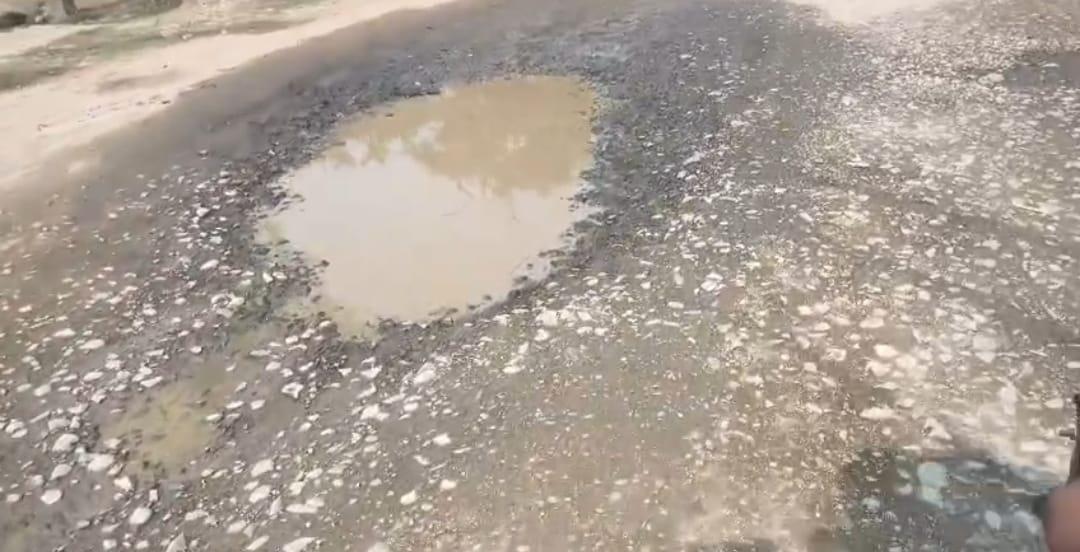
The condition of Nazira’s roads, especially the historic Dhodar Ali, paints a grim picture of neglect and governmental indifference. Once a vital arterial road with historical and economic significance, Dhodar Ali is now in a state of disrepair, causing immense hardship to commuters and residents alike.
Despite being a region blessed with abundant natural resources—such as coal, oil, and stone—and housing major public sector institutions like ONGC, Nazira has seen little in terms of real infrastructural development. The promises made by elected representatives and departmental officials have failed to materialize, leading to growing frustration among the public.
Repeated protests and demands by local organizations have yielded little more than lip service. The authorities continue to make assurances, but the ground reality tells a different story. Road construction work, including on the once-historic Naga Ali, remains incomplete, and what remains has deteriorated further due to poor maintenance and neglect. The local road subdivision office appears largely indifferent, with contractors reportedly making appearances only when pressured.
Adding to the discontent is the fact that even frequent visits by Union Minister of State Pabindra Margherita have done little to expedite the development of key road projects. Roads such as Na-Kapahowa and Rewati Kapahowa are also in alarming condition, compounding the public's concerns.
Nazira’s residents are now left asking a pressing question: Who will take responsibility for developing Nazira? The absence of initiative from both ruling and opposition parties has turned the issue of road development into a political failure. With elections looming in the future, the demand for accountability is expected to grow louder.
The crumbling infrastructure of Nazira is no longer just a local inconvenience—it is fast becoming a symbol of political apathy and failed governance.
What was promised as a major infrastructure upgrade under the Assam Mala Scheme has instead become a symbol of official apathy, contractor failure, and endless public suffering. Nearly two years after work began on the crucial Sivasagar–Sonari Road, commuters continue to battle dust, mud, potholes, and unfinished construction, with no end in sight.
The 18.416-kilometre road stretch from Sivasagar town to Suomoni near Garmur in Charaideo district, sanctioned at a cost of around ₹121 crore, remains incomplete despite repeated assurances from authorities. Daily commuters—including office employees, students, patients, and business owners—have been forced to endure hazardous travel...
eteran journalist, renowned folk artist, social organizer, and retired teacher Anuj Rajkhowa passed away on Monday night at Geleki Primary Health Centre under Nazira Co-District following a prolonged neurological illness. He was 67.
Born in Geleki in 1958, Rajkhowa was the son of freedom fighter late Garejai Rajkhowa. A multifaceted personality, he made significant contributions to journalism, education, culture, sports, and social service over a career spanning more than five decades.
Rajkhowa began his journalism career in 1974 and worked with leading Assamese newspapers, including Dainik Janambhumi, Ajir Asom, The Sentinel, and Asomiya Pratidin. He also served as founder secretary...
Widespread fear has gripped several villages in Nazira following repeated sightings of a large tiger, with residents capturing startling visuals of the animal roaming freely near human habitations on their mobile phones.
According to reports, vast areas of the Nazira Co-District, particularly villages along the Dikhow River, have increasingly become a tiger movement zone. Villages such as Rajapul, Khanikar Gaon, Natun Mati, Duwara Gaon and Gar Ali—located barely three kilometres from Nazira town—have been witnessing frequent tiger activity in recent weeks.
Residents say hearing the loud roars of the big cat and spotting it near residential compounds has become alarmingly common....
Juktali Higher Secondary School, located in Machagarh under Nazira Co-District, has brought laurels to Assam by winning the prestigious “Tobacco-Free Institution Award” at a national-level ceremony held in New Delhi on May 29.
The award was conferred under the nationwide “School Challenge – Tobacco-Free Environment 2025”, an initiative organized by the Ministry of Education, Government of India, to promote tobacco-free educational institutions across the country.
The competition, conducted in August last year, witnessed participation from high and higher secondary schools from across India. Schools were assessed on a range of awareness activities, including street plays, poster-making...
Around 35 tea garden workers, including a pregnant woman, were injured after a vehicle carrying them overturned at Geleki Na Ali in Nazira on Friday morning.
According to reports, the accident occurred at around 7:00 AM when a Tata Ace vehicle (AS-04-BC-9838), owned by Pranjal Pangging of Hatipatti, was transporting workers from Hatipatti and Bogichapori areas to Geleki Athkhel Tea Garden as part of their daily commute.
Sources said the accident took place after a person suddenly ran across the road in front of the vehicle. In an attempt to avoid hitting the pedestrian, the driver applied the brakes abruptly, causing the overloaded vehicle to overturn on the road.
Nearly 35 male...
An emotional and charged atmosphere prevailed at the historic Kareng courtyard as people across Assam marked the first day of Rongali Bihu—the Bohag festival—amid grief over the absence of iconic singer Zubeen Garg. From Upper Assam to Lower Assam, voices united in a powerful call: “Justice for Zubeen Garg.”
Rongali Bihu, the most cherished festival of the Assamese community, began with its first day known as Manuh Bihu, traditionally dedicated to human bonding and respect. This year, however, celebrations carried a deep sense of sorrow as people paid tribute to the beloved artist, widely regarded as the heartbeat of Assamese culture and a youth icon.
At the Kareng...
Nazira, April 10: The declaration of the High School Leaving Certificate (HSLC) examination results has brought encouraging news for the Nazira subdivision, with several government educational institutions registering commendable performances and reinforcing confidence in the region’s academic progress.
Nazira Bartala Higher Secondary School once again upheld its reputation by securing an impressive pass percentage of 95.74. Out of 47 candidates who appeared, 24 achieved first division and 21 secured second division, while 14 students earned letter marks across subjects.
Nazira Higher Secondary Multipurpose School also delivered a satisfactory outcome, recording an 81...
Nazira, April 4: The Assam United Mahasangha has extended its support to four independent candidates in the upcoming elections, underscoring what it described as a critical need to restore governance rights for indigenous communities in the state.
Addressing a press conference in Nazira, the organization’s Security Council President, Matiur Rahman, launched a sharp critique of major political parties. He alleged that their policies have consistently undermined indigenous interests, particularly by favoring migrant populations.
As part of its political stance, the Mahasangha announced its endorsement of the following candidates:
Dr. Bhavendra Nath Mohan from Sivasagar
Rubul...
Nazira, April 3: Senior CPI leader Kanak Gogoi on Friday launched a sharp attack on the BJP-led alliance, alleging that “communal politics has eroded the value-based political culture of Assam,” and expressed confidence that the ruling coalition will be voted out in the upcoming Assembly elections.
Addressing a press conference in Nazira, Gogoi, who is also the CPI’s candidate for the Nazira legislative constituency in the forthcoming 2026 Assam Assembly elections, said the BJP-led government has weakened Assam’s long-standing tradition of communal harmony and socialism. He accused the ruling alliance of promoting divisive “Hindu-Muslim-Miya politics,” which he claimed has misled the...
Nazira, March 26: A severe shortage of petrol, diesel and LPG cylinders has disrupted normal life across Nazira sub-division, causing widespread hardship for residents in several areas.
Amid the ongoing Assembly election period, many localities including Nazira town, Simaluguri, Geleki, Namti, Michajan, Mechagarh, Balighat, Santak, Bihubar, Mathurapur, Athkhel and Singibil are reportedly facing an acute shortage of fuel and cooking gas. Local residents have described the situation as an “artificial” scarcity that has intensified over the past few days.
Most petrol pumps in the region have reportedly run out of stock, leaving consumers struggling to obtain essential fuel. At a few...



Add new comment