
Skip to content Skip to navigation

Conclave on threats to wetland ecosystem held

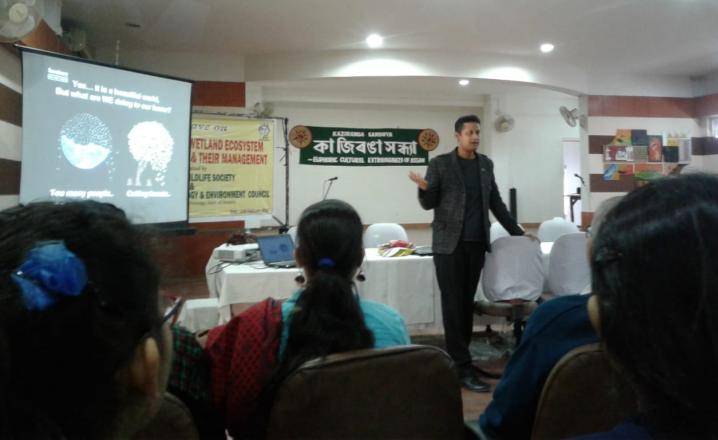
“Conservation of wetlands plays a vital role in ecosystem and vegetation development. The wetlands of Kaziranga support spectacular concentration of wildlife like the Great One-horned Rhino, Water Buffalo, Eastern Swamp Deer and various species of migratory and resident birds, fishes and reptiles. Grave consequences for wildlife have been associated with shrinking of wetlands.” said Prasanna Baruah, senior scientific officer of Assam Remote Sensing Application Centre while speaking on the “status of wetlands in Kaziranga National Park: a geospatial analysis” during a conclave held in the Convention Centre of Kaziranga on Monday. “Erosion, siltation, shallowing of wetlands, invasion of tall grassland and reduction of wet short grass area have become major threats for Kaziranga,” he warned.

The conclave on “Climate Change threats on Wetland Ecosystem of Protected Areas & their Management” was organized by Kaziranga Wildlife Society and Assam Science Technology and Environment Council (ASTEC). 

“Wetland mapping is the first step to monitoring this important part of the ecosystem. Mapping of wetlands using geospatial tool, can be done accurately at minimal costs and manpower use. Monitoring at multiple spatial and temporal scales, support better understanding of the ecosystem for continuous assessment and analysis of future trends,” Baruah also added. 

The conclave on “Climate Change threats on Wetland Ecosystem of Protected Areas & their Management” was organized by Kaziranga Wildlife Society and Assam Science Technology and Environment Council (ASTEC). 
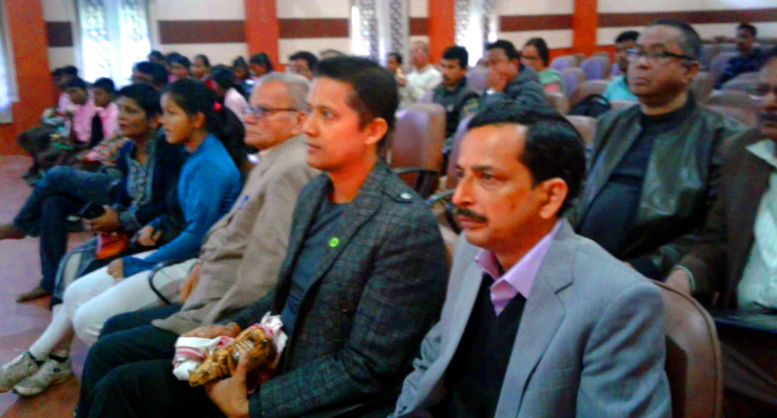
Dr Jaideep Baruah, Head, Environment Division of ASTEC in his opening remarks said that wetlands form a unique ecosystem. The role of wetlands is enormous in maintaining environmental quality, control of floods, ground water recharge and livelihood support. Wetlands provide water and habitat for a diverse range of plants and animals and therefore richest among all ecosystems from biodiversity point of view. He stressed on the need for identification and delineation of wetland areas and periodic monitoring of the physical status of the wetlands in protected areas.

Detailing the objectives of the conclave, Mubina Akhtar, secretary of Kaziranga Wildlife Society said-- “Climate change poses a threat to all ecosystems. The wetland ecosystem is the most vulnerable because wetlands are the least protected ecosystems. The New Wildlife Action Plan 2017-2031 (NWAP) of India sets out the framework for governmental intervention and management plans to be developed in the protected areas (PAs) in the coming 15 years prioritizing development and conservation goals. On the other hand, the thematic focus on climate change—an entirely a new approach in conservation discussions, would set the tone for research specific to climate change, including long-term monitoring and assessment of change in the distribution of vegetation types and ecosystems.” 
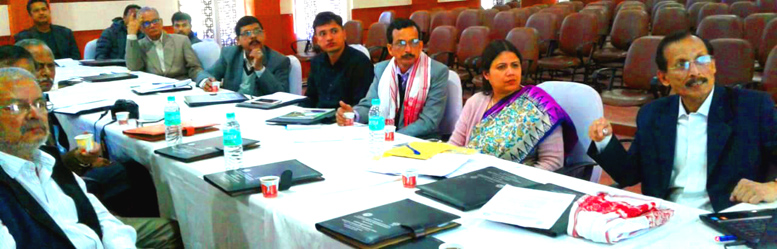
 “Kaziranga Wildlife Society now in its golden jubilee year and with the core objectives--to protect, preserve and propagate nature, wildlife and environment – has sought collaboration with the ASTE Council for a for exchange of scientific ideas on status of wetlands and threats of climate change on wetland ecosystem in protected areas and create a policy discourse between CSOs and government departments/agencies for effective management of wetland ecosystem in protected areas,” added Akhtar.

Opening the discussions, Dr Pradip Sharma, Associate Professor (Retd) Cotton University, gave out a presentation on the effect of climate change and wetland degradation in protected areas and showed the implications of climate change on the wetland ecosystem. Dr Sharma said that the total wetland area estimated in the state is 7, 64, 372 ha i.e. around 9.74% of total geographical area of the state and the number of wetlands having an area of more than 2.25 ha is 5,097. There are about 6,000 wetlands scattered in the Brahmaputra and the Barak valleys having an area of less than 2.25 ha. In addition, the state has several thousands of family owned small tanks. Besides providing water to the people of the nearby areas, these tanks can also be used for rearing fishes and raising plantation crops. Wetlands need to be protected for their unique biodiversity. If properly managed, the wetlands are going to be a source of immense wealth for this state leading also to enrichment of the quality of its environment,” Dr Sharma added.
Talking on the key issue on climate change effects on wetland ecosystem, Dr Sharma said that with increase in temperature evaporation also increases that leads to depletion of surface water level resulting in depletion of aquatic life and vegetation cover. He also blamed poor governance for loss of important wetlands in the state.

Haobam Suchitra Devi, Senior Scientist, North Eastern Space Applications Centre, Shillong  giving an analysis of land cover dynamics in Kaziranga National Park using geospatial technology, said that Bank erosion is the main cause for the loss in area in KNP and the Eastern range of the Park is the most affected one. The result also showed a gradual reduction in woodland till 1988 and again in increasing trend. Land cover in the Park is also very dynamic in nature. Wetlands have changed to grassland and woodland, grasslands to woodlands. Short grassland although occupy less area, is showing an increasing trend. Therefore, monitoring land cover is utmost priority for management of the park, the scientist warned.  

The Divisional Forest Officer of KNP, Rohini Ballav Saikia summarized the findings of the recent Waterfowl Survey in the water bodies of the Park taken up by the department last December. He hoped that future surveys would engage more participants especially from the student community in such surveys. 

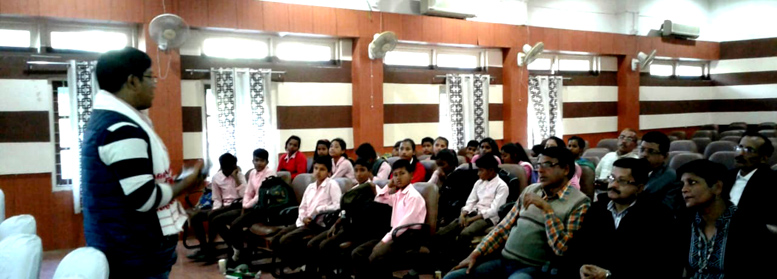
A film show on the great one-horned rhino was held for students in the post lunch session. Raj Phukan of Green Guard Nature Organization interacted with students with a slide show on climate change effects on our environment. Padum Borthakur, president Kaziranga Wildlife Society addressing the students said that the future of this earth depends on our young generation and each of the young people should become a foot soldier in the conservation movement. Arup Duarah, headmaster, Dholaguri ME School urged the students to be aware and remain vigilant of various environmental crimes happening around us. Dr Jaideep Baruah and Dr Pradip Sharma also interacted with students from Kaziranga National Park School, Vivekananda Kendriya Vidyalaya Golaghat and Dholaguri ME School.

Office-bearers and members of KWS—Sourav Mahanta, Chandan Gogoi, Ronjit Dohutia, Alak Sarma, Hariprasanna Gogoi, ACF Kaziranga PV Truinbak, Bhrigu Kalita (NESA), Achinta Goswami, Principal Golaghat VKV, Bhawani Khatiwara, teacher Kaziranga National Park School and members from WWF-India, WTI, Green Guard Nature Organization participated in the programme. 


Add new comment

Other Contents by Author

DIMAPUR, September 13: Zigzak Technologies Pvt. Ltd., a rising technology start-up founded by filmmaker and tech enthusiast Mr. Lorence Kachari, is preparing to launch its flagship lifestyle application, Zigzak, next week. The company has described the initiative as a step towards transforming digital convenience in Nagaland, the North East and beyond. The application is designed to function as an all-in-one service platform, bringing together facilities such as food delivery, grocery shopping, rides, medicines, parcel services and home services on a single interface. The development of the app has been undertaken by a team of fifteen engineers and developers based in Hyderabad, under...
Indigenous leaders of Assam have strongly condemned what they described as "barbaric atrocities" by Assam Police on members of the Koch-Rajbanshi community at Golokganj in Dhubri district on September 10. They demanded an impartial judicial inquiry and strict action against the culprits, urging the state to ensure that such incidents are not repeated when communities raise their democratic rights. At the same press conference, the leaders also expressed outrage over the detention of Bhanu Tatak — a young activist and legal advisor of the Siang Indigenous Farmers’ Forum — at Delhi’s international airport on September 7. Tatak, who had been invited to Dublin City University in Ireland for...
Mumbai: The never-say-die soul of Dr. Bhupen Hazarika enjoyed yet another acme of glory when millions of people across the globe remembered him on his birth centenary on 8th September. From Assam and Kolkata to the capital Delhi, from India’s downtown Mumbai to Bengaluru, the Bard of Brahmaputra came alive with his songs and rhymes. On 8th September, renowned music therapist and performer Anubhuti Goswami, along with her husband and multi-instrumentalist Emon Goswami, presented a soulful tribute to the legend Dr. Bhupen Hazarika as part of the birth centenary celebrations in Kolkata. The duo performed at the Assam Bhawan, organized by the Kolkata Assamese Cultural Association,...
Clashes broke out in Churachandpur district on Thursday evening, barely two days before the scheduled visit of Prime Minister Narendra Modi to Manipur, throwing the administration into a state of heightened alert. The incident occurred near Peasonmun village, situated about five kilometres from the Churachandpur police station, when a group of unidentified persons allegedly attempted to damage decorations and arrangements being put up for the Prime Minister’s public engagement. Police personnel who rushed to the spot were confronted by the miscreants, following which a scuffle ensued. Reports indicate that several properties suffered damage during the course of the incident. While...
A heartfelt felicitation ceremony was held in Lumding to honor Naga woman Mrs. T. Machapakla Ao, the visionary founder of the Assamese medium school in the town. The event, organized by the fortnightly publication Matir Manuh, celebrated her pivotal role in establishing the school in 1956—a milestone in Lumding’s educational history. Prominent speakers at the event included Rajkumar Baishya (Chief Editor, Matir Manuh), Deepak Mena (Executive President), Minati Sharma (Director Member), Prashant Hatimota (General Secretary), Sujata Sharma (Social Media Secretary), Anup Arandhara (Secretary, Mung-Dun-Chung Kham, Assam, NE India), Dr. T. Lima Jamir (President, Nagaland Indigenous People’s...
In recent years, Assam has witnessed a series of eviction drives that have displaced thousands, predominantly targeting Muslims of East Bengali origin. These individuals, often referred to as 'Miyas', have faced allegations of being 'illegal immigrants' despite possessing valid Indian documentation. The state's actions have raised concerns about the underlying motives and the implications for democracy and human rights. Political Motive Behind Evictions Experts argue that these eviction drives are strategically timed ahead of elections to create a divisive narrative. The ruling BJP is accused of attempting to foster a Hindu-Muslim divide, with some local organizations already holding...
In a move that has sparked anger and unease, police in Diphu have detained Karbi youth leader and social activist Lichong Rongphar for spearheading protests demanding eviction of alleged illegal settlers from VGR (Village Grazing Reserve) and PGR (Professional Grazing Reserve) lands in Karbi Anglong. The irony is stark: while Chief Minister Himanta Biswa Sarma’s government is carrying out aggressive eviction drives in the plains—Lakhimpur, Dhubri, Goalpara and Uriamghat—similar demands raised in Karbi Anglong are being met with police crackdowns instead of action. Rongphar had been leading a series of mass protests, insisting that Bengali and Bihari settlers occupying VGR and PGR...
On the auspicious occasion of the birth centenary of Bharat Ratna Dr. Bhupen Hazarika, the Assam government has handed over the legendary singer’s neglected residence at Kuthori, Kaziranga, to local residents for preservation. For the past five years, the house—once vibrant with the maestro’s harmonium, tabla, and compositions—had fallen into disrepair, leaving fans and admirers disheartened. Although the government had acquired the property at a cost of ₹2.51 crore from Fatik Nyog five years ago, no concrete conservation efforts had been initiated since. Responding to repeated demands from villagers, the government announced today that the residence will be developed into a cultural...
The University of Science and Technology Meghalaya (USTM) celebrated the 100th birth anniversary of Bharat Ratna Dr. Bhupen Hazarika with a vibrant cultural programme at its Central Auditorium. Themed “Voice of Bhupen Hazarika: Voice of the People; Leading to a Harmonious Society,” the event featured visual presentations, floral tributes, and lively performances by students and faculty. Prasanta Rajguru, Editor-in-Chief of Prag News, delivered the keynote, highlighting five iconic songs of the maestro and their historical relevance. Actor Kamal Singh presented a special tribute performance, while dignitaries including Dr. Aparna Buzarbaruah graced the occasion. The celebration...
In a landmark wildlife discovery, the elusive Pallas’s Cat has been documented for the first time in Arunachal Pradesh during an extensive high-altitude survey jointly conducted by the Department of Environment, Forest & Climate Change, Government of Arunachal Pradesh and WWF-India. The survey, carried out between July and September 2024, involved 136 camera traps across 2,000 sq km of rugged terrain in Tawang and West Kameng districts. It not only produced the first photographic record of Pallas’s Cat in the state, but also revealed the presence of five other wild cats — snow leopard, common leopard, clouded leopard, leopard cat, and marbled cat — at elevations above 4,200 metres...