
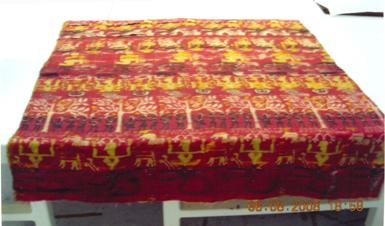
Historical records provide ample evidence of glorious textiles tradition of Assam. At the request of the Koch king’s brother: Prince Chilarai, Sri Sankaradeva took up the project of tapestry weaving for which he engaged the weavers of Tantikuchi or Barpeta. Eventually, the Brindabani Bastra was lost though the last place of resort for the Bastra was the Madhupur Sattra in Koch Behar.
The Brindabani Bastra a figured silks from Assam: from the 16th – 18th century (measuring 120 cubits long and 60 cubits broad) are rare silk textile fragments depicting scenes from the life of Lord Krishna in a floral, naturalistic and preciously elegant style are preserved at the Blythe House, part of British Museum. Also in other museums like Victoria & Albert Museum, Chepstow Museum in Wales, Calico Museum of Textiles in Ahmedabad, Newark Museum in New Jersey, Virginia Museum of Fine Arts in Richmond, Museum of Mankind in London, Philadelphia Museum of Art, Centro Internazionale delle Arti e del Costume in Venice and AEDTA Collection in Paris.
 As Richard Blurton, the Curator at the British Museum explains, it was Perceval Landon, a British journalist and special correspondent for The Times who acquired the Brindabani Bastra on his expedition to Tibet in 1903 – 1904 in a town called Gobshi. And he gave the textile to British Museum in 1905 over a hundred years.
Rosemary Crill, the researcher & the author of the book Vrindavani Vastra: Figured Silks from Assam is a Senior Curator for the Asian Development at the Victoria & Albert Musem. Her suggestion is that it can be linked examples some of which emerged from Tibet to Assamese Vaishnavite rituals. The piece which is at British Museum can not be certain that it belongs to the period of Sankaradeva. But pieces in other places could be about Sankardev's time.
Museum would be very dull places if they could only display works that were made in their own countries or ethnic areas. What is most important is that art is displayed publicly not hoarded in private collections. Galleries upon galleries of European and American museums can be seen filled by objects from ancient Egypt, Greece and Rome.
The colonial powers as we like to call them were the ones that preserved these treasures. Without them most of these artefacts would have disappeared by neglect. Many works of art have been preserved better as a result of being carefully handled in a foreign museum: there is the theory that the Elgin marbles would not have remained in their present condition in Athens because of the high air pollution levels, and similarly, many treasures would have been lost or destroyed for ever had they not been removed by outsiders.
Perceval Landon must have understood the importance of Brindabani Bastra when he found it in Gobshi and decided to bring all the way from Tibet to a safer home like British museum.
The world does seem a smaller place nowadays and to me these treasures do belong to the world. Cultural artefacts were local then became national and are now global. Civilisation is not a civilisation if you do not share with others. British Museum has done a good job of looking after them and naming its original.
As coming from Assam, I can feel the sentiment of Assamese people today being emotional and stubborn to bring back Brindabani Bastra to Assam.
 We can not do anything to conserve what we already have. What about the wealth of historical treasures such as monuments and artefacts from our deep past. In the name of preservation and conservation of the Majuli Sattra, State Archives, State museum, District library to name a few are in a dilapidated condition. Archaeological Survey of India has often complained that lack of adequate funds is largely responsible for its inability to protect the country’s museums and monuments.
Assamese has a very rich literary history, is known to have written literature starting the thirteenth century before the printing press was brought to Assam by Europeans. The books were written painstakingly in hand on especially prepared paper from locally available resources. Some of these documents stored in the museum of Assam and Gauhati University library in various conditions, most not so scientific. And as a result of the natural calamities, sheer neglect and lack of knowledge, the precious hand-written books, dating back centuries are slowly getting destroyed.
A long year of neglect have taken its toll on a number of sites of historical importance, the ancient monuments of the state have failed to get the recognition that they deserve.
We demolish old temples. Not to speak of other sites, cracks on the famed Rang Ghar and Kareng Ghar, have now endangered the very existence of this structure. The NorthBrook gate in Jubilee garden, Panbazar, in the very heart of Guwahati is facing the burnt of neglect, and big cracks have appeared on the pillars. I remember as a child we used to play hide and seek inside the gate. This gate was constructed near Sukreswar ghat on the bank of river Brahmaputra, where NorthBrook got down from the ship to visit the city in 1874. It also welcomed Lord Curzon during his visit to Guwahati from Kolkata.
Another sad example: when we demolished our old Cotton College administrative building, which was built in 1901 initiated by Sir Henry Cotton. It is our heritage. Isn’t it?
British maintained English Heritage. They aim to make people understand and appreciate the importance of historic site to get the care and attention it deserves, from the first traces of civilisation to the most significant buildings of the 20th century. They feel that it is their job at English Heritage to make sure that the historic environment of England is properly maintained and cared for. In Stratford -upon-Avon, Shakespear’s cottage, the original structure of the building still stand as it is. They renovate, redecorate but never change the structure.
Now both India and Assam wants to claim back the Kohinoor Diamond and Brindabani Bastra. Good job Taj Mahal was not mobile! It might have been on the other side of Big Ben today? This is sentiment!
Unfortunately this is like trying to rewind history. Where would you stop? Would every Roman artefact in Britain have to be sent to Italy, along with every Roman or Greek statue? Would the French want back statues that were cast from the bronze of their guns, could the South African’s claim back all their diamonds and gold? Should all Dutch paintings be sent back to Holland? It just wouldn’t work.
 In Victoria & Albert Museum one can see the famous Tipoo’s Tiger which had been damaged in the Second World War. Also many works of Buddhist art from Central Asia was also damaged in Berlin and lost forever. In such a volatile world where works of art be safe?
Who were to deny that Britain is a colonial misadventure of last century? But Britain has also brought a morale system into the society.
We are no more than the summation of our experiences. For our experiences define our identity. In case of Brindabani Bastra, the problem is how can we establish the original ownership? So, far nothing has come up.
But again once the State Government is not in a position to preserve and conserve the already existing artefacts, how can we be assured safe keep of Brindabani Bastra in Assam.
The climate of Assam is very humid. It rains torrentially during the Monsoon season. The Brahmaputra and the many hundreds of big and small rivers and tributaries in Assam are prone to damaging floods almost every year. Earthquakes are fairly common as well. There are hardly any scientifically maintained archival sites.
However a temporary measure, for the public viewing of Brindabani Bastra one can suggest in a place like Srimanta Sankardev Kalashetra, Guwahati, provided it has any scientific method to preserve. The arrangement should be for a limited period only.
Once more Brindabani Bastra in its current location is much more safer and available for many more people who might be interested in arts and culture
As an Assamese, I feel fortunate that I am able to view this historic piece of textile in British Museum where every care is taken to preserve and conserve.
Text & Photo: Rini Kakati, London
- Add new comment
- 89595 reads


Comments
Pages
Add new comment