
Skip to content Skip to navigation

Remembering Panditji

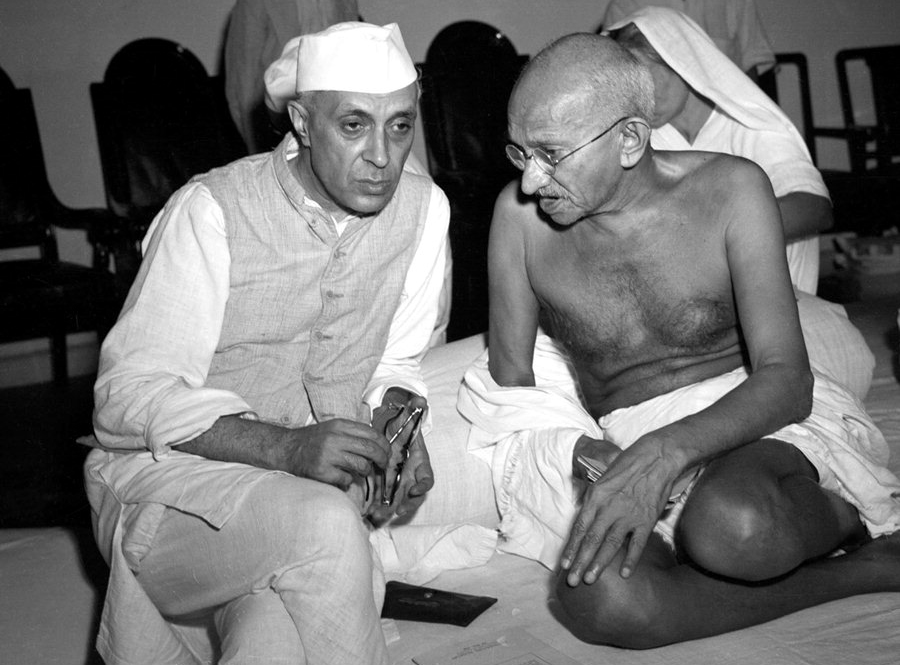
Forty-four years ago on May 27 the first Prime Minister of India died in harness. About Pandit Jawaharlal Nehru, Maulana Abul Kalam Azad wrote in his autobiography: ‘Jawaharlal asked me in despair, what other alternative there was to accepting partition?……..I told Jawaharlal that I could not accept his views.’ Azad added: ‘The Muslim League had accepted the Cabinet Mission Plan, and a satisfactory solution of the Indian problems seemed in sight. Unfortunately the position changed and Mr. Jinnah got a chance of withdrawing from the League’s earlier acceptance of the Plan…… I warned Jawaharlal that history would not forgive us if we agreed to partition. The verdict would then be that India was divided as much by the Muslim League as by the Congress.’ Partition was then inevitable.

In the 1946 July election of Congress President, Maulana Azad would not accept the high office. He desired unanimous election. The contest meant fighting over the opposite issues: Cabinet Mission Plan or Mountbatten Plan? As Vallabhbhai was adamant and would not withdraw, Azad withdrew himself. In my view Azad should not have withdrawn. In the contest he was sure to be re-elected. His was an error of judgment, nay his life’s blunder. The course of history would have been otherwise. There would have been no partition.

The majority in Congress was for the Poona Formula and Meerut Congress resolution of November 1946 – the ‘Congress Formula’ vis-a-vis Cabinet Mission Plan, and strongly against partition. Azad’s Working Committee would have given an altogether different course to the events. Maulana later confessed his error. India as a whole was in no mood to accept partition. So Vallabhbhai found slender support in the Congress. There was confusion – a deadlock. The Congress was caught on the horns of dilemma. Patel had no chance. At the end Jawaharlal was found to be the missing link. He was unanimously elected July 22, 1946. This weak link soon broke down.

I am tempted to ask, why Jawaharlal, who always soared high and who was a staunch, uncompromising opponent of partition of India up to the last, at last succumbed to Mountbatten? Thou too, Brutus!……Nehru did not hold Patel’s view; on the contrary, he was radically opposed to it. In fact, Nehru admitted that ‘Partition was wrong’, but he felt that it was ‘inevitable’, and that ‘it would be wisdom not to oppose what was bound to happen’, and that ‘it would not be wisdom to oppose Lord Mountbatten on this issue’! Jawaharlal accepted defeat, surrendered totally. He ‘believed’ that his friends, the Mountbattens ‘acted in India’s interests as zealously as any India could have done’, so wrote Allen Andrews under the caption, ‘The Fantastic Mountbattens’.

My own reading is: Jawaharlal Nehru might have pleaded that, in the then compelling circumstances ‘individuals did not count’; no ‘static’ thinking would do; ‘force of rapid events’ were compelling; the Congress must take ‘dynamic decision’ in the exigency of the situation that developed; etc. That was all playing to the gallery. But the fact remains that he completely succumbed to the overtures of Mountbatten. And, as a very shrewd politician that he was, he foresaw that it was ‘wisdom’ not to range himself against Patel, the coming hero of partition and therefore to be the sole leader of Congress as soon as partition became a fait accompli: A battle for leadership! In power politics ‘wisdom’ is dictated by majority of votes. Jawaharlal Nehru was after all a ‘democratic leader’! It is an open secret that this battle of leadership and wits between Nehru and Patel continued ad nauseam until the latter made his journey to the ‘bourne from which no traveller ever returns’. Behold, the partition resolution of June 14, 1947, was passed in the A.I.C.C. – the last resolution in pre-independence Congress, by 29 votes for Patel-cum-Nehru and 15 against! (My father, Maulana M. Tayyebulla, Assam Congress President voted ‘against’.) Too many abstentions and absentees….

With all the weaknesses that every political leader has, Panditji remains the most respected, loved, adored and remembered Prime Minister.

Comments

nayan's picture

Nehru was responsible for partition of India. He was selfish and power hungry.

Pages

Add new comment

Other Contents by Author

Chief Minister Tarun Gogoi has written to his counterparts in Kerala, Andhra Pradesh, Karnataka and Maharasthra to ensure safety of the Assamese people living in these states. According to information, Gogoi has received assurance that the people from the states would be provided adequate security in the time of ethnic clash in BTAD areas and Dhubri. Gogoi has given instruction to the district authorities to maintain calm even as Prime Minister Manmohan Singh, UPA chairperson Sonia Gandhi and the Union Home Minister Sushil Shinde have given separate assurances that security will be provided to affected people.
Security forces have been put on alert to ensure peace and normalcy during the Independence Day celebrations across the state on Wednesday. Additional forces are remaining stand by at sensitive locations to foil any attempt by militant outfits to create distrubances. The government has some intelligence inputs about ULFA’s possible attempt to disrupt the celebrations in Sivasagar, Dibrugarh, Tinsukia, Lakhimpur and Dhemaji districts. A 'red alert' has already been sounded across the state, which witnessed a few IED blasts targeted at security personnel during the past couple of weeks, particularly in Goalpara district. The anti-talk faction of ULFA has called a customary state-...
Altogether 10,636 refugees having left the camps set up to accommodate the violence-hit people in BTAD areas and Dhubri. According to government sources, 2,92,852 inmates are still sheltering in 228 relief camps. Kokrajhar district alone has 10,300 inmates in the camps. Around 336 people went back in Chirang. But nobody in Dhubri district has left the camps. Among the total inmates in the relief camp, 61,439 belong to the Bodo community while 2,31,413 are from the minority community. In Dhubri, 1,55,314 people are living in the relief camps, 77,459 in Kokrajhar, 47,477 in Chirang and 12,602 in Bongaigaon, the release said. Dhubri has the highest number of 133 relief camps followed by...
President Pranab Mukherjee on Tuesday expressed grave concerns over the escalating tensions between two ethnic groups in BTAD areas and Dhubri. In his presidential address to the nation on the eve of the Independence Day, Mukherjee said, "old fires that threaten the stability of the nation have not been fully doused the ash continues to smoulder. According to Mukherjee, minorities need solace, understanding and protection from aggression. Violence is not an option violence is an invitation to greater violence. He further said that peace was required for a new economic surge in the region that can quell the competitive causes of violence.
President Pranab Mukherjee on Tuesday said that time has come to revisit the Assam Accord and adapt it to the present conditions. In his address to the nation on the eve of the 66th Independence Day on Tuesday, Mukherjee said that concrete attempts are on to heal the wounds which includes the Assam accord signed by former Prime Minister Rajiv Gandhi. Notably, the Assam Accord was signed on August 15, 1985 by the Centre, state with student leaders of the Assam.
Sashastra Seema Bal personnel have been awarded with various police service medals on the eve of Independence Day. Constable Subhash Kumar was posthumously awarded with the Police Medal for gallantry for undertaking operations against insurgents in Kokrajhar district. The other awardees of the President's Police Medal include DIGs Chanchal Shekhar (meritorious service) and Subhash Kumar (distinguished service). The Centre deploys SSB personnel along Indo-Nepal and Bhutan borders.
The Centre has asked all states to provide security to the north east people living across the country. In a communication, the Home Ministry said there have been reports of attack on students and other people from Northeast in Maharashtra and Andhra Pradesh and immediate steps must be taken to stop such kind of violence. These states include Maharashtra, Andhra Pradesh, Karnataka, Tamil Nadu and Delhi. The communiqué said that a large number of Northeast people have been living in these states which is why, additional forces have been deployed.
Police officials probing the recent Mumbai violence on BTAD riot have raised doubts on the role of a section of politicians from Assam. They sure of a particular political party’s role with vested interests and there was a strong possibility of some people from outside Mumbai being behind it. The agencies have found that those who indulged in violence were brought to the spot in hired buses and were armed with lathis, sickles and other instruments. Two persons were killed and at least 55 injured when a protest in Mumbai’s Azad Maidan against BTAD riots and attacks on Muslims in Myanmar turned violent on Saturday with demonstrators torching vehicles and pelting stones.
Assam Chief Minister Tarun Gogoi on Tuesday said that his government will give priority to the development of rural areas saying that only the rural Assam would help the state progress on all fronts. Addressing a function in Guwahati, he said that the government has been village-centric since day one as without the development of rural areas no real development can take place. Minister for Panchayat and Rural Development Rakibul Hussain said a total 60 vehicles had been distributed today in the first phase to the BDOs to improve their access to the remote areas.
AIUDF has asked Assam Chief Minister Tarun Gogoi to bear responsibility for the incident. Party president Badruddin Ajmal said that the law and order machinery in the state has failed and Gogoi as the chief minister has to bear the responsibility for this. The condition of the minorities affected in the violence was pathetic and they would not be able to return to their respective homes from the camps by August 15 as most are still traumatised.