Skip to content Skip to navigation

Regional workshop on food sovereignty held

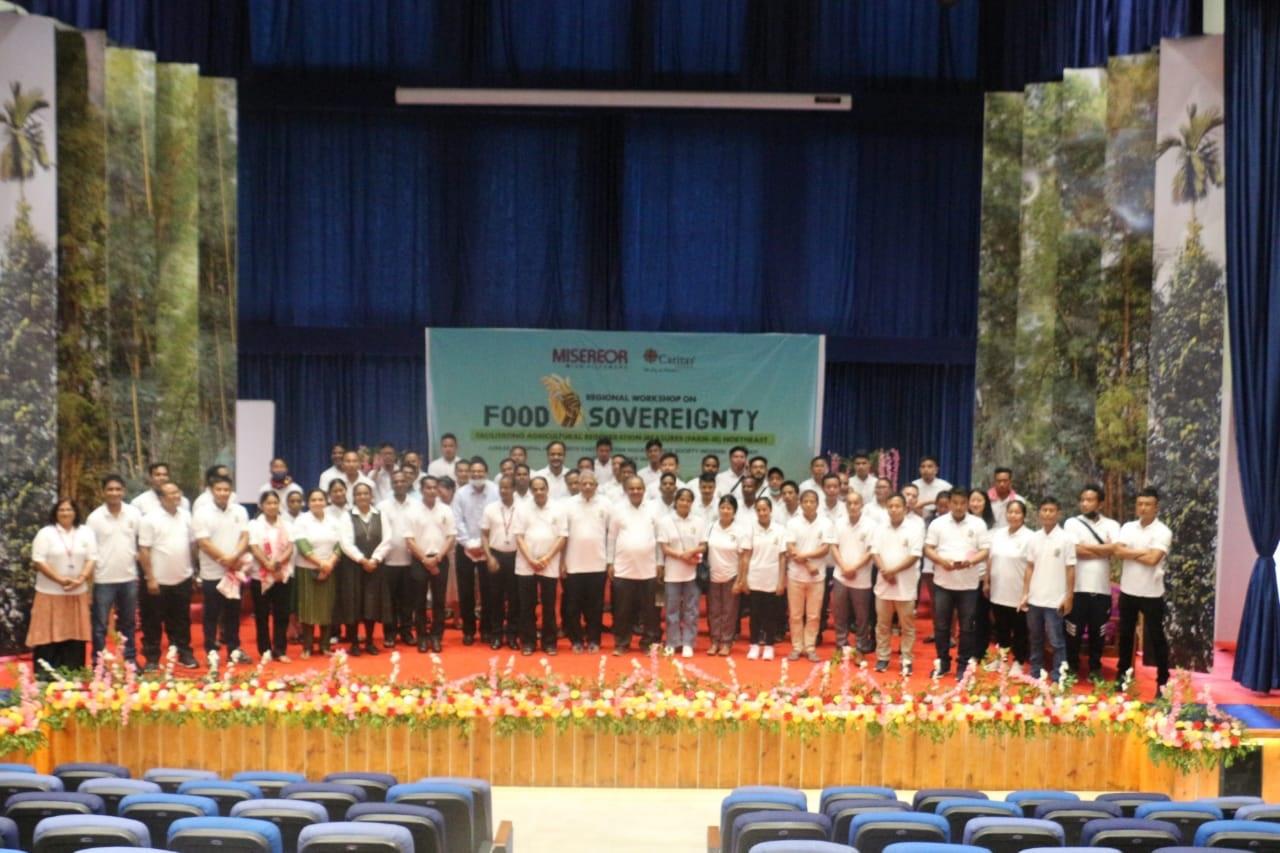
Guwahati: “My home is where my food is grown” was the talking point of two days regional workshop on Food Sovereignty concluded in Guwahati which was held on October 26 to 27 and organized by Caritas India at Silver Jubilee Memorial Conference Hall of Northeast Diocesan Social Service Societies, Guwahati. Altogether 76 participants of 16 partner organisations from all seven states participated. 16 farmers stalls were installed by 16 partner organisations to showcase their organic farm produce as well as wild edibles under the FARM NE banner.

Dr. Rituraj Phukan was the Chief Guest to grace the occasion along with Dr. Pranab Bujarbarua, Assistant Professor, Department of Botany,  Jusmita Borah, Environment Expert, Assam Inland Water Transport Project, Govt of Assam and Mrinal Gohain, Regional Manager ActionAid, Fr. Dr. Sabastian, Director NEDSSS Guwahati. To accompany the honorable guest speakers, Rev Dr Jolly Puthenpura Assistant Executive Director, Devi Kalyani Pattnaik Chief Operations Lead, Pradipta Chand Lead-Climate Adaptive Agriculture and Food Sovereignty along with the Northeast Regional Caritas India team members were among them.

While sharing on the food and climate crisis, Dr Rituraj Pukhan raised concern over the present food habits by quoting a song “My home is where my food is grown” which drew the attention of the participants that we are not eating what we are growing. While sharing his message, he emphasizes the importance of local seasonal food including wild edibles and encourages people to grow their own food. Growing your own food helps to maintain good health by reducing food miles, food waste and external dependency on the market for inputs. He showed the comparison of summer temperature from 1936 to 2021 and showed that the last 7 years were the hottest years.

Rev Dr Jolly Puthenpura shared the current national situation in the context of food and farm biodiversity, where smallholder farmers are among the most vulnerable groups to climate change. They have been hit hardest by climate change considering their small and fragmented landholdings. Scaling-up for resilience and adaptation through smallholder led integrated farming systems, Caritas India has initiated adaptive models considering different agro-ecological climatic conditions of the region in consultation with the relevant regional research stations to ensure smallholder’s production, income, nutrition, resilience, and farmers control in the face of climate threats. Facilitating Agriculture and Regeneration Measures (FARM) is one of those flagship programmes of Caritas India, which is being implemented in 7 states with 12,365 small and marginal farm families. FARM has been able to create a remarkable impact on the lives of small farm families where smallholders are taking the lead in creating sustainable models of agricultural development by enhancing their incomes.

Sharing about the Caritas India’s initiative under the climate adaptive agriculture and food sovereignty theme, Pradipta Kishor Chand has presented three evidence-based models on climate resilient agriculture, community managed food and nutrition and a small-scale value chain of small-farm-agri-food. He shared the relevance, effectiveness, and impact of smallholder owned models experimented with in smallholder adaptive farming and biodiversity networks.

Dr. Pranab Bujarbarua emphasized the promotion of local farm biodiversity by diversifying small farms with maximum local varieties inclusive of cereals, pulses, oil seeds and vegetables to invite pollinators and predators for better farm production. While speaking on this, he also stressed on the wild edibles and leaves having great nutritional values and specific characteristics to be used as bio-pest repellents which are natural and no harm to the local biodiversity. Dr. Jusmita Borah, giving her presentation on resilient communities made participants think about how our resources are going to become extinct. 


Add new comment

Other Contents by Author

The number of journalists killed worldwide has surged dramatically in the first half of 2025, according to the Press Emblem Campaign (PEC). Since January, 86 media workers have been killed across 26 countries, marking a 16% increase compared to the same period last year. Gaza: Epicenter of the Crisis The ongoing conflict in Gaza is the primary driver behind this spike. At least 31 Palestinian journalists were killed in six months by the Israeli army, accounting for more than a third of the global toll. “The Israeli government is directly responsible for this tragedy, which targets civilians reporting on the situation in Gaza. The Israeli soldiers involved in these war crimes must...
Guwahati: – A transformative capacity-building workshop, “Learning from the Land: Participatory Knowledge Harvest from Assam and Meghalaya,” was held at Tata Institute of Social Sciences (TISS), Guwahati Off-Campus, on Friday, June 27, 2025. Organized by TISS in collaboration with UNDP-SGP, the event brought together over 50 NGOs from Assam and Meghalaya to exchange grassroots knowledge and strategies for sustainable land use, agroecological practices, and environmental conservation. The workshop aimed to empower local communities by enhancing skills in biodiversity conservation, land restoration, rural development, sustainability, and climate change adaptation. Prof. Jagannath Ambagudia...
Guwahati: The Assam Pradesh Congress Committee (APCC) has accused the BJP-led state government under Chief Minister Himanta Biswa Sarma of driving tea garden workers into a severe health crisis, with the average worker’s body weight dropping below 50 kg due to malnutrition and anemia. In a press conference on Wednesday at Rajiv Bhawan, APCC Working President Roselina Tirkey, joined by tea tribe leaders Raju Sahu, Etowa Munda, and Pranjal Ghatowar, condemned the government for neglecting workers’ welfare and plotting to dismantle Assam’s tea industry. Raju Sahu emphasized the alarming health decline, stating that malnutrition and anemia have rendered many tea workers unfit to donate blood...
In Assam, the land of the Brahmaputra, tea gardens, and vibrant indigenous cultures, a troubling pattern has emerged. The state’s push for development—solar plants, thermal power stations, cement factories, and urban restoration—has come at a devastating cost to its original inhabitants, the Khilonjiya. These indigenous communities, including Karbi, Bodo, Dimasa, and Adivasi, are being displaced from their ancestral lands to make way for wealthy industrialists and corporate giants like Adani. While rich outsiders are welcomed with open arms, the Khilonjiya bear the burden of uprooted lives, lost livelihoods, and erased heritage. This blog chronicles few recent land disputes, exposing the...
Guwahati: Expressing concern over the Sivasagar crude-oil well gas leakage in the last few days, a northeast India based forum of graduate engineers have urged both Oil and Natural Gas Corporation (ONGC) and Oil India Limited (OIL) to come clear about the so-called ‘abandoned’ wells, which have the potential to harm human life, property and environment, as the concerned private parties operating such wells often do not come forward to take responsibility.  All Assam Engineers Association (AAEA), in a statement, also appealed to the Union government in New Delhi to hold the concerned ONGC/OIL  officials accountable for any disaster at an oil or gas well after having declared it '...
On May 26, 2025, Gaurav Gogoi, a three-time MP and son of former Chief Minister Tarun Gogoi, was appointed President of the Assam Pradesh Congress Committee (APCC). His appointment marked a generational shift in Assam’s Congress leadership and was seen as a strategic move to reinvigorate the party ahead of the 2026 Assembly elections. Gogoi’s clean image, recent Lok Sabha victory from Jorhat by a margin of 1.44 lakh votes, and appeal among youth positioned him as a serious contender against Chief Minister Himanta Biswa Sarma. Gogoi's appointment replaces Bhupen Kumar Borah and is backed by a team of working presidents including Jakir Hussain Sikdar, Roselina Tirkey, and Pradip Sarkar....
Assam, a state rich in natural resources, has faced recurring nightmares from its oil and gas industry, with devastating impacts on its people and environment. The Baghjan gas leak of 2020, operated by Oil India Limited (OIL), and the ongoing ONGC gas leak in Sivasagar (June 2025), operated by Oil and Natural Gas Corporation (ONGC), are stark reminders of the human cost of industrial mishaps. This blog post delves into the profound effects on common people in both incidents, compares their timelines for containment, and highlights the urgency of addressing systemic issues to prevent future tragedies. The Baghjan Gas Leak (2020): A 173-Day Ordeal On May 27, 2020, a catastrophic blowout...
The Tai Ahom Indigenous Rights Forum convened its Executive Committee Meeting today at the Tai Educational and Cultural Centre in Boiragimoth, Dibrugarh. The meeting was presided over by Chow Sanjib Rajkonwar, President of the Forum, and saw the active participation of executive members, advisors, and regional representatives from across Assam. The gathering served as a vital platform to deliberate on the strategic direction of the Forum, with a special focus on aligning the movement for Tai Ahom rights with the principles enshrined in the United Nations Declaration on the Rights of Indigenous Peoples (UNDRIP) 2007. The Forum reaffirmed its unwavering commitment to advocating for the...
New Delhi: The Supreme Court on Monday declined to accept a plea by All BTC Minority Students’ Union (ABMSU) raising concerns over the state’s “indiscriminate” move to detain and deport suspected foreigners. A Bench of the top court comprising Justices Sanjay Karol and Satish Chandra Sharma asked ABMSU to move the the Gauhati High Court. In writ petition, the organisation questioned the growing pattern of deportations by the Assam Government through informal “push back” mechanisms, without any judicial oversight or adherence to the safeguards envisaged by the Constitution.
Guwahati: Rains in Assam have stopped. But the water level of the Brahmaputra and its tributaries have yet to recede rendering over 4 lakh people homeless in as many as 17 districts of the state. In Cachar district alone over 1 lakh been have been rendered homeless because of the 4 day long incessant rains. Sribhumi district also witnessed no less misery of 90,000 people to be followed by Nagaon district where over 65,000 people have been affected. A huge area of Lakhimpur district has come under the surging water after the Ranganadi dam released its excess water pushing thousands of families in brimful misery. Assam Chief Minister Himanta Biswa Sarma is on a stock taking visit to the...