Skip to content Skip to navigation

Flood alert: ‘unprecedented’ volume of water flows down Brahmaputra

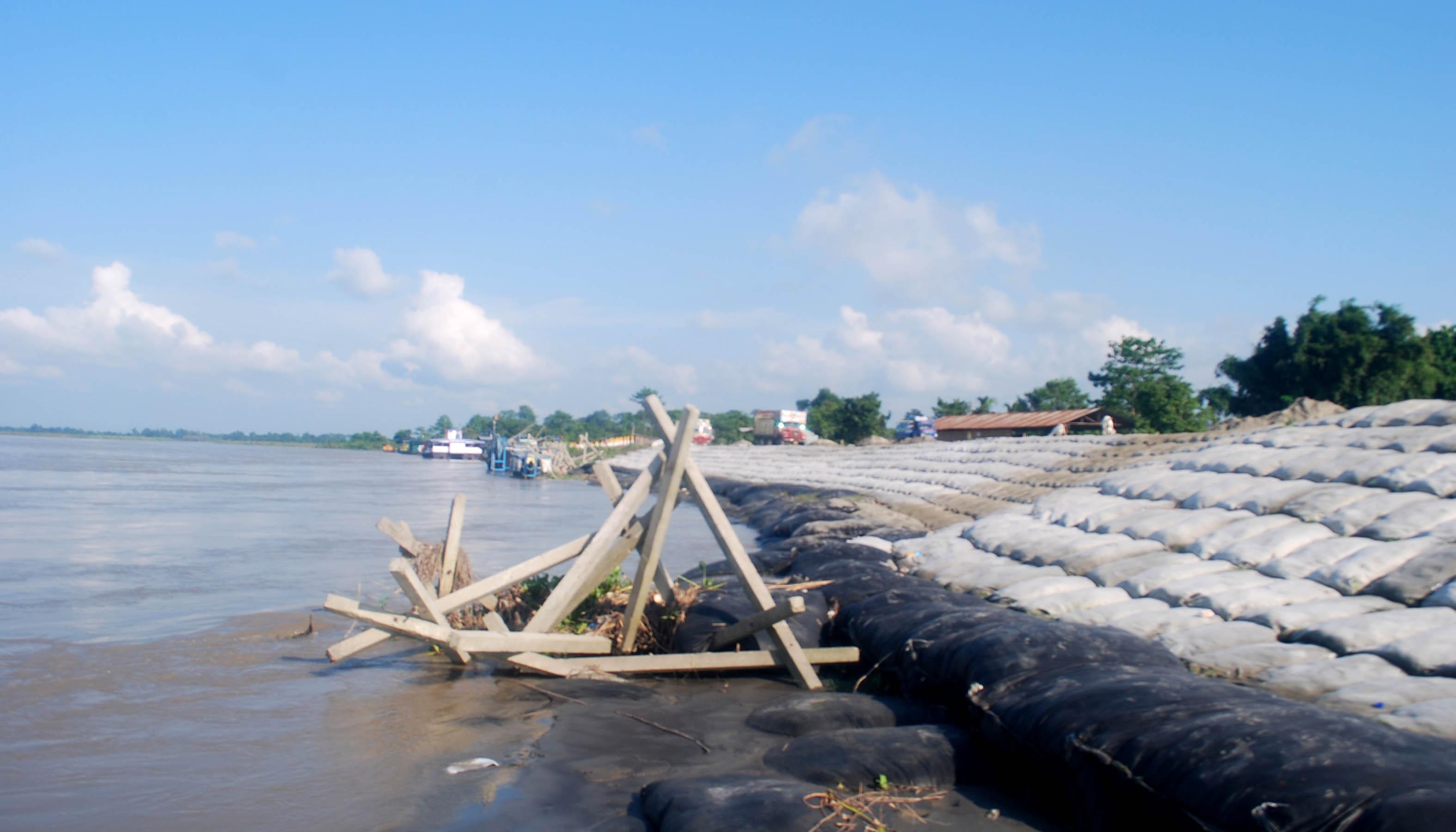
View of Bodatighat of Brahmaputra in Bihpuria. Photo by UB Photos

A massive cloudburst in Tibet has forced authorities in China to release more water down the Brahmaputra than at any time over the last 50 years. China has warned India about the release in the transboundary river – known as Yarlung Zangbo in China – and two Indian states are on high alert for floods.

The discharge was measured at 9,020 cubic metres per second (cumec) at 8 a.m. on August 29 and led to huge waves on the Siang in Arunachal Pradesh, the state in northeastern India through which the river enters India. Eyewitness reports estimated the wave heights at up to four metres, in a river that usually has hardly any waves at all.

In contrast, the discharge on August 14 had been measured at 8,070 cumec, according to India’s Central Water Commission. The Siang joins two other rivers downstream to form the Brahmaputra.

Tamiyo Tatak, the Deputy Commissioner of East Siang district in Arunachal Pradesh, sent out a warning the same day, asking people “to refrain themselves from venturing into Siang river for fishing, swimming etc. to avoid any eventualities. Further, people living in low lying areas (both right bank and left bank) viz. Jarku, Paglek, SS Mission, Jarkong, Banskota, Berung, Sigar, Borguli, Seram, Kongkul, Namsing, MER nearby Siang river are advised to remain alert but not to panic.”

Eyewitness reports on the morning of August 31 said the waves had gone down, but the Siang was still flowing at a far higher level than usual, even during the height of the monsoon.

Despite the official warning, 30 people were reported stranded on an island in the Siang in the Sille-Oyan area on the morning of August 31. The Arunachal Pradesh government has requested the Indian Air Force to send helicopters that can winch these people to safety, since the island is too small for a helicopter to land.

Assam on high alert too

Further downstream, the Assam State Disaster Management Authority (ASDMA) warned the Dibrugarh district administration in the eastern part of the state to be on high alert. Laya Maduri, the Deputy Commissioner of Dibrugarh district, sent out an order on August 30.

It read, “Flood warning has been received from ASDMA that as a result of release of excess water by Chinese Government, there may be unprecedented rise in the water level in the river Brahmaputra thereby causing severe flood. Therefore, officers of district are asked not to leave Headquarter…”

Reports on the morning of August 31 said the Brahmaputra was flowing high in Dibrugarh, but had not crossed the danger mark yet.

Transboundary cooperation

Authorities in India were able to prepare for this 50-year high in Brahmaputra water discharge well in advance, due to the warning provided by the Chinese authorities. China resumed providing water flow data to India this May under a Memorandum of Understanding (MoU) between the two countries. The data supply had been stopped in 2017. Observers in India blamed that on a face-off between the Chinese and Indian armies along their 3,500-km Himalayan border, though the Chinese authorities had said they were upgrading their water level measuring stations.

Since 2009, thethirdpole.net has consistently advocated for closer cooperation between China and India over the transboundary river Brahmaputra, which later flows into Bangladesh to join the Ganga. The scope of the MoU has been expanded over the years, but far more is possible.

Noted Brahmaputra expert Partha Jyoti Das told thethirdpole.net, “It is good that China is now regularly providing hydrological data through the monsoon period, but a lot more can be done. We need topographical data as well. That will tell us where landslides are likely to occur after heavy rain, and then we can foresee the possibilities of a flood even earlier.”

In the absence of any water flow data from the Chinese government in 2017, there had been panic in Arunachal Pradesh and Assam in November that year, when the sediment load in the river went up all of a sudden and the water almost ran black for a number of days. Independent experts from India had later said the high sediment load was due to an earthquake in Tibet, which had led to a landslide blocking the water flow in the river for some time, before it all came roaring down together.

Anamika Barua, who teaches at Indian Institute of Technology, Guwahati, has explored possibilities of regular flow of information between China and India on the Brahmaputra, through civil society channels as well as the governments. The panic in 2017 may have been avoided if some of her recommendations had been acted upon by academics in China.

Das was critical of the central and Assam governments in India for not sharing any information with the people on last November’s episode. “Have they done any studies on why this happened? If they have, why don’t they share their results in public? What the government says is important. Without that, there can be a lot of unnecessary panic.”

 By Joydeep GuptaFirst Published in The Third Pole

Add new comment

Other Contents by Author

Guwahati: – A transformative capacity-building workshop, “Learning from the Land: Participatory Knowledge Harvest from Assam and Meghalaya,” was held at Tata Institute of Social Sciences (TISS), Guwahati Off-Campus, on Friday, June 27, 2025. Organized by TISS in collaboration with UNDP-SGP, the event brought together over 50 NGOs from Assam and Meghalaya to exchange grassroots knowledge and strategies for sustainable land use, agroecological practices, and environmental conservation. The workshop aimed to empower local communities by enhancing skills in biodiversity conservation, land restoration, rural development, sustainability, and climate change adaptation. Prof. Jagannath Ambagudia...
Guwahati: The Assam Pradesh Congress Committee (APCC) has accused the BJP-led state government under Chief Minister Himanta Biswa Sarma of driving tea garden workers into a severe health crisis, with the average worker’s body weight dropping below 50 kg due to malnutrition and anemia. In a press conference on Wednesday at Rajiv Bhawan, APCC Working President Roselina Tirkey, joined by tea tribe leaders Raju Sahu, Etowa Munda, and Pranjal Ghatowar, condemned the government for neglecting workers’ welfare and plotting to dismantle Assam’s tea industry. Raju Sahu emphasized the alarming health decline, stating that malnutrition and anemia have rendered many tea workers unfit to donate blood...
In Assam, the land of the Brahmaputra, tea gardens, and vibrant indigenous cultures, a troubling pattern has emerged. The state’s push for development—solar plants, thermal power stations, cement factories, and urban restoration—has come at a devastating cost to its original inhabitants, the Khilonjiya. These indigenous communities, including Karbi, Bodo, Dimasa, and Adivasi, are being displaced from their ancestral lands to make way for wealthy industrialists and corporate giants like Adani. While rich outsiders are welcomed with open arms, the Khilonjiya bear the burden of uprooted lives, lost livelihoods, and erased heritage. This blog chronicles few recent land disputes, exposing the...
Guwahati: Expressing concern over the Sivasagar crude-oil well gas leakage in the last few days, a northeast India based forum of graduate engineers have urged both Oil and Natural Gas Corporation (ONGC) and Oil India Limited (OIL) to come clear about the so-called ‘abandoned’ wells, which have the potential to harm human life, property and environment, as the concerned private parties operating such wells often do not come forward to take responsibility.  All Assam Engineers Association (AAEA), in a statement, also appealed to the Union government in New Delhi to hold the concerned ONGC/OIL  officials accountable for any disaster at an oil or gas well after having declared it '...
On May 26, 2025, Gaurav Gogoi, a three-time MP and son of former Chief Minister Tarun Gogoi, was appointed President of the Assam Pradesh Congress Committee (APCC). His appointment marked a generational shift in Assam’s Congress leadership and was seen as a strategic move to reinvigorate the party ahead of the 2026 Assembly elections. Gogoi’s clean image, recent Lok Sabha victory from Jorhat by a margin of 1.44 lakh votes, and appeal among youth positioned him as a serious contender against Chief Minister Himanta Biswa Sarma. Gogoi's appointment replaces Bhupen Kumar Borah and is backed by a team of working presidents including Jakir Hussain Sikdar, Roselina Tirkey, and Pradip Sarkar....
Assam, a state rich in natural resources, has faced recurring nightmares from its oil and gas industry, with devastating impacts on its people and environment. The Baghjan gas leak of 2020, operated by Oil India Limited (OIL), and the ongoing ONGC gas leak in Sivasagar (June 2025), operated by Oil and Natural Gas Corporation (ONGC), are stark reminders of the human cost of industrial mishaps. This blog post delves into the profound effects on common people in both incidents, compares their timelines for containment, and highlights the urgency of addressing systemic issues to prevent future tragedies. The Baghjan Gas Leak (2020): A 173-Day Ordeal On May 27, 2020, a catastrophic blowout...
The Tai Ahom Indigenous Rights Forum convened its Executive Committee Meeting today at the Tai Educational and Cultural Centre in Boiragimoth, Dibrugarh. The meeting was presided over by Chow Sanjib Rajkonwar, President of the Forum, and saw the active participation of executive members, advisors, and regional representatives from across Assam. The gathering served as a vital platform to deliberate on the strategic direction of the Forum, with a special focus on aligning the movement for Tai Ahom rights with the principles enshrined in the United Nations Declaration on the Rights of Indigenous Peoples (UNDRIP) 2007. The Forum reaffirmed its unwavering commitment to advocating for the...
New Delhi: The Supreme Court on Monday declined to accept a plea by All BTC Minority Students’ Union (ABMSU) raising concerns over the state’s “indiscriminate” move to detain and deport suspected foreigners. A Bench of the top court comprising Justices Sanjay Karol and Satish Chandra Sharma asked ABMSU to move the the Gauhati High Court. In writ petition, the organisation questioned the growing pattern of deportations by the Assam Government through informal “push back” mechanisms, without any judicial oversight or adherence to the safeguards envisaged by the Constitution.
Guwahati: Rains in Assam have stopped. But the water level of the Brahmaputra and its tributaries have yet to recede rendering over 4 lakh people homeless in as many as 17 districts of the state. In Cachar district alone over 1 lakh been have been rendered homeless because of the 4 day long incessant rains. Sribhumi district also witnessed no less misery of 90,000 people to be followed by Nagaon district where over 65,000 people have been affected. A huge area of Lakhimpur district has come under the surging water after the Ranganadi dam released its excess water pushing thousands of families in brimful misery. Assam Chief Minister Himanta Biswa Sarma is on a stock taking visit to the...
Lakhimpur: In the early hours of Saturday, around 1 a.m., the water level of the Ranganadi River began to overflow following the release of dam water from the Panyor Hydroelectric Project by the North Eastern Electric Power Corporation (NEEPCO), located upstream at Yazali in Arunachal Pradesh. The sudden release of water, without any prior warning, submerged vast areas of Assam’s Lakhimpur district, leaving thousands of people in distress. Many residents were caught unaware in their sleep as the floodwaters entered their homes. People fled with only the clothes they were wearing, leaving behind all belongings. The floodwaters swept through 243 villages across the Ranganadi and Naoboicha...