Skip to content Skip to navigation

Flood alert: ‘unprecedented’ volume of water flows down Brahmaputra

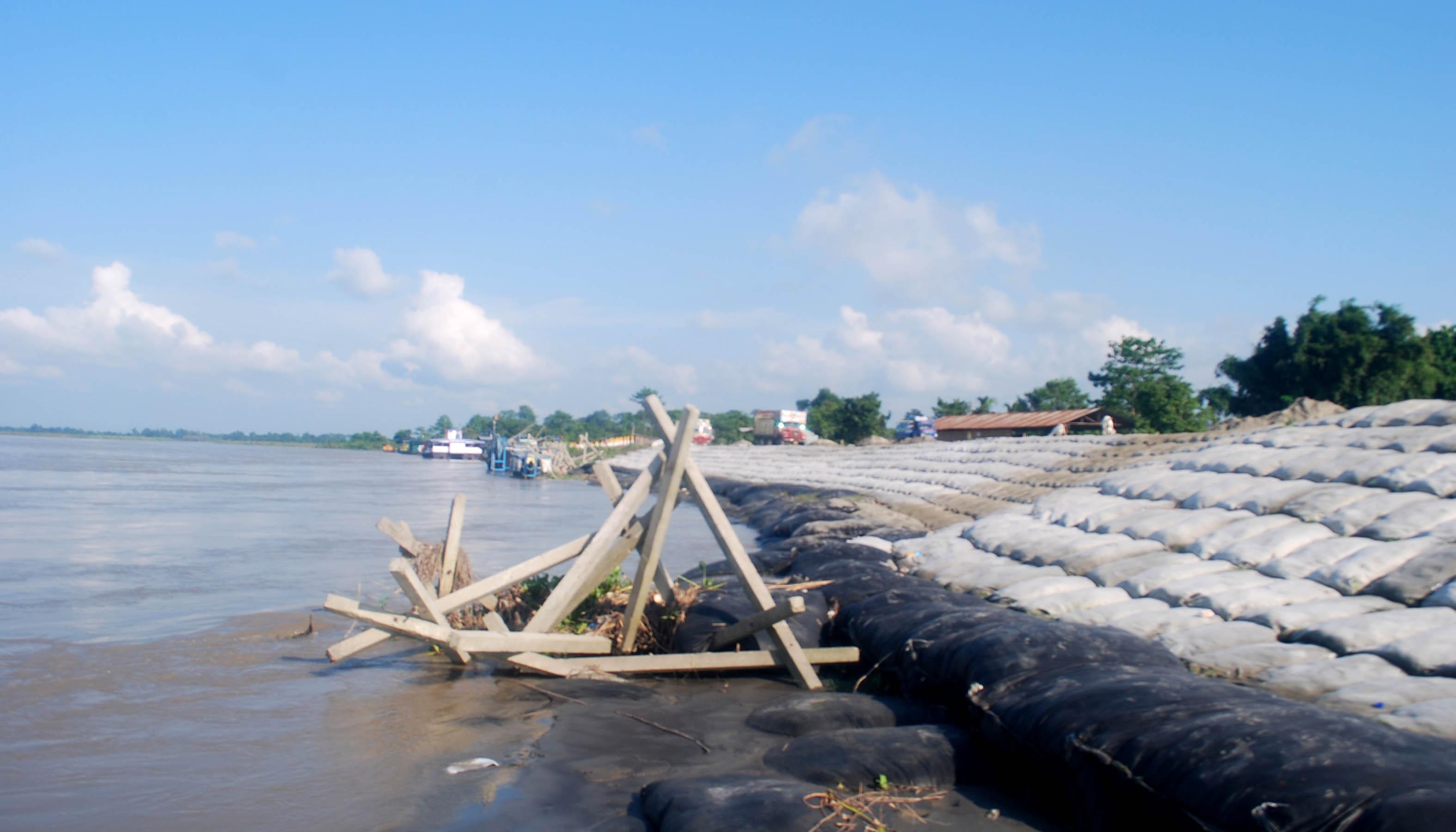
View of Bodatighat of Brahmaputra in Bihpuria. Photo by UB Photos

A massive cloudburst in Tibet has forced authorities in China to release more water down the Brahmaputra than at any time over the last 50 years. China has warned India about the release in the transboundary river – known as Yarlung Zangbo in China – and two Indian states are on high alert for floods.

The discharge was measured at 9,020 cubic metres per second (cumec) at 8 a.m. on August 29 and led to huge waves on the Siang in Arunachal Pradesh, the state in northeastern India through which the river enters India. Eyewitness reports estimated the wave heights at up to four metres, in a river that usually has hardly any waves at all.

In contrast, the discharge on August 14 had been measured at 8,070 cumec, according to India’s Central Water Commission. The Siang joins two other rivers downstream to form the Brahmaputra.

Tamiyo Tatak, the Deputy Commissioner of East Siang district in Arunachal Pradesh, sent out a warning the same day, asking people “to refrain themselves from venturing into Siang river for fishing, swimming etc. to avoid any eventualities. Further, people living in low lying areas (both right bank and left bank) viz. Jarku, Paglek, SS Mission, Jarkong, Banskota, Berung, Sigar, Borguli, Seram, Kongkul, Namsing, MER nearby Siang river are advised to remain alert but not to panic.”

Eyewitness reports on the morning of August 31 said the waves had gone down, but the Siang was still flowing at a far higher level than usual, even during the height of the monsoon.

Despite the official warning, 30 people were reported stranded on an island in the Siang in the Sille-Oyan area on the morning of August 31. The Arunachal Pradesh government has requested the Indian Air Force to send helicopters that can winch these people to safety, since the island is too small for a helicopter to land.

Assam on high alert too

Further downstream, the Assam State Disaster Management Authority (ASDMA) warned the Dibrugarh district administration in the eastern part of the state to be on high alert. Laya Maduri, the Deputy Commissioner of Dibrugarh district, sent out an order on August 30.

It read, “Flood warning has been received from ASDMA that as a result of release of excess water by Chinese Government, there may be unprecedented rise in the water level in the river Brahmaputra thereby causing severe flood. Therefore, officers of district are asked not to leave Headquarter…”

Reports on the morning of August 31 said the Brahmaputra was flowing high in Dibrugarh, but had not crossed the danger mark yet.

Transboundary cooperation

Authorities in India were able to prepare for this 50-year high in Brahmaputra water discharge well in advance, due to the warning provided by the Chinese authorities. China resumed providing water flow data to India this May under a Memorandum of Understanding (MoU) between the two countries. The data supply had been stopped in 2017. Observers in India blamed that on a face-off between the Chinese and Indian armies along their 3,500-km Himalayan border, though the Chinese authorities had said they were upgrading their water level measuring stations.

Since 2009, thethirdpole.net has consistently advocated for closer cooperation between China and India over the transboundary river Brahmaputra, which later flows into Bangladesh to join the Ganga. The scope of the MoU has been expanded over the years, but far more is possible.

Noted Brahmaputra expert Partha Jyoti Das told thethirdpole.net, “It is good that China is now regularly providing hydrological data through the monsoon period, but a lot more can be done. We need topographical data as well. That will tell us where landslides are likely to occur after heavy rain, and then we can foresee the possibilities of a flood even earlier.”

In the absence of any water flow data from the Chinese government in 2017, there had been panic in Arunachal Pradesh and Assam in November that year, when the sediment load in the river went up all of a sudden and the water almost ran black for a number of days. Independent experts from India had later said the high sediment load was due to an earthquake in Tibet, which had led to a landslide blocking the water flow in the river for some time, before it all came roaring down together.

Anamika Barua, who teaches at Indian Institute of Technology, Guwahati, has explored possibilities of regular flow of information between China and India on the Brahmaputra, through civil society channels as well as the governments. The panic in 2017 may have been avoided if some of her recommendations had been acted upon by academics in China.

Das was critical of the central and Assam governments in India for not sharing any information with the people on last November’s episode. “Have they done any studies on why this happened? If they have, why don’t they share their results in public? What the government says is important. Without that, there can be a lot of unnecessary panic.”

 By Joydeep GuptaFirst Published in The Third Pole

Add new comment

Other Contents by Author

A heartfelt felicitation ceremony was held in Lumding to honor Naga woman Mrs. T. Machapakla Ao, the visionary founder of the Assamese medium school in the town. The event, organized by the fortnightly publication Matir Manuh, celebrated her pivotal role in establishing the school in 1956—a milestone in Lumding’s educational history. Prominent speakers at the event included Rajkumar Baishya (Chief Editor, Matir Manuh), Deepak Mena (Executive President), Minati Sharma (Director Member), Prashant Hatimota (General Secretary), Sujata Sharma (Social Media Secretary), Anup Arandhara (Secretary, Mung-Dun-Chung Kham, Assam, NE India), Dr. T. Lima Jamir (President, Nagaland Indigenous People’s...
In recent years, Assam has witnessed a series of eviction drives that have displaced thousands, predominantly targeting Muslims of East Bengali origin. These individuals, often referred to as 'Miyas', have faced allegations of being 'illegal immigrants' despite possessing valid Indian documentation. The state's actions have raised concerns about the underlying motives and the implications for democracy and human rights. Political Motive Behind Evictions Experts argue that these eviction drives are strategically timed ahead of elections to create a divisive narrative. The ruling BJP is accused of attempting to foster a Hindu-Muslim divide, with some local organizations already holding...
In a move that has sparked anger and unease, police in Diphu have detained Karbi youth leader and social activist Lichong Rongphar for spearheading protests demanding eviction of alleged illegal settlers from VGR (Village Grazing Reserve) and PGR (Professional Grazing Reserve) lands in Karbi Anglong. The irony is stark: while Chief Minister Himanta Biswa Sarma’s government is carrying out aggressive eviction drives in the plains—Lakhimpur, Dhubri, Goalpara and Uriamghat—similar demands raised in Karbi Anglong are being met with police crackdowns instead of action. Rongphar had been leading a series of mass protests, insisting that Bengali and Bihari settlers occupying VGR and PGR...
On the auspicious occasion of the birth centenary of Bharat Ratna Dr. Bhupen Hazarika, the Assam government has handed over the legendary singer’s neglected residence at Kuthori, Kaziranga, to local residents for preservation. For the past five years, the house—once vibrant with the maestro’s harmonium, tabla, and compositions—had fallen into disrepair, leaving fans and admirers disheartened. Although the government had acquired the property at a cost of ₹2.51 crore from Fatik Nyog five years ago, no concrete conservation efforts had been initiated since. Responding to repeated demands from villagers, the government announced today that the residence will be developed into a cultural...
The University of Science and Technology Meghalaya (USTM) celebrated the 100th birth anniversary of Bharat Ratna Dr. Bhupen Hazarika with a vibrant cultural programme at its Central Auditorium. Themed “Voice of Bhupen Hazarika: Voice of the People; Leading to a Harmonious Society,” the event featured visual presentations, floral tributes, and lively performances by students and faculty. Prasanta Rajguru, Editor-in-Chief of Prag News, delivered the keynote, highlighting five iconic songs of the maestro and their historical relevance. Actor Kamal Singh presented a special tribute performance, while dignitaries including Dr. Aparna Buzarbaruah graced the occasion. The celebration...
In a landmark wildlife discovery, the elusive Pallas’s Cat has been documented for the first time in Arunachal Pradesh during an extensive high-altitude survey jointly conducted by the Department of Environment, Forest & Climate Change, Government of Arunachal Pradesh and WWF-India. The survey, carried out between July and September 2024, involved 136 camera traps across 2,000 sq km of rugged terrain in Tawang and West Kameng districts. It not only produced the first photographic record of Pallas’s Cat in the state, but also revealed the presence of five other wild cats — snow leopard, common leopard, clouded leopard, leopard cat, and marbled cat — at elevations above 4,200 metres...
In a historic gathering that marks a new chapter in Moran political mobilization, the Moran community today formally launched its new political platform, Jatiya Gan Mancha (National People’s Forum), at a mass assembly held at Kakopathar public ground. The event was convened under the aegis of leading Moran organizations, including the Assam Moran Sabha, All Moran Students’ Union, Moran Mahila Parishad, Moran Sahitya Sabha, Moran Art & Culture Development Centre, and the Moran National Educational Development Forum. The assembly commenced with ceremonial tributes to the community’s forebears, accompanied by devotional songs and cultural performances, setting a solemn and festive tone...
The Asom Gana Parishad (AGP) loves to wear the mantle of regionalism. It proudly recalls its birth from the Assam Agitation and the sacrifices of 855 martyrs. Yet every fresh controversy over the Citizenship (Amendment) Act (CAA) exposes the party for what it has become: a political outfit addicted to power, reduced to theatrics whenever Assamese identity is threatened. The script is depressingly familiar. In 2019, when CAA protests shook Assam, AGP staged a high-decibel drama—ministers resigned, alliance with the BJP was declared broken, the party promised to stand with the people. Two months later, under the cover of midnight negotiations, AGP crawled back into power, its leaders...
Arunachal Pradesh law teacher Gemini Loriak has shaken the internet with a viral classroom talk that cuts deep into India’s collective conscience. In her fiery remarks, she dismantles the stereotype of India as a “lawless country,” declaring that it is not the absence of laws but the refusal of citizens to follow them that creates chaos. Loriak points to everyday hypocrisy: bribing to bypass queues, fastening seatbelts only when police are in sight, dismissing domestic violence as a “private matter,” normalizing harassment, and celebrating VIP culture while preaching equality. Quoting the Constitution—Article 14 on Equality, Article 21 on the Right to Life with Dignity, and Article...
In a swift development following public outrage, Assam Police have arrested three officials of Bhartia Infra Projects Ltd (BIPL) after the tragic death of a three-year-old boy who fell into an uncovered drain at the Arya Nagar flyover construction site in Guwahati. The incident, which occurred earlier this week, triggered shock across the city and led to demands for accountability from both the company and government authorities. According to reports, the toddler, identified as Sunit Kumar, slipped into an unguarded drain within the construction zone. CCTV footage and eyewitness accounts later revealed several exposed manholes and drains left unattended at the site. The flyover work had...