Skip to content Skip to navigation

Essays on Srimanta Sankaradeva

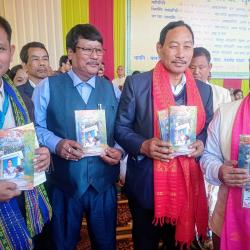
Essays on Srimanta Sankaradeva authored by Dr Sanjib Kumar Borkakoti is a valuable addition to the works on Indian culture and philosophy. The author has carried out extensive research on Assamese hagiographies, particularly Sankaradeva and different aspects of Sankari culture. The book contains several analytical articles, a few of them that have already been published in different journals or websites. Dr Borkakoti has analysed in this book the significant impact left by the saint litterateur Srimanta Sankaradeva on the socio-cultural as well as economic milieu of Assam. How the medieval polymath influenced the society from literature to culture to economy is exhaustively analysed in this lucid book. Right from economic sustenance of the Sattra institution to the Vivartanavada philosophy of Srimanta Sankaradeva, everything is analysed in a compact manner in these essays. These articles deal with the Vaishnavite saint's contributions, which are quite relevant for knowing Assam's remarkable contributions in the spiritual and literary ecosystems, says Dr Borkakoti. He has successfully described the prominent role of the saint litterateur in shaping the socio-cultural fabric of Assam.

The author has shown how the Sattra institution created by Srimanta Sankaradeva stands out as a unique model of self-sufficiency. He has written elaborately on the economic sustenance of these Sattras based on his own field work covering as many as forty eight Sattras and Thans in different districts of Assam. The author also prescribes viable economic activities for the Sattras so that the currently existing Sattras can sustain themselves in a befitting manner for the present era. Thus it is not only a study, but also a great plan that the author has presented. It may be mentioned that the units set up by the saint himself were known as Than, those set up later as Sattra. This and many such gems of knowledge can be found in these essays by Dr Borkakoti.

The book also elaborates the contributions of Srimanta Sankaradeva in areas like feminism, aesthetics, philosophy etc. The Vivartanavada philosophy of the saint is explained with all its features in a valuable essay. The author makes a comparison with other Sanātana Hindu philosophies in his book. He also shows how Srimanta Sankaradeva succeeded in bringing the two parallel paths of wisdom and devotion together. Very few people knew for instance that he was the first to say that Ishwara and Brahma are the same. Spinoza’s philosophy echoed the same after several centuries. Such pathbreaking pronouncements in Indian philosophy needs to be highlighted, to say the least. Dr Borkakoti has done exactly that in his essays. This will go a long way in establishing Srimanta Sankaradeva among the pantheon of saints in India.

Srimanta Sankaradeva was also a pioneer of the drama movement in India, being the first playwright in all modern Indian languages. His plays are called Ankiya plays. He created the unique costume, ornament, make-up etc of the actors worn in his plays. It is hard to find such multi-talented person on earth. The author has elaborated the Aharya of these plays in one of the essays in this book. The author being involved in promotion of these works himself, as he heads an organisation named ‘Society for Srimanta Sankaradeva’, the readers get to know the authentic staff about this culture.

Another fascinating area covered in the book is the comparative study between the ‘Eka Sarana Nama Dharma’ of Srimanta Sankaradeva and Sikhism of Guru Nanak. There are numerous common socio-economic common elements, which have been pointed out by the author. He says that Guru Nanak had spiritual guidance from Srimanta Sankaradeva; in fact Guru Nanak came to Assam to meet the polymath during the first Udasi. This is a great discovery, which will go a long way in establishing Srimanta Sankaradeva with his due status among the medieval luminaries of India.

The author has analysed the works of feminism as reflected in the writings of Srimanta Sankaradeva. The polymath departed from the original version of Ramayana in his Assamese transcreation; he presented his own version of Sita, a revolutionary Sita, who spoke with vengeance against her banishment by Rama. Srimanta Sankaradeva’s Sita is very different from Valmiki’s Sita, the analysis of which itself is sufficient to establish the polymath as a pioneer of feminism. His Sita says that she would never again call herself as Rama’s wife. Such utterance was unheard of in the then Indian literature. Clearly the works of the saint litterateur belonged to a different genre. The author rues that strangely very little is known about Srimanta Sankaradeva outside Assam and his pivotal contributions have been almost forgotten for lack of research. He says that Srimanta Sankaradeva should be reckoned as an unusual genius among all saints of India.


Dr Borkakoti successfully presents a Pan-Indian role of Srimanta Sankaradeva in his book. He showed how the influence of the saint litterateur spread to other regions of India. These include the eulogy of Sant Kabir, the social structure of Odisha influenced by the saint, the Yatra movement of Bengal derived from the Ankiya plays of Srimanta Sankaradeva etc. Certainly these essays by Dr Borkakoti will go far in throwing light on the formative years of many regional cultures of India. ‘Essays on Srimanta Sankaradeva’ is therefore a valuable addition to the study of Indian literature and culture and philosophy.

Add new comment

Other Contents by Author

Assam has emerged as the state with the lowest life expectancy in India, averaging just 66 years, according to recent data from the National Family Health Survey (NFHS-5). This figure not only falls below the national average of approximately 69 years but also trails behind other Northeastern states, with neighboring Nagaland boasting a life expectancy exceeding 75 years. Health experts attribute Assam's lagging life expectancy to a combination of factors, including air pollution, poor dietary habits, high blood pressure, smoking, and environmental hazards. Dr. Rahul Mehra, UNESCO Chair Representative for Global Health and Education, emphasized the urgency of integrating health education...
Nazira paid tribute to the late Aboni Borthakur, a distinguished educationist and former Principal of Nazira College, with a memorial meeting held on Sunday. The event, organized at the Nazira M.C. Club, was presided over by Atul Gogoi, a former Principal of another college. The gathering saw the presence of several notable figures, including retired professor Dr. Provat Borah, renowned writer Juri Borah Borgohain, Nazira MLA Debabrata Saikia, and CPI leader Kanak Gogoi, among others. The speakers reflected on Borthakur’s contributions to education and society, celebrating his legacy as a thinker and academician. A highlight of the meeting was the unveiling of a memorial book that...
The demolition of Mahafezkhana, Assam’s oldest surviving concrete structure and a vital piece of Northeast India’s architectural heritage, has triggered widespread outrage. Built between 1855 and 1865, the 160-year-old building—once a custodian of crucial land records during British colonial rule—was razed by the Guwahati Metropolitan Development Authority (GMDA) as part of a park extension and Brahmaputra riverfront beautification project, according to reports published on Sunday. Senior journalist Mrinal Talukdar expressed his dismay on X, describing the demolition as “not just demolition—this is desecration.” In a series of posts, including one at 2:30 AM IST on March 30 (Post ID:...
The Dhansiri River, a vital tributary of the Brahmaputra, is facing severe pollution due to industrial discharge from the Numaligarh Refinery Limited (NRL), as reported by Janani Live, a local news portal from Golaghat. The contamination has raised alarms among environmentalists and local communities dependent on the river for irrigation and drinking water. Growing Pollution Crisis:According to Janani Live, untreated effluents from the refinery have been flowing into the Dhansiri, increasing chemical toxicity and degrading water quality. The river, which originates in Nagaland and flows through Golaghat and Dimapur, is already burdened by urban sewage, agricultural runoff, and sand...
Congress MP and Lok Sabha Deputy Opposition Leader Gaurav Gogoi has written a letter to Prime Minister Narendra Modi, demanding an investigation into alleged financial irregularities worth approximately ₹70 crore at the Assam Cooperative Apex Bank. According to Gogoi, the scandal involves an outsider businessman, Rajesh Bajaj, who is accused of misappropriating around ₹20 crore, along with an additional ₹50 crore irregularities under the guise of a tender for a data storage system. Gogoi has urged the Prime Minister to order an independent probe into the matter. In a post on his official X handle, Gogoi stated, “I have written a letter to Hon’ble PM Shri Narendra Modi ji regarding the...
Assam Minister Ranjit Das has sparked outrage after allegedly using a caste-based slur during an election campaign, prompting protests and a police complaint. The controversy erupted while Das, a Bharatiya Janata Party (BJP) leader, was campaigning for a ruling coalition candidate in the 30-Bamunigaon constituency of the Rabha Hasong Autonomous Council on March 18. During a public speech, he referenced India’s four main social groups—"the poor, women, farmers, and youth"—but also used a derogatory word for Scheduled Castes in Assam. The All Assam Scheduled Caste Youth Students’ Union filed a complaint against Das at Dispur Police Station under the Scheduled Castes and Scheduled Tribes...
A massive protest erupted today in Sonapur, near Guwahati, as thousands of tribal people gathered to oppose the proposed transfer of vast tracts of land to the Indian Air Force. The demonstration, held at the Sonapur Mini Stadium on Friday, March 28, saw local tribal communities voicing their outrage against what they perceive as an encroachment on their ancestral lands, with slogans such as "We will give our blood, not our land" and "Down with Digaru Air Force" resonating through the air. The unrest stems from the state government's alleged plan to hand over a significant portion of land in Digaru, close to Sonapur, to the Air Force. This move has sparked widespread anger among the...
 The Chief Judicial Magistrate’s Court of Kamrup Metropolitan District has granted bail to senior journalist Dilowar Hussain Majumdar in his second case. Following interrogation and searches starting on March 27, Majumdar was produced in court on Friday and released on a bond of 20,000 rupees. The decision came after his advocate, Angshuman Bora, presented arguments in his favor. Police conducted searches at Majumdar’s residence and business establishments, seizing two dumpers during the operation. In a related case involving the managing director of Apex Bank, the police advocate requested the addition of extra charges, but the court rejected the plea. Due to a delay in submitting...
The Press Club of India (PCI) on Friday sharply criticized Assam Chief Minister Himanta Biswa Sarma for attempting to define who qualifies as a “legitimate” journalist, following the re-arrest of senior digital media journalist Dilawar Hussain Mozumder by Assam Police on March 27 evening. Mozumder, assistant general secretary of the Guwahati Press Club (GPC), was detained hours after his bail release in a case involving alleged theft of bank documents while covering a protest tied to a recruitment scam. The PCI demanded Mozumder’s immediate release, accusing the state of undermining press freedom. The PCI’s statement highlighted Sarma’s remarks as a distraction from the core issue—...
The Shillong Press Club (SPC) has strongly condemned the arrest of senior Assam journalist Dilawar Hussain Mazumdar, issuing a statement denouncing the action. Mazumdar, the chief reporter of Crosscurrent Digital Media, was first arrested on the night of March 25. Although he was granted bail on March 26, he was rearrested on March 27 based on a complaint filed by the managing director of the Assam Cooperative Apex Bank.  SPC President D L Syiemlieh stated that the rearrest of Mazumdar shortly after being granted bail is deeply concerning and represents a shocking misuse of legal processes. He emphasized that this action constitutes a direct assault on the freedom of the press and...