

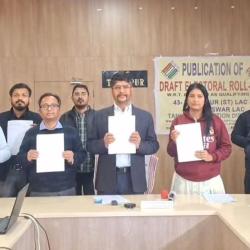
Guwahati: In a landmark act that rattles both Delhi and Dispur, the All Assam Students Union has put the Clause VI panel report in public domain which the Centre has not received yet.
Apart from ILP provision, the report strongly suggested a slew of measures to ensure constitutional safeguard for the indigenous people of Assam.
These include reservation of seats for indigenous people in job and legislative assembly, upper House.
The state's influential student organization has demanded measures to implement it since PM Narendra Modi and Union home minister Amit Shah repeatedly promised to implement it letter and spirit.
Notably, led by Justice (retd) BK Sarma the panel tried to submit the report before the union home minister who refused to receive it and asked CM to do it.
Report of the Committee on Implementation of Clause 6 of the Assam Accord
Constituted by Ministry of Home Affairs, Government of IndiaThe Committee is of the opinion that to give full effect to its Recommendations, as stated hereinbelow, several Constitutional and legislative amendments will be necessitated. The existing Article 371-B in the Constitution of India will need to be amended. A Draft text of such proposed Constitutional and legislative amendments, including the structure of the proposed amended Article 371B (Special Provisions with Respect to the State of Assam in Matters Connected with the Assam Accord) has been prepared by the Committee and annexed to the Report as Annexure V as a basis for further analysis. (pp. 127-141)
The Core Proposal
- Assam Accord must be fully implemented in a time bound manner, so as to facilitate detection, deletion and deportation of foreigners in Assam. (p.56, 77)
- The Committee noted that the Assam Accord is yet to be fully and effectively implemented even after 35 years of its signing. It is felt that complete implementation of all Clauses of Assam Accord especially Clauses 5.1 to 5.9, Clauses 7, 10 and 11 are essential for the safeguards to be provided under Clause 6 of the Assam Accord. (p.56)
- Prompt and adequate measures to be adopted to completely seal the IndoBangladesh Border in the line of Indo-Pakistan Border. (p.77)
- Till deportation of post 1971 stream of declared foreigners is completed, they should be resettled in areas outside the State of Assam, as an interim measure. (p.77)
The Key Recommendations
- The Committee after deliberations and upon consideration of the various
representations from the stakeholders and further on the basis of interactions with various organisations and individuals, the Committee has come to the conclusion that the definition of Assamese People for specific purpose of implementation of Clause 6 of Assam Accord should consist of Indigenous Tribals as well as other Indigenous Communities of Assam over and above Indigenous Assamese.
While providing constitutional, legislative and administrative safeguards in terms of Clause 6 of Assam Accord, the term “Assamese People” shall be construed as including:
All citizens of India who are part of:
- Assamese community, residing in the Territory of Assam on or before
01.01.1951 Or- Any indigenous Tribal Community of Assam residing in the Territory of Assam
on or before 01.01.1951 Or- Any other indigenous community of Assam residing in the Territory of Assam
on or before 01.01.1951 Or- All other citizens of India residing in the territory of Assam on or before
01.01.1951 And- Descendants of the above categories
Explanation: Assam shall mean the territory of Assam as defined in the First
Schedule of the Constitution of India (as amended) (p.42-43)
Hereinafter, any reference to the term “Assamese People” shall be understood to be in terms of the provisions of Clause A above.
B. Reservation of seats in Parliament, Assam Legislative Assembly and Local
Bodies
- 80 to 100% of seats in Parliament which are allotted to the State of Assam, should be reserved for the “Assamese People”. (p.56, 72)
- Committee has recommended reservation of seats for the “Assamese People” in the Assam Legislative Assembly and Local Bodies to the extent of 80 to 100% which will be inclusive of pre-existing reservations. Similar reservation to be extended in respect of local bodies excluding Sixth Schedule Councils. (p.50)
- Immediate and effective implementation of various agreements so far arrived at, with regard to the Sixth Schedule Councils namely Karbi Anglong Autonomous Council, North Cachar Hills Autonomous Council and Bodoland Territorial Autonomous Council. The Committee also recommends that rights and privileges of all indigenous communities residing in such areas should be duly protected while doing so. (p.51, 67)
- The Committee further recommends that the Statutory Autonomous Councils created by the State Acts namely, Rabha Hasong Autonomous Council, Tiwa Autonomous Council, Mising Autonomous Council, Deori Autonomous Council, Thengal Kachari Autonomous Council and Sonowal Kachari Autonomous Council should be made fully functional by providing adequate financial and administrative support. Similar support should be extended to Development Councils. (p.51, 67)
C. Creation of Upper House
- Recommends the making of adequate provision for an Upper House (Legislative Council of Assam) and all seats thereof to be reserved for the “Assamese People”. The composition of the House shall be from among the SC, ST and the tribes/communities of the State (seats allotted in descending order of population of each tribe on rotational basis). For implementation of the recommendations suggested by the Committee, it would be necessary to amend the existing Article 371 B of the Constitution of India by making necessary amendments as suggested in the Report. (p.51, 67, Annexure V at p.127)
D. Inner Line Permit
- Adequate measures, as suggested in Annexure V, p.132 for creation of enabling provisions in respect of Inner Line Permit (ILP) system. (p.77)
E. Employment
- 80 to 100% of Group C and D level posts in Central Government/Semi-central Government/Central PSUs/Private Sector including under PPP Mode falling and arising in Assam should be reserved for “Assamese People”. (p. 56, 72)
- 80 to 100% of jobs under Government of Assam and State Government undertakings and 70 to 100% of vacancies arising in private partnerships including PPP mode in State of Assam shall be reserved for Assamese people. (p. 55, 71) These safeguards must be incorporated in Article 371B as per proposed amendment at Annexure V, p.127.
F. Land and Land Rights:
So far as land rights are concerned, the provisions of Assam Land Revenue and Regulation, 1886 (as amended) be strictly followed. In addition, the land rights be confined to the “Assamese People” putting restrictions on transferring the same by any means to other persons other than “Assamese People.” Unless the land rights of the “Assamese People” are protected along with the political rights, it will be a futile exercise to adopt measures for full implementation of Clause 6 of the Assam Accord in its true spirit, keeping in mind the background facts. Therefore, the Committee makes the following recommendations in addition to the recommendations made in the Report of Shri H.S Brahma Committee on Land Reforms submitted in January, 2018 and the provisions of the Land Policy, 2019. (p.57)
a. Alienation of Land
- In addition to tribal belts and blocks under Chapter X of ALRR 1886, the State Government should identify the Revenue Circles of the State, where only “Assamese People” can own and possess land and transfer of such land in these areas are limited to them alone. The selected urban areas under the Assam Municipal Act will however be excluded without affecting the interest of the Assamese people. (p.57)
- Government should take immediate steps to prevent shrinkage/decrease of Prime
Agricultural Land. There has to be complete ban on transfer of such land for nonagricultural purposes. (p.57)
- Section 8 of the Assam Agricultural Land (Regulation of Re-classification and Transfer of Land for Agricultural Purpose) Act, 2015 which allows violation of the law pertaining
to re-classification should be repealed. Whenever, re-classification is sought, the public
opinion in a meeting of the Gram Sabha will be a mandatory condition. (p.58)
- The prime agricultural land included in recent Notification No. RLA 192/2017/30 dated
18.01.2018 issued by the Government of Assam in the Revenue & D.M (LR) Department as Industrial Belt in Lower Assam from Guwahati to Tihu be excluded and
de-notified. (p.58)
- The question of alienation of land in tribal belts and blocks, made in violation of the provisions of Chapter X of the Assam Land Revenue and Regulation, 1886 have been
discussed in Chapter 4 hereinabove. On the basis of such considerations, the Committee recommends that Land Tribunals be established at the district level for
deciding such issues in accordance with law. Such tribunals should be manned by
competent judicial officers and officers having experience in matters pertaining to the Assam Land Revenue and Regulation, 1886. Provisions for appeal against any order by the Tribunal should be decided by the Assam Board of Revenue. (p.59)
- All Tribal Belt and Block Land should be exempted from the provisions of the Assam
State Capital Region Development Authority Act, 2017. (p.59)
- All Wetlands, Professional Grazing Reserve (PGR), Village Grazing Reserve (VGR)
should be freed from encroachment and protected. An Act needs to be enacted making encroachment of Government land, forest land etc a cognizable criminal offence with provisions for an expeditious trial. (p.58)
- Char areas should be surveyed and newly created Char areas should be treated as Government land and erosion affected people should get priority in allotment. Alternatively, Char land is to be taken over for agricultural and allied activities like dairy, fodder plantation etc through community ownership. (p.58)
b. Tea Land
- State Government must devise schemes in line with the “Small Tea Garden” revolution in the fields of Agriculture/Horticulture/Pisciculture/Animal Husbandry etc which would restrain the “Assamese People” from transferring their land to others. (p.58)
- Provisions by way of enacted law to prohibit transfer of tea land from the original grantee to any other person by any covert mechanisms including transfer of shares to the lessee Tea Company without prior permission of the Government. No such permissions should be allowed without payment of appropriate premium. (p.58)
- Statutory provisions prohibiting transfer of tea land for any other use without permission of the State Government must be enforced. (p.58)
c. Administrative Reforms in Land Management
- Time bound programme for updating and authenticating the land records. (p.58)
- Time bound 3-year programme in mission mode to allot patta to “Assamese People” who are in occupation of land for decades but without any documents. “Assamese People” who are in occupation of Government land and are eligible for settlement of land as per Land Policy, 2019 should be given pattas in a time bound manner. (p.58)
- Cadre of trained Land Administration personnel be created who would be exclusively devoted to the administration of land and revenue in the State. Number of officers and land record staff must be increased. (p.58)
G. Language
- Assamese language shall continue to be Official Language of Assam as per the provisions of the Assam Official Language Act, 1960 throughout the State with appropriate provisions for use of local languages in Barak Valley, Hill Districts and the BTAD. (p.53, 68)
- The policy pertaining to official language of the State must be given appropriate constitutional protection under Article 371 B. (p.68)
- Mandatory provision of an Assamese language paper should be made applicable for recruitment in State Government services with alternatives for Barak Valley districts, BTAD and Hills Districts. (p.69)
- All languages including the Bodo language, which is already included in the 8th Schedule of the Constitution of India are to be protected and promoted in a manner similar to the case of Assamese language, which is the official language of the State. All the indigenous languages of Assam as well must be protected and promoted irrespective of number of speakers. (p.52)
- The Four Language Policy should be given appropriate legislative protection.(p.70)
- To set up Academies for all-round development of each of the indigenous tribal languages including, Bodo, Mishing, Karbi, Dimasa, Koch-Rajbongshi, Rabha, Deuri, Tiwa, Tai and other indigenous languages. (p.54)
- An Autonomous Language and Literature Academy/Council of Assam should be constituted and given statutory status to protect, preserve and promote all indigenous languages of Assam and the same should be headed by a distinguished literary person. All the literary bodies of indigenous languages shall be members of the academy/council. The main objective of the academy/council shall be to develop the indigenous languages for their spread and enrichment of their literature. The academy should be given statutory financial support for its functioning and for linguistic and literary projects. (p.53)
- An Autonomous Institute/Council to be set up in Assam under an Act of Parliament with the objective of protection, preservation and promotion of cultural, social, linguistic identity and heritage of Assam, with separate campuses for BTAD, Karbi Anglong Autonomous Council districts and Dima Hasao district. The Council should be given statutory financial assistance for its activities. (p.54)
- To protect and preserve the cultural heritage of Assam as defined in the UNESCO Convention of 1972. All the components of cultural heritage, tangible and intangible, should be covered by the Council. (p.54)
- A chapter of Sahitya Akademi shall be established in the State by the Sahitya Akademi in collaboration with the various Sahitya Sabhas in the state for all-round development of Assamese and other indigenous languages. (p.54)
- A multilingual Central Library for Assamese and other indigenous languages of the state shall be established on the model of the National Library of Kolkata, and the said library shall be notified under Section 3 read with Section 2(b) of the Delivery of Books and Newspapers (Public Libraries) Act, 1954 as amended. (p.55)
H. Cultural and Social Rights
- The Assam Ancient Monuments and Records Act, 1959 should be suitably amended as per the draft amendment at Annexure V, p.132, to protect tangible and intangible cultural heritage assets, protected and unprotected sites of historical significance and for providing a mechanism to create a Consolidated Fund and Board for the management of cultural heritage assets. (p.60, 75)
- Cultural institutions like Sattras, Naamghars and other indigenous religious institutions shall be given statutory legislative protection. A separate Board with autonomous functioning and statutory financial assistance from both the Central and State Government shall be set up to look after the all-round development of Sattras of Assam. (p.60, 75)
- Separate cultural and research Institutions/Centres/Chapters of National organisations focused on different branches of visual/performing/literary arts (e.g. Sahitya Academy, Lalit Kala Academy, Sangeet Natak Academy) should be set up to facilitate research, documentation, conservation, promotion and support of the cultural, linguistic/literary heritage of the “Assamese People.” (p.60)
- The Madhupur Sattra at Coochbehar in West Bengal shall be developed and protected by the concerned Central Govt. agencies. (p.61, 75-76)
- Preservation and documentation of the Zikirs and Zaris composed by Ajan Pir, the celebrated Sufi saint of Assam. Efforts should be made for translation of Zikirs in various indigenous languages of the State. (p.61)
- Multipurpose cultural complexes should be built throughout the State towards protection, preservation and upliftment of cultural heritage of each one of the tribes and other ethnic communities of Assam. Such cultural complexes shall have provisions for state-of-the-art auditorium, seminar hall, art gallery etc. (p.61)
- Special assistance from the Central Govt. as well as from the State Govt. shall be extended to traditional industries of Assam such as i) Weaving Industry of Sualkuchi, ii) Bell-metal industry of Sarthebari and Hajo etc by declaring them as Heritage Industries of the State. (p.61)
- Organisations like Jyoti Chitraban Film Society, Dr. Bhupen Hazarika Regional Government Film and Television Institute, Srimanta Sankardev Kalakshetra etc. shall be provided with adequate funds to augment infrastructure. (p.61)
- Central universities to be established and/or strengthened to study, document and preserve the natural and cultural heritage of the State and should be provided with adequate financial assistance to augment their cultural, educational and research programmes. (p.61)
- State-of-the-art Museums shall be set up for preservation of the cultural heritage of all tribal groups and other indigenous communities of the State of Assam. (p.61)
I. Protection of Resources and Biodiversity
- Value addition to the State’s natural resources, both renewable or otherwise, be carried out within the State itself so as to generate economic activities and employment opportunities in the State. (p.63)
- The Assam State Biodiversity Board should be strengthened with sufficient financial assistance from both the Central and the State Government for effective functioning and taking up measures for consideration of the biodiversity of Assam. (p.63)
- An appropriate body should be formed to monitor the execution of the recommendations of the High-Level Committee and to reconcile any constitutional or legal challenges that may arise in their implementation. The body should preferably be headed by a retired Judge of the Supreme Court/High Court, with representatives from Ministry of Home Affairs, Government of India, Government of Assam and All Assam Students Union. The Body should meet at least once every three months to monitor the progress. (p.78)
- The Committee is of the view that the recommendations suggested in this Report be implemented at the earliest by drawing up a time bound programme but not later than two years from the date of its submission.
- 14134 reads






Add new comment