

Mining Near Kaziranga: The Deihori River Questions That Won’t Go Away
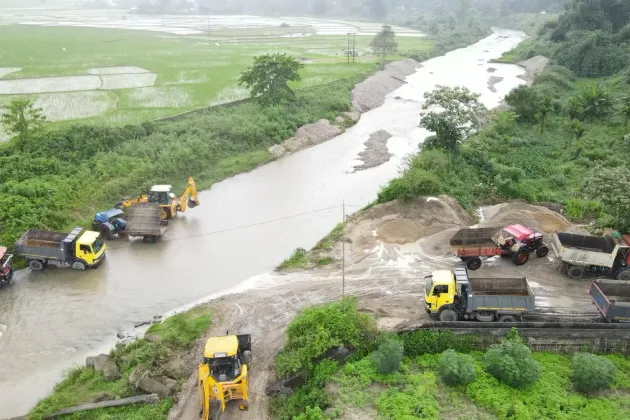

GUWAHATI, August 15, 2026 — Excavators operating near a river channel, dump trucks beside large stockpiles of sand and gravel, and tractors and other heavy vehicles moving through the site — recent images from the Deihori River area of Karbi Anglong have revived concerns over mining in the ecologically sensitive landscape adjoining Kaziranga.
The issue has a substantial documentary history.
The Deihori River Sand cum Sand Gravel Mining Contract Area appears in official Assam mining records. In February 2025, the Karbi Anglong Autonomous Council (KAAC) was reported to have decided to suspend operations at the Deihori River sand-and-gravel mahal under the Northern Range, Dolamara.
Now, Mohajon Kro, an RTI activist from Rongbin Aklam in Diphu, has approached environmental authorities and, according to reports, the National Green Tribunal, alleging mechanised riverbed extraction and violations of mining and environmental safeguards.
The records reviewed so far do not establish that the activity seen in the recent images is illegal. They also do not establish whether the photographs were taken within the precise mining area covered by the reported 2025 suspension.
But they do point to a set of questions that now require clear documentary answers.
If the activity shown in the photographs is taking place within the same Deihori mining area that KAAC decided to suspend, what permission is currently in force?
The government mining record names Rahul Singnar
An official list of mining plans published by the Assam Directorate of Geology and Mining includes the “Deihori River Sand Cum Sand Gravel Mining Contract Area, Dist. Karbi Anglong, Assam.”
The entry names Rahul Singnar, of Deihori Singnar Gaon, P.O. Deithor, Karbi Anglong, in connection with the mining plan.
The record describes the mineral as sand-cum-sand gravel, gives the mining-plan approval date as 3 May 2023, and refers to an earlier environmental-clearance-related entry dated 8 May 2020. It also contains details of the plan period and production figures associated with the contract area.
The document is important for one specific reason: Rahul Singnar's name appears in an official Assam government mining-plan record connected with the Deihori River contract area.
That record alone, however, does not answer every question about the present operation. It does not show whether Singnar is still the current operator, whether the contract was later suspended, renewed or transferred, or whether any extraction now taking place has valid official approval.
Those details would require the latest settlement, lease and suspension records.
A separate regulatory trail leads to Songja Terang
Another public record points to a different name.
The national pollution-control consent management database lists SONGJA TERANG at Deithor, Karbi Anglong, under the industrial category “Mining and ore beneficiation”, with a record dated 5 August 2024.
The same database also contains a separate entry for the “Deihori River Sand cum Sand Gravel Mining Contract Area” at Deihori Songron, P.O. and P.S. Deithor, dated 21 September 2024.
The two entries should not be treated as proof that Songja Terang and Rahul Singnar held the same mining right or had the same legal status.
The public records reviewed by Assam Times do not establish that. Nor do they show that either person was operating the machinery visible in the recent photographs.
What the available records show is narrower but still relevant: Rahul Singnar appears in the mining-plan record; Songja Terang appears separately in a pollution-control database under a mining-related category; and the Deihori mining area itself also has a separate regulatory entry.
The authorities need to clarify who currently holds the mining settlement or lease, who holds or held environmental clearance, whether any pollution-control consent is applicable and valid, and whether the reported 2025 suspension remains in force.
The reported 2025 KAAC decision
The Deihori operation was also discussed at a high-level KAAC meeting in February 2025 concerning mining and quarrying within the proposed Eco-Sensitive Zone around Kaziranga National Park and Tiger Reserve.
The meeting examined a factual report submitted by the Divisional Forest Officer of the Karbi Anglong East Division, Diphu, on mining and quarrying activities in the Dolamara and Parkup Pahar ranges.
According to reports of the decision, KAAC resolved to suspend operations at 14 stone quarries within the proposed eco-sensitive zone.
The same report said the meeting had also decided to suspend the Deihori River Sand cum Sand Gravel Mahal under the Northern Range, Dolamara, and directed the DFO, Karbi Anglong East Division, Diphu, to issue the necessary suspension order.
That reported decision makes the actual suspension order a key document in this case.
Was the order issued? What was its number and date? What exact area did it cover? Did it apply to the site seen in the recent photographs? Has it since been withdrawn, modified or superseded?
Those are factual questions that can be answered through official records.
The wider mining restrictions around Kaziranga
The Deihori dispute cannot be separated from the larger history of mining restrictions in the Karbi Anglong hills adjoining Kaziranga.
On 12 April 2019, the Supreme Court, while dealing with the T.N. Godavarman Thirumulpad matter and issues concerning mining in the Kaziranga landscape, ordered restraint on all kinds of mining and related activities along the Kaziranga National Park area and in the catchment areas of rivers, streams and rivulets originating in the Karbi Anglong hills and flowing into Kaziranga National Park, including the Tiger Reserve.
The court also directed the Assam Director General of Police and the concerned Superintendents of Police to ensure that illegal mining and transportation of illegally mined material did not take place in the areas covered by its order.
The proceedings had included concerns raised by environmental activist Rohit Choudhury. Contemporary reporting focused on mining along Kaziranga's southern landscape and in catchments connected to the park.
For Deihori, therefore, the existence of a mining plan or contract is not the only issue. The location of the site in relation to the catchments covered by the court's restrictions is equally important.
Government action followed
The mining restrictions did not remain limited to the 2019 court order.
In a reply published by the Press Information Bureau in 2025, the Union government recorded that the Assam government had reported certain mining activities in Karbi Anglong as being in violation of the Supreme Court's 12 April 2019 order.
The government said orders had been issued for the closure of 28 stone quarries and 18 stone crushers operating under the Northern Range, Dolamara, to ensure compliance and protect Kaziranga and adjoining environmentally sensitive catchment areas.
This is the same broader Northern Range-Dolamara landscape in which the Deihori River mahal was later identified in the February 2025 KAAC discussion for suspension.
The question of mining in this region has also continued to reach the courts.
In an order dated 2 June 2025, the Gauhati High Court dealt with petitions involving stone-crushing units at Sarso Terang Gaon, Dolamara. The court referred to the Supreme Court restrictions and a 30 May 2025 communication from the Central Empowered Committee.
The High Court recorded that mining or related activity could not be carried out in the Kaziranga National Park area and in the covered catchments of rivers, streams and rivulets originating in the Karbi Anglong hills and flowing into Kaziranga. Permission to transport extracted stone material was refused, although the removal of crushing machinery without the stone was allowed.
In another proceeding in 2026, the Gauhati High Court again referred to the history of the 2019 Supreme Court order and the subsequent suspension of mining operations within the proposed and default Eco-Sensitive Zone around Kaziranga.
The legal and administrative scrutiny of mining in this landscape is therefore continuing.
Mohajon Kro's complaint
Against this background, Mohajon Kro, identified in reports as a resident of Rongbin Aklam in Diphu and an RTI activist, has become the latest person to challenge alleged extraction in the Deihori River area.
Reports say Kro approached the National Green Tribunal and the Ministry of Environment, Forest and Climate Change, alleging the use of heavy earthmoving machinery and excavators in the Deihori River.
He has questioned compliance with the Sustainable Sand Mining Management Guidelines, 2016, and the Enforcement and Monitoring Guidelines for Sand Mining, 2020.
These allegations have not been adjudicated by the NGT.
The exact case number, formal list of respondents and registration status should be confirmed from the tribunal's own record or an official acknowledgement of the petition before being reported as established details of an NGT case.
What the recent photographs show — and what they do not
Photographs provided to Assam Times appear to show an active extraction or material-handling site.
An excavator can be seen operating close to or inside a water channel. Several dump trucks and tractors are visible, along with large piles of what appear to be sand or gravel-like material.
The photographs are evidence that heavy machinery and large-scale material handling were present at the location shown.
They do not, by themselves, prove that the activity was illegal.
Several facts still need to be established: the exact location and coordinates of the site, when the photographs were taken, whether the location falls within the Deihori River Sand cum Sand Gravel Mining Contract Area, who owns or operates the machinery, what permission governs the activity, and whether the reported 2025 suspension applied to that precise location.
These questions fall primarily within the records of KAAC, the Forest Department, mining authorities and the relevant operator.
Kro's press meet and Dorsing Ronghang
At a recent press meet, Kro also made public allegations and referred to Dorsing Ronghang, the BJP MLA from Howraghat.
Official Assam Legislative Assembly records identify Ronghang as the elected member from Howraghat. Text accompanying a video from the press meet also refers to him in connection with the Land Settlement Advisory Board.
Assam Times has not, however, independently obtained a certified translation or complete transcription of Kro's Karbi-language statement in the video.
The exact allegation should therefore not be expanded or paraphrased beyond words that have been independently verified.
A statement made at a press meet remains an allegation unless supported by documents or other independently established evidence.
Ronghang should be given the specific allegation and a clear opportunity to respond before publication.
The people and institutions in the Deihori trail
| Name / Institution | Role appearing in the public record | What the record establishes |
|---|---|---|
| Mohajon Kro | Petitioner / RTI activist | Has publicly raised allegations regarding alleged mechanised extraction and approached environmental authorities/NGT, according to reports |
| Rahul Singnar | Name appearing in Assam mining-plan record | Listed in connection with the Deihori River Sand Cum Sand Gravel Mining Contract Area |
| Songja Terang | Name appearing in pollution-control database | Listed separately at Deithor under “Mining and ore beneficiation” |
| Dorsing Ronghang | Howraghat MLA | Named by Kro at his press meet |
| DFO, Karbi Anglong East Division, Diphu | Forest authority | Reportedly directed by KAAC in 2025 to issue the suspension order concerning the Deihori River sand-and-gravel mahal |
| KAAC | Autonomous council authority | Took the reported February 2025 decision concerning suspension of the Deihori operation |
| Assam Directorate of Geology and Mining | Mining regulator | Published mining-plan record naming the Deihori River contract area and Rahul Singnar |
| Pollution Control Board system | Environmental regulatory record | Public consent-management database contains entries for the Deihori mining area and separately for Songja Terang |
| MoEFCC | Central environmental ministry | Received or was approached in connection with Kro's complaint, according to reports |
| National Green Tribunal | Environmental tribunal | Named as a forum approached by Kro; registration and case details need confirmation from the tribunal record |
| Rohit Choudhury | Environmental activist | Associated with the earlier legal/environmental challenge that formed part of the wider Kaziranga mining controversy LINK |
| Central Empowered Committee | Supreme Court-appointed environmental body | Appears in the subsequent compliance and mining-related legal trai LINK |
| SCI Order |
The mining-plan record naming Rahul Singnar, the separate pollution-control entries concerning Songja Terang and the Deihori site, the reported 2025 KAAC decision and the continuing court proceedings together form the main documentary trail currently available in the public domain.
They should not be used to draw conclusions beyond what each record actually says.
Questions that need official answers
Assam Times should now seek documentary responses from the authorities and people concerned.
To KAAC: Was the Deihori River Sand cum Sand Gravel Mahal formally suspended after the February 2025 decision? Please provide the suspension order and its present status.
To the DFO, Karbi Anglong East Division: Was a suspension order issued for the Deihori operation? What area and activities did it cover? Has the order been withdrawn, modified or superseded?
To the Directorate of Geology and Mining: Who is the present holder of the Deihori River mining settlement, contract or lease? What mining-plan and environmental permissions are currently valid?
To the Pollution Control Board: What is the present status and scope of the entries relating to the Deihori River contract area and Songja Terang? Are any valid consents in force for operations at the site?
To Rahul Singnar and Songja Terang: What is your present or past legal relationship, if any, with the Deihori River mining operation? Do you presently operate, control, hold a settlement for or have any involvement with extraction at the site shown in the recent photographs?
To Dorsing Ronghang: What is your response to the allegations made by Mohajon Kro at the recent press meet? What is your present or past role, if any, in decisions concerning land settlement, mining or permissions connected with the area referred to by the activist?
To Mohajon Kro: What documents, coordinates, photographs, videos and official records support your complaint? What specific relief have you sought from the NGT and the MoEFCC?
A question of records, not rhetoric
The Deihori matter can be resolved by documents.
The available public record shows that the area has a documented mining history; that Rahul Singnar is named in an Assam government mining-plan record connected with the Deihori River contract area; that the pollution-control database separately contains entries concerning Songja Terang and the Deihori mining area; that KAAC was reported to have decided in 2025 to suspend the Deihori River sand-and-gravel mahal; and that mining in the wider Karbi Anglong-Kaziranga catchment has been subject to Supreme Court restrictions, government closure action and continuing judicial scrutiny.
The remaining issue is more specific.
Does the activity seen in the recent photographs fall within the same legally sensitive area and, if it does, what authority permits it?
The answer should come from the suspension order, current mining settlement, environmental clearance, regulatory consent records, site coordinates and transport permissions—not from competing claims alone.
That is where the Deihori trail now leads.
Comments (0)
No comments yet. Be the first to share your thoughts.
Leave a Comment