
Skip to content Skip to navigation

Unceremonious departure of a popular Assamese weekly
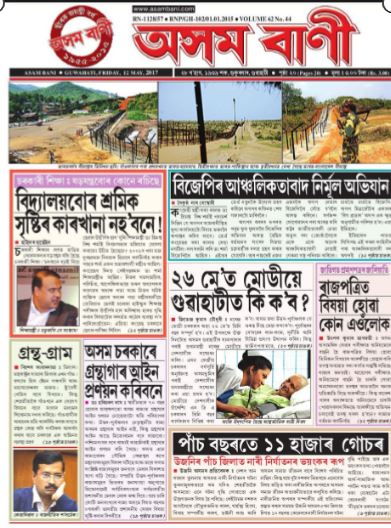
Amid an existential crisis in the Guwahati-based Assam Tribune group of newspapers, which worsened after the Covid-19 pandemic, a popular Assamese weekly newspaper lost its publication in the latter part of 2025. Asom Bani, once a mainstream weekly for Assamese readers for decades, stopped hitting the stands from September last year, as the management lost interest in continuing its printing every Friday. Even though the seven-decade-old Assamese-language weekly was lost from the media market, the management did not make any statement about Asom Bani’s fate. Prior to its departure, the weekly was merged with Dainik Asom, an acclaimed Assamese daily from the prestigious media house, as its Friday supplement.

Once edited by prominent Assamese journalist-authors namely Satish Chandra Kakati, Tilak Hazarika, Phani Talukdar, Nirod Chowdhury, Homen Bargohain, and Chandraprasad Shaikia, the weekly had Dilip Chandan as its last editor, who served Asom Bani for nearly three decades. Launched on 1 July 1955 by legendary Assamese entrepreneur Radha Govinda Baruah, the weekly witnessed and reported various important socio-political developments, including the Assamese-medium (instruction in schools) movement, the Assam anti-influx agitation, the abrupt rise of separatist-influenced insurgency, social unrest, the emergence of regional politics, and its diminishing popularity, with all sincerity to the indigenous population.

As the pandemic severely affected the circulation of all newspapers published by the Assam Tribune group, the subsequent impact was observed in shrinking advertisement revenues from commercial entities. Like many other media institutions across India, the Assam Tribune group also faced a severe financial crisis, which started reflecting in irregular salary disbursements to employees, including working journalists. The employees’ union came out in public with various difficulties, including unpaid dues meant for retired employees. The union leaders also made allegations that the group was not receiving a huge amount of money from the State Information and Public Relations Directorate against published advertisements.

Soon, rumours spread over the probable sale of the entire media group to another city-based television house. However, the Assam Tribune management strongly denied this, terming the reports as false portrayals. In an official statement, the management assured its firm commitment “to its editorial independence, journalistic integrity, and continued services to its readers, advertisers, and stakeholders”. The management even urged all concerned to “disregard such baseless speculation and refrain from spreading misinformation”. Needless to mention, its primary news outlet, The Assam Tribune, which came into being on 4 August 1939 (with Lakshminath Phukan as its first editor), continues to be the highest-circulated English daily in the north-eastern region.

But assurances of the management led by Prafulla Govinda Baruah (second son of R.G. Baruah, who died on 14 December at the age of 93) did not prevent the handing over of the responsibility of Dainik Asom, now over six decades old, to a different media group owned by young entrepreneur Kishor Borah, who runs the Assamese satellite news channel ND24. The deal was made public on 17 September last year, following which the new management took responsibility for publishing Dainik Asom, but did not prefer to take care of Asom Bani (which had already ceased to be an independent publication). As a supplement of Dainik Asom, the weekly hit the stands on 12 September 2025 for the last time.

The new management of Dainik Asom did not absorb all engaged media employees, and on a single day, on 18 September, over 70 employees (many of whom were enjoying extended tenures with a monthly lump-sum payment) lost their jobs. The Assam Tribune management assured them of all legal dues within a few weeks, but this did not materialise. Having no other options, they approached the labour court demanding their dues, which seemingly amount to around rupees six crores altogether. It is unfortunate that the media house, which was India’s first institution to implement the recommendations of the statutory Majithia Wage Board in 2010, has now taken the route of escapism by avoiding legal payments to retired employees.

Media observers believe that the Tribune house usually maintained its credibility while disseminating information, editorial viewpoints, and other articles, but in recent times, the same principles were largely compromised. Its prime mover (The Assam Tribune) lavishly supported the anti–Citizenship Amendment Act movement that broke out in 2019, where it provided huge space to the public uprising that denounced the Union government’s initiative to politically support persecuted Hindu, Sikh, Buddhist, and Christian families coming from Pakistan, Afghanistan, and Bangladesh to India. The chaos engulfed the Brahmaputra Valley of Assam for weeks, with the narrative that the new citizenship law would discredit the Assam Accord (signed in 1985 to culminate the six-year-long anti-foreigner agitation).

Moreover, the people of Assam remember when the newspaper produced a series of voluminous reports on the backdrop of a city press club election with little credibility, where the editorial focus was exposed as biased, unprofessional, and marred by character assassinations of a particular press club official, putting its integrity at stake. The present financial status of the Assam Tribune group remains pathetic, but it was not entirely orchestrated by the pandemic alone. Rather, the situation was made more complicated by a section of arrogant media professionals who enjoyed all due benefits only to create disorder within the media house, where, shockingly, the management turned out to be a mute spectator.

Add new comment

Other Contents by Author

A recent controversy erupted following a social media post by a television journalist, associated with Gauhati Press Club (earlier Guwahati Press Club) in northeast India, brought many questions for the media body, which invited a minister in Assam chief minister Himanta Biswa Sarma’s cabinet for a cultural program, but shockingly ‘faced derogatory comments’. The particular post was generated by the journalist working for a satellite news channel owned by the CM’s family, and his outburst that the State health & family welfare minister Ashok Singhal disrespected a delegation from GPC, was taken seriously. According to the journalist, the GPC delegation went to invite Singhal for a...
The recently concluded by-polls for 48 legislative assembly constituencies in 14 States (along with two Parliamentary constituencies in Kerala and Maharashtra) divulged an important fact that no less than  41 assembly seats needed  the special elections as those were vacated by the respective legislators after they were elected to the lower house of Indian Parliament. The representatives of different political parties (irrespective of their ideologies or position in the governments) participated in the last general elections and succeeded to be  lawmakers in the 18th Lok Sabha. One may wonder how all these members of State legislative assemblies turned Parliamentarians...
Geneva based the Press Emblem Campaign (PEC), a global organization advocating for media safety and rights, has expressed deep concern over the ongoing violence against journalists in Pakistan. The latest victim, Janan Hussain (40), was killed in Khyber Pakhtunkhwa near the Afghan border on November 20, during an ambush in the Kurram area that claimed the lives of 42 Shiite Muslims. Hussain, a journalist with Channel 365 and a member of the Parachinar Press Club, is the 11th media worker killed in Pakistan this year. "Janan Hussain's murder marks the 129th journalist killed globally since January 1, highlighting the grim reality of impunity in such cases," said Blaise Lempen, President...
The Press Emblem Campaign (PEC) awarded its annual prize for the protection of journalists to Palestinian journalist Iyad Alasttal. This recognition comes amidst the unprecedented loss of over 150 Palestinian and Lebanese journalists since October 7, 2023, marking one of the highest tolls in such a short period in a conflict. The PEC dedicated the prize to the memory of these journalists who risk their lives daily. Iyad Alasttal, a journalist from Gaza, was forced to flee due to Israeli reprisals following the Hamas attack on October 7, 2023. Alasttal, who launched the Gaza Stories project in 2019, has been chronicling life in Gaza and reporting for French and Western media outlets....
On the midnight of August 31, 2019, an extraordinary bureaucrat unveiled the contentious National Register of Citizens (NRC) in Assam, amidst a large gathering of eager media personnel in Guwahati. Prateek Hajela, the then State NRC coordinator, not only explained various features of the NRC to the assembled reporters but also declared the supplementary list as the definitive one. Some television journalists, excited by the so-called "extraordinary work" of the technocrat-turned-IAS officer, went as far as to applaud Hajela as a superhero. However, the ground reality paints a different picture. The Assam NRC has never been endorsed—nor is it today—by the Registrar General of India (RGI...
It’s shocking to report that a number of Guwahati-based scribes and RTI (right to information) activists have been facing interrogation and even arrest by Assam chief minister’s special vigilance cell following the allegations of Sewali Devi Sharma, the prime accused in Rs 105 crore State council of educational research and training (SCERT) scam, as being blackmailers to her in different occasions. The arrestees include a female reporter (identified as Pujamoni Das alias Honey Kashyap, who reportedly took a large volume of money from Ms Sharma) along with a satellite news channel reporter named Bhaskarjoti Hazarika.  RTI activists namely Rabijit Gogoi (who pretended to be a...
Can we imagine a world of zero poverty, zero unemployment, and zero carbon emissions with a new approach in post-corona economics! Ask Nobel laureate Professor Muhammad Yunus and he will answer in the affirmative. The university professor turned revolutionary banker believes that the human race should not only dream about a safer world by reducing global warming, wealth concentration and unemployment, but also work in that direction with personal and collective capacities. In his latest book titled ‘A World of Three Zeros’, Prof Yunus proposes a new economic system focusing on every human being as an entrepreneur in the making. He believes that humans are not born to work only for...
Guwahati: Assam is all set to host first sustainable financial working group (SFWG) meeting and Youth 20 inception meeting as part of India's year-long G20 presidency, where it is meticulously chalked out various tour programs that would help in promoting the State’s rich biodiversity and socio-cultural heritage in international arena. The authorities have completed the preparation to welcome the foreign delegates to the State. Guwahati is adorned with digital wall painting, thematic gates, flags of G 20 countries, LED cut-outs, standees, hoarding, etc as part of branding and beautification. The government has also completed the arrangement for the visiting delegates to places of...
Guwahati: India observes National Press Day on 16 November with an aim to pay tributes to everyone who contributed to the growth of print media along with its mentor & watchdog the Press Council of India (PCI). Moreover, it’s also an occasion for the practicing media persons to introspect seriously over their noble profession where it has been heading in the post-Covid-19 pandemic era. Since its inception and functioning, the PCI continues to symbolize a free and responsible press in the largest democracy in the world. Among all press or media councils, functioning in various countries, the PCI is recognised as a unique entity that exercises authority over the media and also safeguards...
Participating in a debate on satellite television or digital channels needs some homeworks to make the deliberations short and clear. Unless you face an arrogant anchor and unruly participants, the experience in talk shows normally emerges as an intriguing one. It happened to me, as I had recently participated in a digital media discussion on the pertinent issue of National Register of Citizens  (NRC) in Assam, where the prime guest was none other than the immediate past State NRC coordinator Hitesh Dev Sarma. The talk show host Dikshit Sharma put the questions in a clever way so that the issue comes alive and my part was just to interpret Dev Sarma’s version for clarity to the valued...