
Skip to content Skip to navigation

64 Polytechnic Lecturers Terminated After 23-Day Hunger Strike for Job Regularization

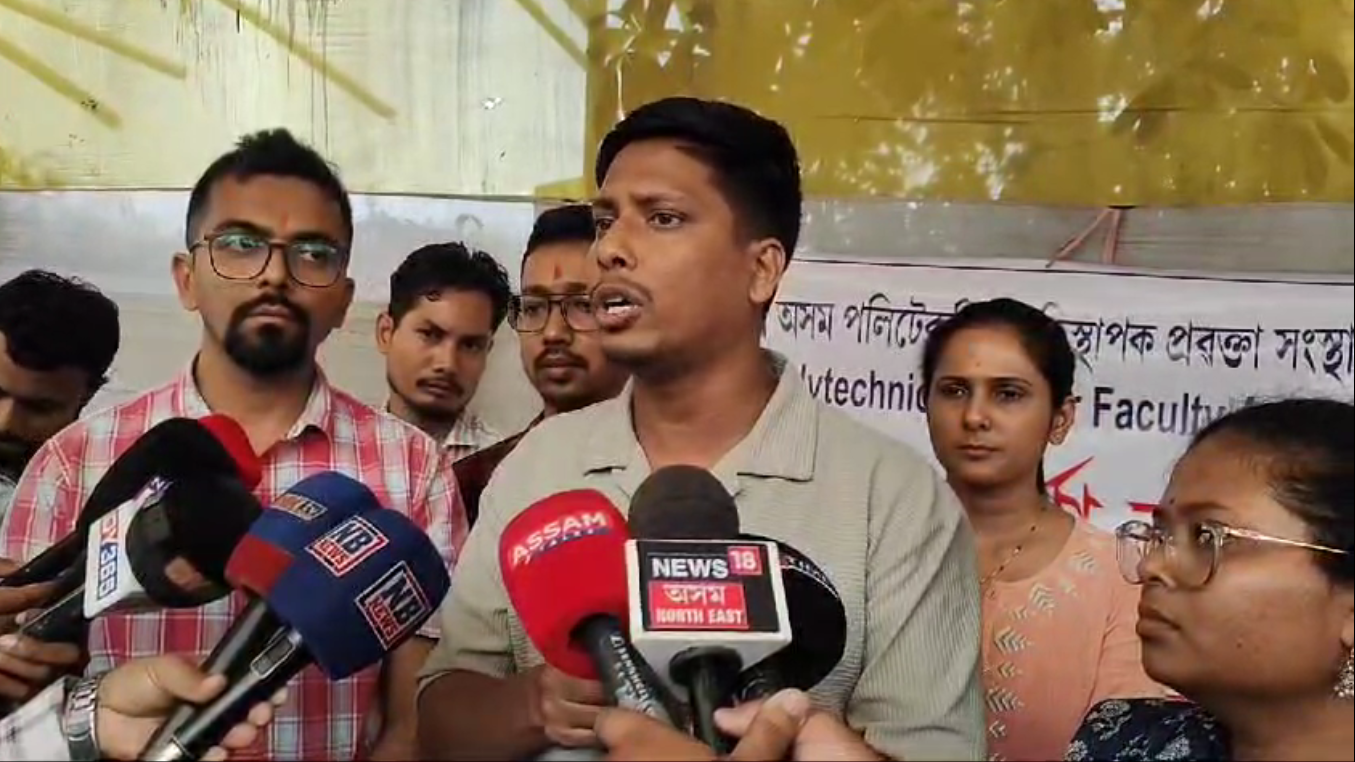
In a controversial move, the Assam government has terminated 64 lecturers from polytechnic institutes who were protesting for the regularization of their jobs. These lecturers had been on a hunger strike for 23 days, demanding that their temporary positions be made permanent. They were initially appointed during the tenure of Himanta Biswa Sarma as the Education Minister.

The lecturers, who have been working as founder faculty members in polytechnics for eight years, had come to Guwahati during the budget session to appeal to the government regarding their demands. However, the government’s refusal to regularize their jobs forced them to stage a protest under the open sky. Their demonstration, which began on the first day of the budget session, continued for 23 days. Despite their relentless efforts, including tearful appeals, the government remained unmoved and ultimately decided to terminate their services.

On the night of March 10, the principals of the polytechnic institutes issued termination notices to the protesting lecturers. The decision left the lecturers devastated, as they felt that instead of addressing their concerns, the government had chosen to dismiss them. They have now appealed to the Chief Minister to intervene, emphasizing that they are highly qualified individuals, with many having students who scored above 84%, postgraduates, and even rank holders in examinations. They demanded the reinstatement of their jobs, stating that they were initially hired on contractual terms that prevented them from seeking other employment and required them to submit their original certificates.

Rajib Kalita, President of the All Assam Polytechnic Founder Faculty Association, highlighted that the lecturers were appointed on a temporary basis when the polytechnics were established in 2017. The government had obtained approval from the All India Council for Technical Education (AICTE) by presenting them as regular employees, despite their temporary status. Kalita accused the government of misleading the AICTE and now terminating their services based on directives from the Directorate of Higher and Technical Education.

The lecturers expressed their frustration, stating that many positions remain vacant, and classes are not being held regularly. They had hoped for some assurance from the government during their protest but were instead met with termination. After eight years of service, they now face an uncertain future, having lost their prime working years. Out of 451 protesting faculty members, only 64 founder lecturers continued the protest until the end. These lecturers had been working since the inception of the institutes, even when basic facilities like chairs, benches, and bathrooms were absent. They questioned how they could now appear for recruitment exams at their age, especially when their own students have secured jobs in organizations like ONGC and oil companies.

The lecturers had submitted a memorandum to Chief Minister Himanta Biswa Sarma during their protest, but neither the CM nor any government representative responded. Instead, the government imposed harsh punishment on the lecturers, who were fasting in unhygienic conditions under makeshift tents. The All Assam Polytechnic Founder Faculty Association had also been on a hunger strike for 23 days, expressing their anger through anti-government slogans. They reiterated that they were founder faculty members appointed in 2017 when the polytechnics were established, but the government failed to regularize their jobs. They have been struggling to receive their salaries on time and feel that the government has done them a grave injustice.

Add new comment

Other Contents by Author

India has witnessed protest movements, student uprisings, anti-corruption campaigns and meme wars before. But perhaps no recent phenomenon captures the frustration of India’s younger generation as sharply as the sudden rise of the “Cockroach Janta Party” (CJP). What started as an internet joke has rapidly evolved into a national political conversation. The movement emerged after controversial remarks attributed to Supreme Court judge Surya Kant during a hearing, where unemployed youth and activists were allegedly compared to “cockroaches” and “parasites.” Though later clarifications suggested the remarks were directed at fake-degree holders and not unemployed youth generally, the...
Dudhnoi, May 22: A day-long capacity building programme for agri-export oriented stakeholders was organized by Agricultural and Processed Food Products Export Development Authority in collaboration with ICAR-Krishi Vigyan Kendra Goalpara at the KVK campus in Dudhnoi on May 18, 2026. The programme witnessed enthusiastic participation from nearly 80 farmers and members of Farmer Producer Organizations (FPOs) and Farmer Producer Companies (FPCs) from different parts of Goalpara district. The initiative aimed to create awareness about export opportunities in the agricultural sector and equip stakeholders with knowledge on export procedures and support mechanisms. The programme began with...
The Tata Institute of Social Sciences (TISS), Guwahati Off-Campus on Saturday held its 12th Convocation for students who graduated in 2025 at the Zubeen Garg Auditorium of Krishna Kanta Handiqui State Open University (KKHSOU) in Guwahati. The convocation was attended by Gauhati High Court Judge Justice Soumitra Saikia as the chief guest, along with TISS Chancellor and former UGC Chairperson Prof. D.P. Singh, TISS Vice Chancellor Prof. Badri Narayan Tiwari, Officiating Registrar Dr. Narendra Mishra and Dean Academic Affairs Prof. Sunil D. Santha. Several dignitaries, including officials from KKHSOU, OKDISC and ICSSR-NERC, and Assam government adviser Dr. Keshav Kumar, IPS (Retd.), were...
Press Emblem Campaign (PEC), the Geneva-based global media safety and rights body, has expressed concern over the continued press censorship in Myanmar, as the military junta authorities have recently revoked the licenses of three more independent news outlets. The junta’s information ministry had lately restricted the publication of Myaelatt Athan, Red News Agency, and Asia Citizens News Agency, citing different sections of the law. Mentionable is that the South Asian nation of 55 million people witnessed a coup on 1 February 2021, when a democratically elected government led by Daw Aung San Suu Kyi was ousted by the then military chief Min Aung Hlaing. Since then, the junta has revoked...
 A grassroots effort to resurrect Spirit Airlines has gone viral after being launched by Hunter Peterson, an aviation enthusiast who has spoken publicly about being autistic and his lifelong interest in airplanes. The campaign, organized through LetsBuySpiritAir.com, calls for a “community-owned airline” model in which passengers, employees and supporters would collectively fund and govern a rebooted version of the bankrupt budget carrier. The proposal spread quickly across TikTok, Reddit and X, drawing millions of views under the hashtag #Spirit2.0. Peterson, 24, a content creator, gained attention after posting a video last week in which he said, “I’m kind of autistic, and I...
Scientists conducting the 5th Khangri Glacier Expedition in Arunachal Pradesh’s Tawang district have reported alarming geomorphological changes in the Khangri Glacier, including the formation of a potentially dangerous proglacial lake that could trigger a Glacial Lake Outburst Flood (GLOF) in the Mago Chu Basin. The expedition was jointly conducted by the Centre for Earth Sciences and Himalayan Studies in collaboration with the National Centre for Polar and Ocean Research and North Eastern Regional Institute of Science and Technology. The scientific mission began on May 4 in the transboundary Mago Chu Basin, a critical headwater region of the larger Brahmaputra river system. According...
Heavy pre-monsoon rainfall has caused multiple breaches, locally known as “rain cuts”, in the Ulfa dyke at Panigaon in Assam’s Lakhimpur district, raising fresh concerns of flooding in the region. The 3.7-km-long agri-bund embankment—stretching from Jorkhat-Boniyagaon to Pub-Aamtola Nepaligaon under Pachim Telahi Gaon Panchayat—is popularly known as the Ulfa dyke. It was originally constructed in 1989 by members of the United Liberation Front of Asom (ULFA) with community participation. According to reports, continuous rainfall over recent weeks has led to the formation of more than 20 rain cuts along the embankment, significantly weakening its structure ahead of the...
A district-level convening of humanitarian organisations and civil society groups was held in Jorhat at the premises of the North-East Affected Area Development Society (NEADS), Dhekiakhowa, focusing on Community Feedback Mechanism (CFM) and flood preparedness. Organised by NEADS in collaboration with the State Inter Agency Group and Roots to Branches Foundation, with support from UNICEF Assam, the meeting brought together civil society representatives, district authorities, and local humanitarian actors to strengthen coordination ahead of the flood season. The session opened with a welcome address by Tirtha Prasad Saikia, who underscored the importance of community-centred approaches...
In a grim reminder of the city’s crumbling urban infrastructure, four lives were lost within 48 hours after heavy rains triggered widespread artificial flooding across Guwahati. What should have been a seasonal downpour instead exposed a deadly mix of neglected drains, poor planning, and administrative failure. The first victim, Payel Nath Das (around 30), a Dharapur resident working at a jewellery shop on GS Road, met a tragic end on the night of April 19. At around 9:30 pm, while wading through knee-deep water at Maligaon Chariali, she slipped into an uncovered roadside drain concealed beneath floodwaters. Her body was recovered 150–250 metres away the next morning by SDRF personnel...
Voting for the Assam Assembly elections gathered steady momentum through the morning hours on April 9, with scenes from across the state reflecting a strong and participatory democratic exercise. By mid-morning, polling booths were already witnessing long queues, as men and women, young voters and the elderly alike, stepped out early to cast their votes. The initial hours after 9 AM saw a smooth and peaceful polling process, backed by visible security presence and efficient booth management. In Guwahati, the day unfolded with a calm yet purposeful energy. Polling stations across the city saw a steady stream of voters, many arriving with family members, some even accompanied by children,...