
Skip to content Skip to navigation

Flood alert: ‘unprecedented’ volume of water flows down Brahmaputra

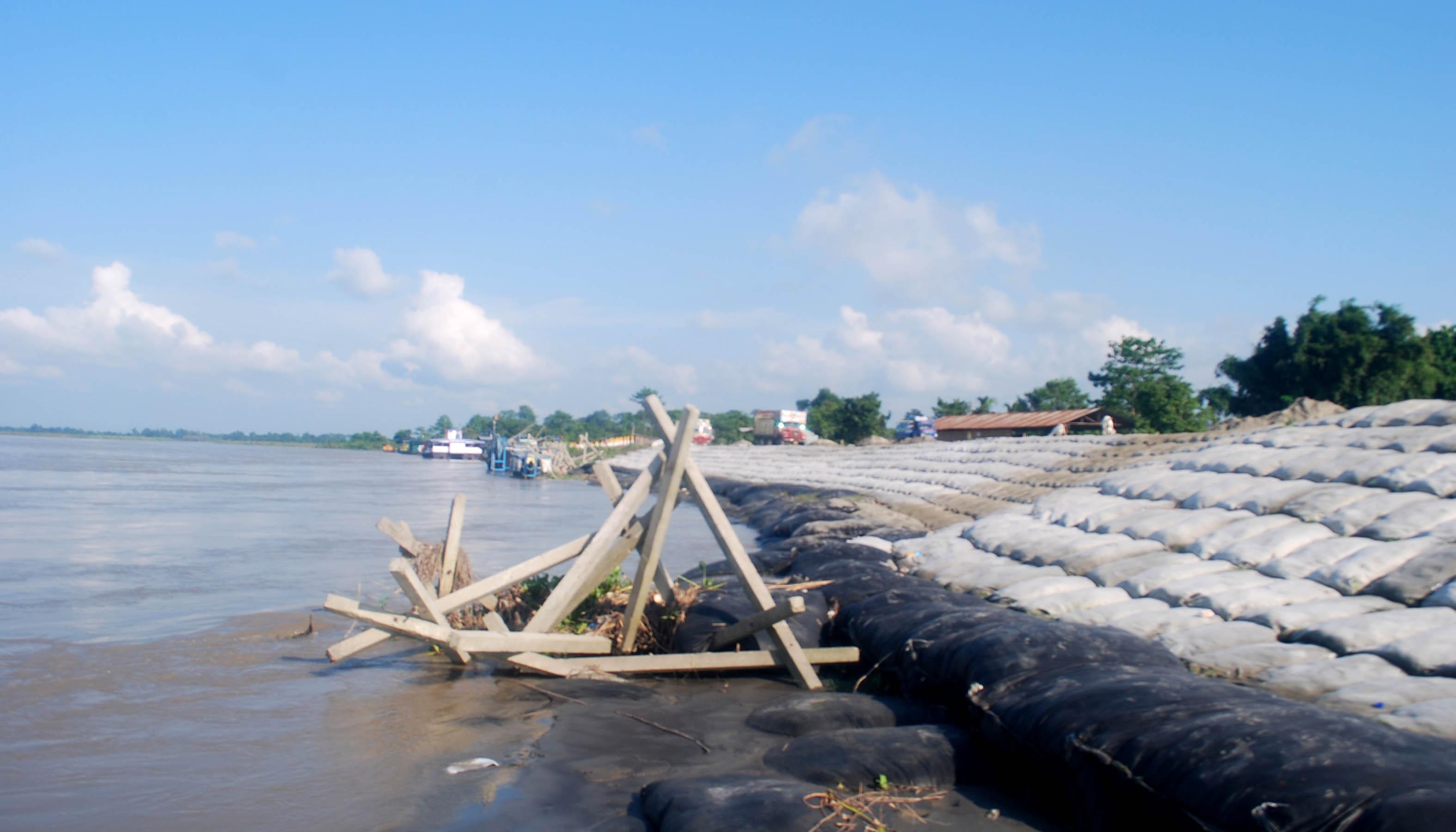
View of Bodatighat of Brahmaputra in Bihpuria. Photo by UB Photos

A massive cloudburst in Tibet has forced authorities in China to release more water down the Brahmaputra than at any time over the last 50 years. China has warned India about the release in the transboundary river – known as Yarlung Zangbo in China – and two Indian states are on high alert for floods.

The discharge was measured at 9,020 cubic metres per second (cumec) at 8 a.m. on August 29 and led to huge waves on the Siang in Arunachal Pradesh, the state in northeastern India through which the river enters India. Eyewitness reports estimated the wave heights at up to four metres, in a river that usually has hardly any waves at all.

In contrast, the discharge on August 14 had been measured at 8,070 cumec, according to India’s Central Water Commission. The Siang joins two other rivers downstream to form the Brahmaputra.

Tamiyo Tatak, the Deputy Commissioner of East Siang district in Arunachal Pradesh, sent out a warning the same day, asking people “to refrain themselves from venturing into Siang river for fishing, swimming etc. to avoid any eventualities. Further, people living in low lying areas (both right bank and left bank) viz. Jarku, Paglek, SS Mission, Jarkong, Banskota, Berung, Sigar, Borguli, Seram, Kongkul, Namsing, MER nearby Siang river are advised to remain alert but not to panic.”

Eyewitness reports on the morning of August 31 said the waves had gone down, but the Siang was still flowing at a far higher level than usual, even during the height of the monsoon.

Despite the official warning, 30 people were reported stranded on an island in the Siang in the Sille-Oyan area on the morning of August 31. The Arunachal Pradesh government has requested the Indian Air Force to send helicopters that can winch these people to safety, since the island is too small for a helicopter to land.

Assam on high alert too

Further downstream, the Assam State Disaster Management Authority (ASDMA) warned the Dibrugarh district administration in the eastern part of the state to be on high alert. Laya Maduri, the Deputy Commissioner of Dibrugarh district, sent out an order on August 30.

It read, “Flood warning has been received from ASDMA that as a result of release of excess water by Chinese Government, there may be unprecedented rise in the water level in the river Brahmaputra thereby causing severe flood. Therefore, officers of district are asked not to leave Headquarter…”

Reports on the morning of August 31 said the Brahmaputra was flowing high in Dibrugarh, but had not crossed the danger mark yet.

Transboundary cooperation

Authorities in India were able to prepare for this 50-year high in Brahmaputra water discharge well in advance, due to the warning provided by the Chinese authorities. China resumed providing water flow data to India this May under a Memorandum of Understanding (MoU) between the two countries. The data supply had been stopped in 2017. Observers in India blamed that on a face-off between the Chinese and Indian armies along their 3,500-km Himalayan border, though the Chinese authorities had said they were upgrading their water level measuring stations.

Since 2009, thethirdpole.net has consistently advocated for closer cooperation between China and India over the transboundary river Brahmaputra, which later flows into Bangladesh to join the Ganga. The scope of the MoU has been expanded over the years, but far more is possible.

Noted Brahmaputra expert Partha Jyoti Das told thethirdpole.net, “It is good that China is now regularly providing hydrological data through the monsoon period, but a lot more can be done. We need topographical data as well. That will tell us where landslides are likely to occur after heavy rain, and then we can foresee the possibilities of a flood even earlier.”

In the absence of any water flow data from the Chinese government in 2017, there had been panic in Arunachal Pradesh and Assam in November that year, when the sediment load in the river went up all of a sudden and the water almost ran black for a number of days. Independent experts from India had later said the high sediment load was due to an earthquake in Tibet, which had led to a landslide blocking the water flow in the river for some time, before it all came roaring down together.

Anamika Barua, who teaches at Indian Institute of Technology, Guwahati, has explored possibilities of regular flow of information between China and India on the Brahmaputra, through civil society channels as well as the governments. The panic in 2017 may have been avoided if some of her recommendations had been acted upon by academics in China.

Das was critical of the central and Assam governments in India for not sharing any information with the people on last November’s episode. “Have they done any studies on why this happened? If they have, why don’t they share their results in public? What the government says is important. Without that, there can be a lot of unnecessary panic.”

 By Joydeep GuptaFirst Published in The Third Pole

Add new comment

Other Contents by Author

A massive protest erupted today in Sonapur, near Guwahati, as thousands of tribal people gathered to oppose the proposed transfer of vast tracts of land to the Indian Air Force. The demonstration, held at the Sonapur Mini Stadium on Friday, March 28, saw local tribal communities voicing their outrage against what they perceive as an encroachment on their ancestral lands, with slogans such as "We will give our blood, not our land" and "Down with Digaru Air Force" resonating through the air. The unrest stems from the state government's alleged plan to hand over a significant portion of land in Digaru, close to Sonapur, to the Air Force. This move has sparked widespread anger among the...
 The Chief Judicial Magistrate’s Court of Kamrup Metropolitan District has granted bail to senior journalist Dilowar Hussain Majumdar in his second case. Following interrogation and searches starting on March 27, Majumdar was produced in court on Friday and released on a bond of 20,000 rupees. The decision came after his advocate, Angshuman Bora, presented arguments in his favor. Police conducted searches at Majumdar’s residence and business establishments, seizing two dumpers during the operation. In a related case involving the managing director of Apex Bank, the police advocate requested the addition of extra charges, but the court rejected the plea. Due to a delay in submitting...
The Press Club of India (PCI) on Friday sharply criticized Assam Chief Minister Himanta Biswa Sarma for attempting to define who qualifies as a “legitimate” journalist, following the re-arrest of senior digital media journalist Dilawar Hussain Mozumder by Assam Police on March 27 evening. Mozumder, assistant general secretary of the Guwahati Press Club (GPC), was detained hours after his bail release in a case involving alleged theft of bank documents while covering a protest tied to a recruitment scam. The PCI demanded Mozumder’s immediate release, accusing the state of undermining press freedom. The PCI’s statement highlighted Sarma’s remarks as a distraction from the core issue—...
The Shillong Press Club (SPC) has strongly condemned the arrest of senior Assam journalist Dilawar Hussain Mazumdar, issuing a statement denouncing the action. Mazumdar, the chief reporter of Crosscurrent Digital Media, was first arrested on the night of March 25. Although he was granted bail on March 26, he was rearrested on March 27 based on a complaint filed by the managing director of the Assam Cooperative Apex Bank.  SPC President D L Syiemlieh stated that the rearrest of Mazumdar shortly after being granted bail is deeply concerning and represents a shocking misuse of legal processes. He emphasized that this action constitutes a direct assault on the freedom of the press and...
An emergency executive meeting of the Guwahati Press Club was held today, March 28, 2025, to address the recent re-arrest of Dilwar Hussein Mazumdar and assess the ensuing situation. The meeting concluded with the announcement of the following action plan to highlight concerns and demand action. All journalists are urged to wear black badges during duty hours from March 28, 2025, to March 30, 2025, as a mark of protest and solidarity. A general meeting of journalists has been scheduled for Sunday, March 30, 2025, at 11:30 AM at the Press Club premises. The agenda includes a detailed discussion on the decisions taken during the impromptu meeting held on March 26, 2025. Resolutions will...
A tense situation unfolded at Gauhati University today as students staged a fierce protest against the alleged misbehavior of the university’s examination controller. The demonstration escalated when Vice-Chancellor Dr. Nani Gopal Mahanta, instead of calming the students, was seen sitting on the ground and shouting, “Hit me, hit me!” in a dramatic display of defiance. This behavior further provoked the students, intensifying the unrest on campus. According to sources, the protest erupted after Examination Controller Kandarpa Sharma reportedly mistreated a section of students earlier today, sparking outrage among the Postgraduate Students’ Union (PGSU). During the agitation, the Vice-...
Dilwar Hussain Mazumdar, a journalist associated with a local digital media outlet, has been re-arrested by the Guwahati Police from Central Jail and taken to the Panbazar Police Station. This is in connection with Case No. 111/25, where multiple charges have been filed under sections 329, 324(4), 351(3), 309(4), and 115 of the Indian Penal Code. Notably, Section 309(4) is non-bailable, carrying a potential sentence of up to 10 years if convicted. Additionally, a robbery case has been filed against him for allegedly fleeing with crucial documents from the Assam Co-operative Apex Bank. On March 25, the bank authorities lodged two FIRs, but initially, only one was disclosed by the police....
The state of Assam's healthcare system has come under intense scrutiny following a tragic incident in Nagaon, where a father lost his daughter due to alleged medical negligence. Dr. Surajit Kumar Bhagwat, a spokesperson for Nagaon Medical College, has filed a complaint with the Human Rights Commission after his 21-year-old daughter, Angana Bhardwaj, passed away due to a lack of timely medical care. On December 16, 2024, Angana suddenly fell ill and lost consciousness. Dr. Bhagwat rushed her to a private clinic, Kapili Nursing Home in Nagaon, where treatment was started immediately. However, her condition worsened rapidly, and the clinic, lacking essential emergency equipment like an ECG...
After being released on bail, Meghalaya Chief Minister Conrad Sangma met Mahbubul Haque, the Vice-Chancellor of the University of Science and Technology Meghalaya (USTM), at the Chief Minister's residence. This was the first meeting of Sangma after his release from custody. During their meeting, it is reported that the Assam Chief Minister, Himanta Biswa Sarma, discussed the use of unethical methods in examinations. Following the meeting, Haque described the discussion as "important and insightful," noting that the Chief Minister had provided valuable advice. After spending nearly a month in custody, Haque expressed his intention to focus on the education sector at USTM. He emphasized...
In a significant development, six developed countries have imposed travel restrictions on Assam and Northeast India, citing concerns over the region's law and order situation. The countries include the United States, the United Kingdom, Australia, New Zealand, Canada, and Switzerland. This alarming information was shared by Assam's Tourism Minister, Ranjit Kumar Das, in response to a query by Congress MLA Rekibuddin Ahmed during the Assam Legislative Assembly session on Tuesday. According to the Minister, the decision to impose the ban is primarily due to concerns over the law and order situation in the region. However, he assured that efforts are underway, in coordination with the...